
Was this sample helpful? Rate it!
Average: 4.9 (19 votes)



Contents
Key Takeaways for a UI UX Designer Resume
Why This UI UX Designer Resume Works
How to Write a UI UX Designer Resume
What to Include in a UI UX Designer Resume
UI UX Designer Resume Summary Examples
UI UX Designer Work Experience Examples
Top UI UX Designer Skills
Certifications for a UI UX Designer
UI UX Designer Salary
Common UI UX Designer Resume Mistakes
UI UX Designer Resume FAQs

Summary
UI/UX designer with eight years designing digital products end to end for a fintech company in Barcelona. Designs products people find easy and enjoyable — researching users, mapping flows, designing both how a product works and how it looks, testing with real people, and turning what is learned into a better experience. Redesigned an onboarding flow that lifted completion and a core journey that cut support contacts. Runs research, designs flows and interfaces, prototypes and tests, builds design systems, and works with product and engineering. User-centred, thorough and visual. Looking for a UI/UX role with a team that designs from the user inward and cares about both how a product works and how it feels.
Professional History
UI/UX Designer
Barcelona Fintech Company, Barcelona, Spain
Jan 2019 – Present
- Design products people find easy and enjoyable, turning what is learned from users into a better experience.
- Redesigned an onboarding flow that lifted completion and a core journey that cut support contacts.
- Research users and map flows, understanding what people actually need before designing anything for them.
- Design both how a product works and how it looks, owning the experience from flow through to finished interface.
- Prototype and test with real people, putting designs in front of users and improving them on the evidence.
- Build design systems and work with product and engineering, so good design ships consistently and intact.
Product Designer
Spain Digital Products, Barcelona, Spain
Mar 2016 – Dec 2018
- Designed flows and interfaces and ran usability tests for products, learning UI/UX design hands-on over years.
- Researched users and designed and tested screens, steadily building research and design skills.
- Learned UX research, flow design and interface design on the job across nearly three years.
- Gained the certification and experience that led into a full UI/UX-designer role of my own.
Qualification
BA in Interaction Design, Interaction Design
ELISAVA, Barcelona
Sep 2011 – Jun 2015
- Degree in interaction design covering UX research, interface design and prototyping, with a portfolio. The programme built the user-centred foundation UI/UX design requires. It led directly into designing digital products.
UX Research & Design Certificate, UX Design
Nielsen Norman Group
Aug 2015 – Feb 2016
- Certification covering UX research, usability and interaction design to a recognised standard. It sharpened the design toolkit across research and interface. It supported designing both how products work and how they look.
Highlights
Onboarding that more people finish
- Redesigned an onboarding flow that lifted completion. Users who give up during onboarding never become customers, so a redesign that gets more people through it directly grows how many people actually start using the product.
A journey that cut support contacts
- Redesigned a core journey that cut support contacts. When people contact support, the design has usually failed them, so a journey clear enough that fewer people need help proves the experience genuinely got easier.
Certifications
UX Research & Design Certificate
Nielsen Norman Group
Feb 2016 – Present
- Certification covering UX research, usability and interaction design to a recognised standard, which sharpened the design toolkit across research and interface and supports designing both how products work and how they look.
Recognition
Designs from the user inward
- Relied on to design products that are easy and enjoyable to use, valued for an onboarding redesign that lifted completion and a core journey redesign that measurably cut support contacts.
Languages
- Spanish — Native or Bilingual Proficiency
- English (UK) — Full Professional Proficiency
Specialisties
- UX Research
- User Flows
- Interface Design
- Prototyping
- Usability Testing
- Design Systems
- Information Architecture
- Figma
- Interaction Design
- Accessibility
Personal Skills
- User Empathy
- Thoroughness
- Visual Sense
- Curiosity
- Communication
Activities & Interests
- Xbox
- Karate
- Dancing
- Poker
- Park
Key Takeaways for a UI UX Designer Resume
Declare your centre of gravity, then prove it with work that actually shipped:
- Say which end you are strong at, since presenting as equally expert in research and visual craft convinces very few hiring managers.
- Put the portfolio link in the header, because a design hire always begins with looking rather than with reading the resume.
- Show shipped products rather than concepts, as work that survived engineering constraints is worth far more than a polished mockup.
- Give outcomes where you have them, covering conversion, task completion, support ticket reduction or activation movement.
- Name your research methods honestly, distinguishing usability testing you ran from research you read someone else's report on.
- List your tools and design system work, since Figma component contribution is a concrete and verifiable thing to have done.
Why This UI UX Designer Resume Works
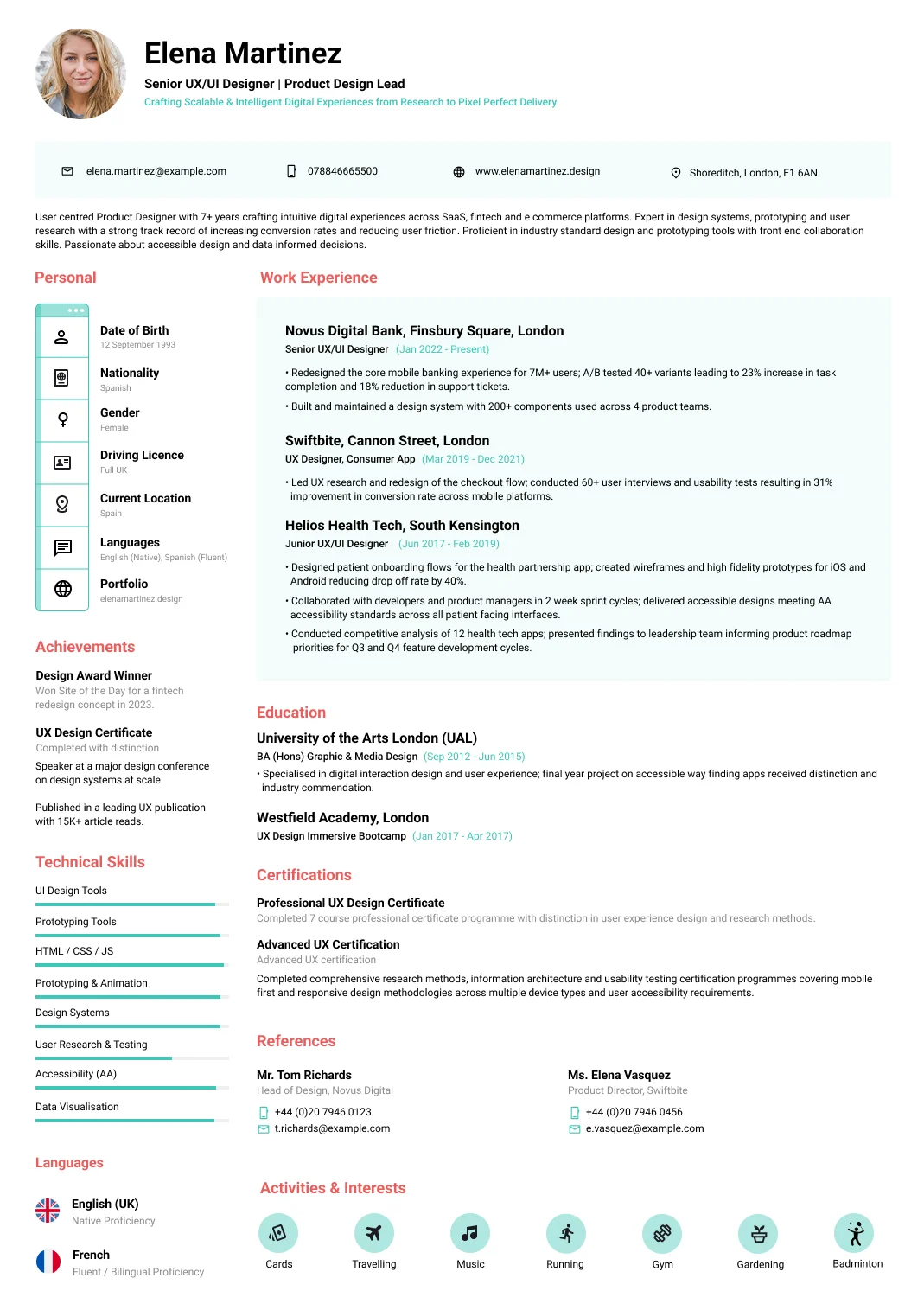
This sample belongs to a designer with five years in product teams, and it takes a position rather than claiming the whole discipline.
- The opening declares a UX centre of gravity, which reads as self-knowledge rather than as a gap in visual capability.
- A portfolio link sits in the header, giving a hiring manager the fastest possible route to the evidence they will judge on.
- Shipped features are named rather than concepts, and work that survived engineering constraints demonstrates something a mockup cannot.
- Product outcomes appear alongside the design work, which is what separates a designer from someone producing attractive screens.
- Research methods are described specifically, distinguishing studies genuinely run from findings inherited from another team's report.
- Design system contribution is included, since building components other designers reuse is a concrete and checkable piece of work.
How to Write a UI UX Designer Resume
A design lead is deciding what you would own on their team and whether your work has survived contact with engineering.
Declare where your weight sits
Research and interaction, or visual and interface craft. Say it in the opening line. Claiming equal mastery of both usually reads as a generalist, and most product teams are recruiting to fill one specific gap rather than a general one.
Lead with the portfolio
Header placement, live link, three to five deep case studies rather than twenty screenshots. Every design hire starts with looking, so the resume's main job is getting someone to the portfolio with the right expectation already set.
Show work that shipped
Features released, products launched, flows now in production. Concept work shows taste while shipped work shows you can hold a design idea together through engineering constraints, scope cuts and the compromises that always follow.
Attach outcomes to the work
Conversion, task success rate, time on task, support tickets, activation, retention. Design is often measured badly, but a designer who knows what their work did is arguing on the ground product leaders actually make decisions on.
Be honest about research
Studies you ran, participants recruited, tests moderated, findings you acted on. There is a real difference between running usability sessions and reading a research summary, and design leads ask about it in every interview.
Include system and craft work
Design system components built, tokens defined, accessibility standards met, handoff specifications written. This is the unglamorous work that teams depend on, and it is concrete enough for a lead to verify at interview.
The resume gets a hiring manager to the portfolio, so it should be quick and specific rather than art directed. You can build a free UI UX designer resume and keep your shipped work and outcomes easy to scan.
What to Include in a UI UX Designer Resume
Beyond the standard sections, a design lead looks specifically for these:
A stated centre of gravity, saying whether you lean toward research and interaction or toward visual interface craft.
Portfolio link in the header with three to five deep case studies rather than a gallery of finished screens.
Shipped products and features, named and dated, with your specific contribution to each of them stated clearly.
Product outcomes covering conversion, task completion, support contact reduction, activation or retention movement.
Research methods you personally ran, including usability testing, interviews, surveys and any analytics work.
Design system and accessibility work, covering components built, tokens defined and the standards you worked to.
Extra tips
Once your portfolio is assembled, look at which case studies are strongest and let that decide your stated centre of gravity.
A declared lean that matches the evidence reads as self-knowledge, while one that contradicts it undermines the whole application.
UI UX Designer Resume Summary Examples
Two summaries at different stages, both declaring a centre of gravity rather than claiming the whole discipline:
Entry-level resume summary example
Product designer with two years in a small software team, strongest on interaction and flows rather than on brand-level visual work. Designed and shipped the onboarding rework that reduced drop-off between account creation and first meaningful action, working directly with two engineers through build and release. Runs moderated usability sessions with five to eight participants per round and translates the findings into specific interface changes rather than into a general report. Works in Figma daily and contributes components back into the team's design system. Holds a portfolio of four deep case studies covering shipped work, and is looking for a product design role with more research responsibility.
Senior-level resume summary example
Product designer with five years across two software companies, weighted toward research and interaction design with solid interface craft rather than the reverse. Owned the redesign of a core workflow used daily by several thousand customers, which measurably improved task completion and reduced the support contacts that had been generated by the previous flow. Runs discovery and usability research directly including recruitment, moderation and synthesis, then holds the design decisions through engineering constraints and scope reduction. Maintains a shared Figma design system and works to accessibility standards throughout. Looking for a senior or lead product design position.
UI UX Designer Work Experience Examples
Three sets covering the shape of product design work, since research, design execution and delivery are judged separately.
Research and problem definition
- Ran moderated usability sessions with five to eight participants per round including recruitment, moderation and synthesis, then translated the findings into specific interface changes rather than a general report.
- Conducted discovery interviews with customers before designing anything, since a well-executed solution to a problem nobody actually has is the most expensive mistake a product team can make.
- Used product analytics to locate where users were dropping out of key flows, which focused design effort on the steps genuinely losing people rather than the ones that felt most interesting.
- Reframed feature requests into underlying problems before designing, because a request for a new button frequently describes a symptom of something structurally wrong further up the flow.
- Shared research findings with engineering and product in a form they could act on, which is what determines whether research changes a roadmap or simply gets filed and quietly forgotten.
Design execution and craft
- Owned the redesign of a core workflow used daily by several thousand customers, taking it from problem definition through wireframes and prototypes to the shipped and released production interface.
- Designed for the states that get forgotten including empty, loading, error and permission-restricted views, since these are where an otherwise good interface tends to fall apart in real use.
- Built and maintained components within a shared Figma design system, defining tokens and usage rules so that other designers could reuse the work rather than quietly rebuilding it themselves.
- Worked to accessibility standards throughout including contrast, focus order and keyboard navigation, treating them as design constraints from the start rather than as a remediation pass afterwards.
- Produced handoff specifications detailed enough that engineers did not need to guess at spacing, behaviour or edge cases, which removed most of the back and forth during implementation.
Delivery and outcomes
- Shipped the onboarding rework that measurably reduced drop-off between account creation and first meaningful action, working alongside two engineers through the build and release process.
- Held the core design intent through engineering constraints and scope reduction, deciding which compromises were survivable and which would have quietly undermined the entire point of the work.
- Reduced support contacts on a workflow by redesigning the step that had been generating them, which is among the clearest ways design work shows up directly in an operational cost line.
- Reviewed implemented builds against the design before release and raised the differences that genuinely mattered, rather than either accepting everything or objecting to every pixel of it.
- Presented design work to stakeholders with the reasoning attached, since a decision that cannot be explained tends to get overturned by whoever speaks most confidently in the next meeting.
Top UI UX Designer Skills
What a design lead screens for, weighted toward shipped work and genuine research capability:
Hard skills
- Figma
- Interaction Design
- Wireframing & Prototyping
- User Flows & Information Architecture
- Usability Testing
- User Interviews
- Design Systems
- Component Libraries
- Design Tokens
- Accessibility (WCAG)
- Responsive & Mobile Design
- Visual Design & Typography
- Product Analytics
- A/B Test Design
- Journey Mapping
- Developer Handoff & Specification
- Design Critique & Review
Soft skills:
- Self-Knowledge
- Explaining Decisions
- Taking Critique
- Collaboration With Engineers
- Curiosity
- Pragmatism
Certifications for a UI UX Designer
Design hiring runs on portfolio, but a few credentials help when you are switching into the field:
-
Nielsen Norman Group UX Certification
— Nielsen Norman Group The most respected training credential in the field, earned through completed courses rather than a single examination. Recognised by design leads, though a strong portfolio still outweighs it comfortably.
-
Google UX Design Certificate
— Google via Coursera A reasonable structured entry point for career changers, covering process end to end. Widely held, so it distinguishes little on its own, but the portfolio projects it produces are genuinely useful.
-
Interaction Design Foundation Courses
— Interaction Design Foundation Inexpensive and broad, useful for filling specific gaps such as research methods or accessibility. Worth listing selectively where a course explains a visible capability in your portfolio work.
-
Accessibility Certification
— International Association of Accessibility Professionals Increasingly valuable as accessibility becomes a legal requirement rather than a preference. Genuinely differentiating in public sector, healthcare and financial services design roles.
UI UX Designer Salary
Design pay tracks company type and stage more than title, with software product companies paying well above agencies:
USD 70,000 – USD 180,000 · UI UX designer · US
National median around $104,000. Established software companies pay well above this, while agencies and smaller organisations commonly sit below it.
Common UI UX Designer Resume Mistakes
These weaken applications in a field where the portfolio decides and the resume frames it:
- Claiming equal expertise in research and visual craft, which reads as generalism when most teams are recruiting for one specific gap.
- Burying the portfolio link, when a design hire always begins with looking and the resume exists mainly to get someone there.
- Filling a portfolio with concepts, since work that never shipped shows taste but not the ability to survive engineering reality.
- Presenting process diagrams instead of outcomes, which describes a method rather than what any of the work actually achieved.
- Overstating research involvement, when design leads ask directly whether you moderated the sessions or read somebody's summary.
- Over-designing the resume itself, which competes with the portfolio and frequently parses badly in the systems larger companies use.
UI UX Designer Resume FAQs
The questions designers most often search when applying, answered directly:
UX covers research, problem definition, flows and interaction, deciding what should exist and how it behaves. UI covers the visual interface itself, including layout, typography, colour and component craft. They overlap but are recruited differently.
Use it where postings do, since that is how many roles are advertised. But say in the opening line where your weight actually sits, because claiming equal mastery of both frequently reads as strong at neither to a design lead.
Three to five deep case studies rather than a gallery. For each, the problem, what you did, the constraints you worked inside and what happened afterwards. Shipped work matters far more than polished concept pieces.
Use conversion, task completion, time on task, support contact reduction, activation or retention. Where you have no metrics, describe the specific problem the design solved and how the team confirmed it had actually worked.
Redesign something real with genuine constraints rather than a famous app for practice. Recruit five people for usability testing, act on what you learn, and document the reasoning. Constraint and evidence beat polish every time.
Figma is the baseline and effectively the industry standard. Add prototyping capability, a product analytics tool, and familiarity with a design system. Knowing basic front-end constraints helps considerably when working with engineers.
Get Started With Our
Free Resume Creator today!
Free sign-up. No credit card required.