
Was this sample helpful? Rate it!
Average: 4.7 (23 votes)


Contents
Key Takeaways for a UI Designer Resume
Why This UI Designer Resume Works
How to Write a UI Designer Resume
What to Include in a UI Designer Resume
UI Designer Resume Summary Examples
UI Designer Work Experience Examples
Top UI Designer Skills
Certifications for a UI Designer
UI Designer Salary
Common UI Designer Resume Mistakes
UI Designer Resume FAQs

Summary
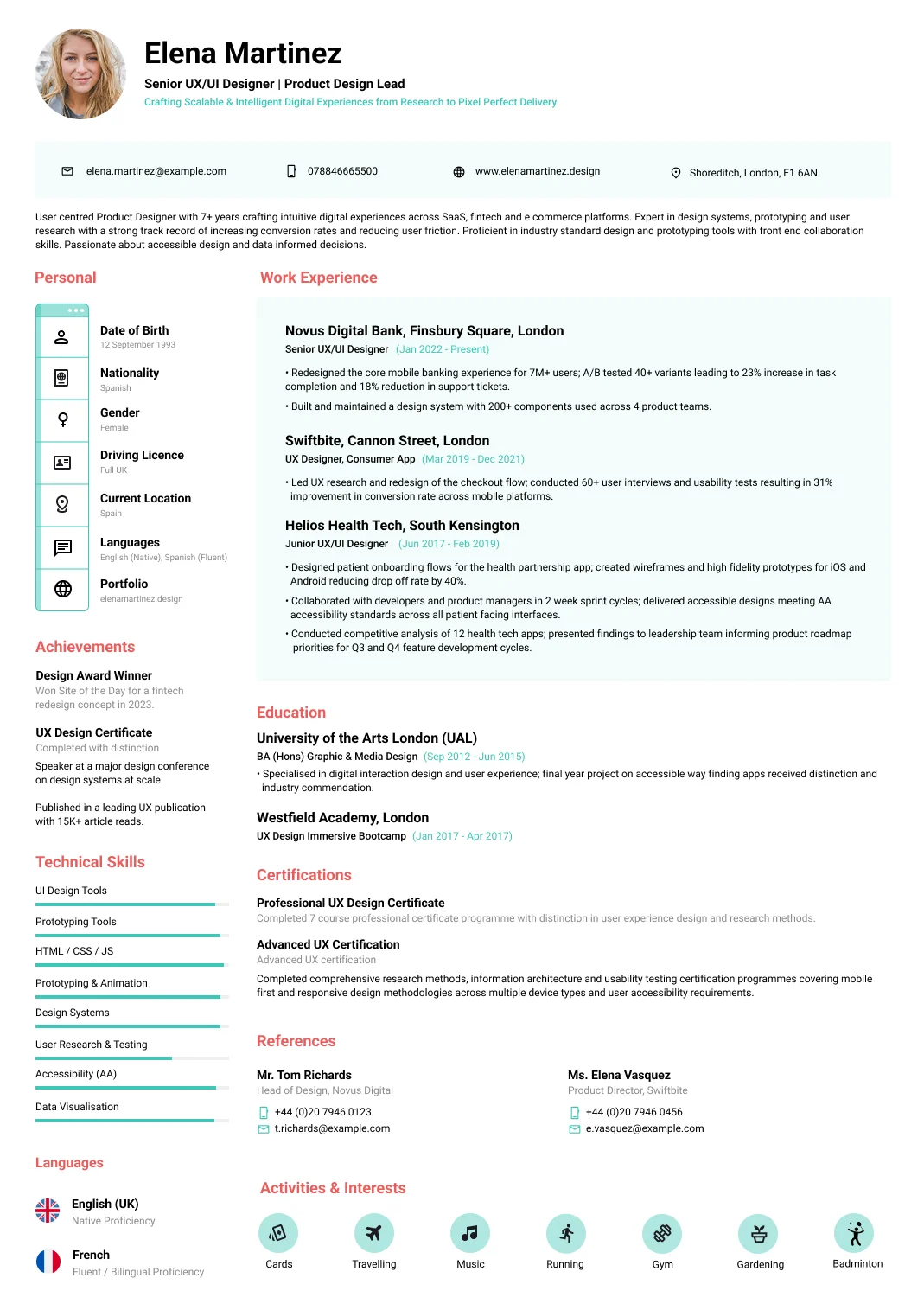
UI designer with seven years designing the visual interfaces of web and mobile products for a software company in Tokyo. Makes interfaces look right and feel effortless — turning flows and wireframes into clean, polished screens, building and maintaining a design system, and getting the typography, colour, spacing and detail to a standard that feels considered. Redesigned a product's interface that lifted engagement and built a design system that sped up the whole team. Designs interfaces and components, builds and maintains design systems, crafts visual detail, prototypes, and works closely with developers. Visual, precise and systematic. Looking for a UI-design role with a product team that cares about how its interface looks and feels in every detail.
Work Experience
UI Designer
Tokyo Software Company, Tokyo, Japan
Jan 2019 – Present
- Make interfaces look right and feel effortless, getting the detail to a standard that feels truly considered.
- Redesigned a product's interface that lifted engagement and built a design system that sped up the whole team.
- Turn flows and wireframes into clean, polished screens, designing the interface users actually see and touch.
- Build and maintain the design system, so components stay consistent and the product feels like one product.
- Craft typography, colour and spacing carefully, getting the visual detail right rather than just close enough.
- Prototype and work closely with developers, making sure what ships looks and behaves the way it was designed.
Junior UI Designer
Japan Digital Agency, Tokyo, Japan
Dec 2016 – Dec 2018
- Designed interface screens and components under senior designers, learning UI design hands-on each day.
- Built screens and refined visual detail, steadily building interface and design-system skills quickly.
- Learned interface design, components and visual craft on the job during this first role.
- Gained the certificate and experience that led into a full UI-designer role of my own.
Education
BA in Graphic & Digital Design, Digital Design
Tama Art University, Tokyo
Apr 2012 – Mar 2016
- Degree in graphic and digital design covering visual design, typography and interface design, with a portfolio. The programme built the visual foundation UI design requires. It led directly into designing product interfaces.
UI & Design Systems Certificate, UI Design
Interaction Design Foundation
May 2016 – Nov 2016
- Certificate covering UI design, components and design systems to a recognised standard. It sharpened the interface-design toolkit. It supported building polished interfaces and the systems that keep them consistent at scale.
Highlights
Redesign that lifted engagement
- Redesigned a product's interface in a way that lifted engagement. A cleaner, clearer interface makes a product nicer to use, so engagement rising after the redesign shows the visual work genuinely improved the experience.
A design system that sped up the team
- Built a design system that sped up the whole team. Reusable, consistent components mean designers and developers stop rebuilding the same things, so a good system makes everyone faster and the product more coherent.
Certifications
UI & Design Systems Certificate
Interaction Design Foundation
Nov 2016 – Present
- Certificate covering UI design, components and design systems to a recognised standard, which sharpened the interface-design toolkit and supports building polished interfaces and the systems that keep them consistent at scale.
Recognition
A designer who sweats the detail
- Relied on to make the product's interface look polished and consistent, valued for a redesign that lifted engagement and for building a design system that made the whole team faster.
Languages
- Japanese — Native or Bilingual Proficiency
- English (US) — Professional Working Proficiency
Technical Skills
- Interface Design
- Design Systems
- Typography
- Colour & Visual Detail
- Figma
- Component Design
- Prototyping
- Responsive Design
- Design-to-Dev Handoff
- Visual Polish
Personal Skills
- Eye for Detail
- Visual Sense
- Consistency
- Craft
- Collaboration
Activities & Interests
- Gym
- Basket Ball
- Dreaming
- Shopping
- Sleeping
Key Takeaways for a UI Designer Resume
This is a craft role assessed on visible work, so the resume should frame the portfolio rather than compete with it:
- Put the portfolio link in the header, since interface craft is visible and a hiring manager will always look before reading.
- Show design system work covering components built, tokens defined and the standards other designers then worked to.
- Evidence the full state range including empty, loading, error and disabled views, which is where interfaces usually fail.
- Prove accessibility competence through contrast, focus order and keyboard navigation rather than as a claimed value.
- Show shipped interfaces, because work that survived engineering is worth considerably more than an unbuilt mockup.
- Name your handoff practice, since specifications an engineer can build from without asking is a concrete and rare skill.
Why This UI Designer Resume Works
This sample belongs to a UI designer with four years on a product design system team, and it evidences craft as a discipline rather than as taste.
- The portfolio sits in the header, which is where a hiring manager looks first when assessing a role decided on visible craft.
- Design system contribution is described concretely, since components other designers reuse is checkable work rather than a claim.
- Component states are called out explicitly, and designing the empty and error views is what separates finished work from a demo.
- Accessibility appears as implemented practice with named criteria rather than as a general statement of good intentions.
- Shipped interfaces are named, showing that the work held together through engineering constraints and scope reduction.
- Handoff specification is included, and engineers building without asking questions is a measurable saving a lead recognises.
How to Write a UI Designer Resume
A design lead is deciding whether your craft is systematic or decorative, and whether engineers can build from what you produce.
Lead with the portfolio
Header placement and a live link. Interface craft is entirely visible, so the fastest route to your work is the most valuable thing on the page. Curate for the role rather than showing everything you have ever produced.
Show the system, not just screens
Components built, variants defined, tokens established, documentation written, adoption across teams. A designer who builds the system other designers work inside is operating at a different level from one producing individual screens.
Design the unglamorous states
Empty, loading, error, disabled, permission-restricted, long content, short content. Interfaces fail in these states rather than in the happy path, and a designer who covers them is doing the work most portfolios quietly skip.
Make accessibility concrete
Contrast ratios met, focus order defined, keyboard navigation designed, target sizes, screen reader considerations. Name the standard you worked to, since accessibility as a stated value convinces nobody who has to implement it.
Show work that shipped
Interfaces released, products launched, screens now in production. A mockup shows taste while a shipped interface shows the design survived engineering constraints, technical limits and the compromises that always arrive late.
Describe your handoff
Specifications, redlines, documented behaviour, edge cases covered. Engineers building correctly without a stream of questions is a real saving, and it is one of the clearest signals of a designer who thinks in implementation.
The resume is the frame around the portfolio, so keep it plain and let the work carry the weight. You can build a free UI designer resume and put your portfolio link and system work where a hiring manager will find them.
What to Include in a UI Designer Resume
Beyond the standard sections, a design lead looks specifically for these:
Portfolio link in the header, curated toward the role rather than presented as a complete archive of your work.
Design system contribution covering components, variants, tokens, documentation and adoption across teams.
Component state coverage including empty, loading, error, disabled and the long content cases most portfolios skip.
Accessibility work with named criteria such as contrast ratios, focus order, keyboard navigation and target sizes.
Shipped interfaces named and dated, with your specific contribution to each stated rather than left implied.
Handoff practice covering specifications, documented behaviour and how engineers actually built from your files.
Extra tips
Include a single component in your portfolio with every variant and state documented, including error and disabled.
It evidences systematic craft faster than a set of finished screens, and very few candidates ever think to do it.
UI Designer Resume Summary Examples
Two summaries at different stages, both leading with system and craft rather than with a love of clean design:
Entry-level resume summary example
UI designer with two years in a small product team, working in Figma daily on interface design across web and mobile. Designed and shipped the settings and account management screens for a customer-facing application, covering the empty, loading and error states alongside the primary flow rather than only the happy path. Contributes components into the team's shared design system with defined variants and usage notes. Works to accessibility criteria including contrast ratios and keyboard navigation, and checks implemented builds against the design before release. Holds a portfolio of shipped interface work, and is looking for a UI role on a larger design system team.
Senior-level resume summary example
UI designer with four years on a product design system team, responsible for the component library that four product squads build their interfaces from. Defined the type scale, spacing system and colour tokens, then documented usage rules clearly enough that adoption happened without a designer having to police it. Designs the full state range on every component including error, disabled and long content cases, and works to accessibility criteria throughout rather than as a remediation pass. Produces handoff specifications detailed enough that engineers implement without a stream of clarifying questions. Looking for a senior UI or design systems position.
UI Designer Work Experience Examples
Three sets covering the shape of interface work, since system craft, screen design and implementation are judged separately.
Design system and component craft
- Owned the component library that four product squads built their interfaces from, defining variants, states and usage rules so that consistency happened by default rather than through constant review.
- Defined the type scale, spacing system and colour tokens underpinning the product, which removed the endless small inconsistencies that appear when every screen is decided independently.
- Documented component usage clearly enough that adoption happened without a designer having to police it, since a system nobody understands quietly gets bypassed within a couple of sprints.
- Audited existing interfaces against the system and consolidated the accumulated variations, which reduced the component count substantially without removing anything genuinely being used.
- Worked with engineers on how components were actually implemented in code, so that the design library and the built component library did not slowly drift apart from one another over time.
Interface design and states
- Designed and shipped interfaces across web and mobile including navigation, forms, tables and data-dense views, adapting layout and density appropriately rather than scaling one design down.
- Covered the full state range on every screen including empty, loading, error, disabled and permission-restricted views, since interfaces fail in those states rather than in the happy path.
- Designed for long and short content, since a layout that only works with the ideal label length breaks the moment real customer data arrives and nobody notices until after release.
- Worked to accessibility criteria including contrast ratios, focus order, keyboard navigation and target sizing, treating them as constraints from the start rather than as a later remediation pass.
- Built interactive prototypes for the flows where behaviour mattered more than appearance, which resolved questions in review that a set of static screens would simply have left open.
Implementation and collaboration
- Produced handoff specifications detailed enough that engineers implemented without a stream of clarifying questions, covering spacing, behaviour, transitions and the edge cases that always arise.
- Reviewed implemented builds against the design before release and raised the differences that genuinely mattered, rather than either accepting everything or objecting to every single pixel.
- Adjusted designs where technical constraints made the original approach expensive, finding a version that preserved the intent instead of insisting on something the team could not afford.
- Presented interface work in design critique with the reasoning attached, since a decision that cannot be explained tends to get overturned by whoever argues most confidently in the room.
- Mentored a junior designer on systems thinking and state coverage, reviewing their files until designing the error case had become an instinct rather than a checklist item to remember.
Top UI Designer Skills
What a design lead screens for, weighted toward systematic craft and implementable output:
Hard skills
- Figma
- Design Systems
- Component Libraries
- Design Tokens
- Typography & Type Scales
- Layout & Grid Systems
- Colour Systems
- Interaction States
- Responsive & Adaptive Design
- Accessibility (WCAG)
- Prototyping
- Developer Handoff & Specification
- Iconography
- Data-Dense Interface Design
- Form Design
- Motion & Transition Design
- Design Critique
Soft skills:
- Precision
- Systems Thinking
- Explaining Decisions
- Collaboration With Engineers
- Consistency
- Restraint
Certifications for a UI Designer
Interface design hires on portfolio, but a few credentials support specific claims:
-
Accessibility Certification
— International Association of Accessibility Professionals Genuinely differentiating as accessibility becomes a legal requirement rather than a preference. Particularly valuable in public sector, healthcare and financial services interface work where compliance is enforced.
-
Nielsen Norman Group UX Certification
— Nielsen Norman Group Respected across the field and worth holding even on the interface side, since it covers the interaction principles that separate systematic craft from purely visual decoration.
-
Google UX Design Certificate
— Google via Coursera A structured entry route for career changers, covering process end to end. Widely held so it distinguishes little alone, but the projects it produces can seed a genuine first portfolio.
-
Front-End Fundamentals
— freeCodeCamp or an equivalent provider Not a design credential, but understanding how interfaces are actually built makes handoff considerably better. Design leads notice a designer whose specifications reflect real implementation constraints.
UI Designer Salary
Interface design pay tracks company type more than title, with product companies well above agencies:
USD 65,000 – USD 165,000 · UI designer · US
National median around $104,000. Established software companies and design system roles pay above this, while agencies and smaller organisations commonly sit below.
Common UI Designer Resume Mistakes
These cost interviews in a discipline where the work itself is immediately visible:
- Burying the portfolio link, when interface craft is visible and a hiring manager will look at the work before reading anything.
- Showing only happy path screens, since the empty, loading and error states are where interfaces genuinely fail in real use.
- Treating accessibility as a value rather than a practice, which convinces nobody who has had to implement against a standard.
- Presenting concepts instead of shipped work, because surviving engineering constraints is what a lead is actually assessing.
- Omitting design system contribution, which is the clearest evidence of systematic thinking rather than screen-by-screen taste.
- Over-designing the resume itself, which competes with the portfolio and frequently parses badly in larger companies' systems.
UI Designer Resume FAQs
The questions interface designers most often search when applying, answered directly:
A UI designer owns the interface itself including layout, type, colour, components and states. A UX designer owns research, flows and interaction decisions. They overlap constantly, but teams recruit for one or the other.
Lead with Figma and design systems, then typography, layout and colour systems, interaction states and accessibility. Add prototyping and developer handoff, since implementable output is what separates strong candidates.
Shipped interfaces with the full state range, design system work, and enough process to show the decisions were reasoned. Three to five deep pieces beat a large gallery, and curate toward the specific role every time.
Not to build, but understanding how interfaces are implemented makes handoff much better and constraints easier to design within. Design leads consistently notice specifications written by someone who understands the front end.
Redesign something real with genuine constraints, build a small design system for it, and cover every component state. Constraint and completeness are what read as professional, far more than polish on a single hero screen.
Increasingly central. Most product teams now work inside a system rather than designing screens independently, so component and token work is often the specific capability a UI hire is being recruited to bring.
Get Started With Our
Free Resume Creator today!
Free sign-up. No credit card required.