Was this sample helpful? Rate it!
Average: 4.5 (22 votes)



Contents
Incident Manager Resume: The Essentials
Why This Incident Manager Resume Works
How to Write an Incident Manager Resume That Gets Interviews
What to Include in an Incident Manager Resume
Incident Manager Resume Summary Examples
Incident Manager Work Experience Examples
Top Incident Manager Skills
Certifications for an Incident Manager
Common Incident Manager Resume Mistakes
Incident Manager Resume FAQs

Summary
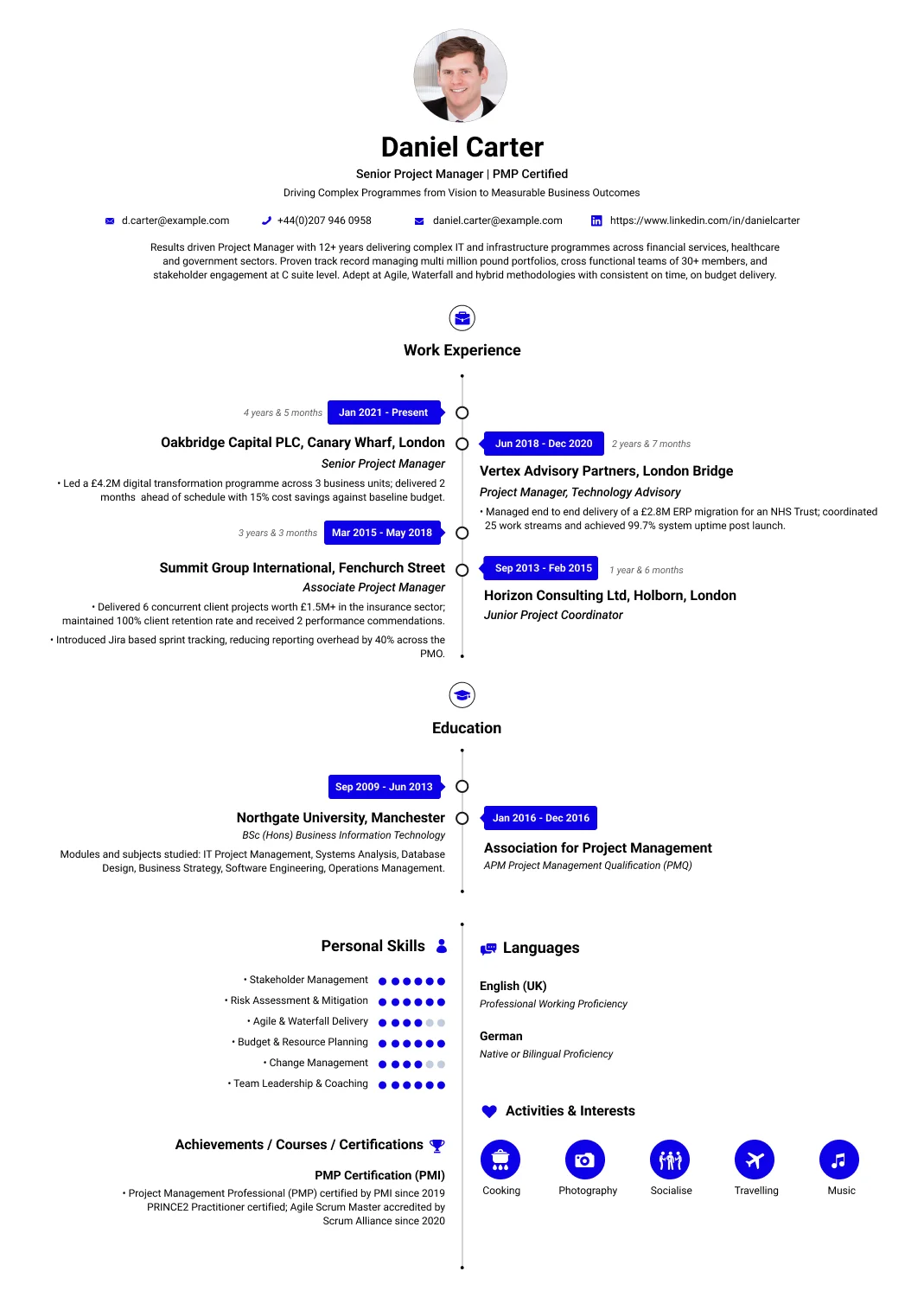
IT incident manager with eight years owning major-incident response for a Leeds managed-service provider. Leads the response to high-severity outages end to end — coordinating technical teams, communicating with stakeholders, and driving to restoration as fast as safely possible. Cut mean-time-to-resolution on major incidents by tightening the process and the bridge-call discipline. Runs post-incident reviews that turn outages into genuine problem fixes, manages the on-call and escalation framework, and reports to ITIL standards. Calm and decisive on a P1 bridge at 3am, and clear with anxious stakeholders. Looking for an incident-management, major-incident or service-management role with an organisation that takes resilience seriously.
Work Experience
Incident Manager
Northern Managed Services, Leeds, UK
Apr 2018 – Present
- Own the end-to-end response to high-severity P1 and P2 outages right across many client environments.
- Cut mean-time-to-resolution on major incidents by tightening the response process and the bridge-call discipline.
- Coordinate the technical teams on the incident bridge, driving toward restoration as fast as is safely possible.
- Communicate clearly with stakeholders and clients all the way through an incident and its resolution.
- Run post-incident reviews that turn outages into genuine root-cause problem fixes, not just restarts.
- Manage the on-call and escalation framework and report the incident metrics to full ITIL standards.
Service Desk Team Lead
Yorkshire IT Solutions, Leeds, UK
Aug 2014 – Mar 2018
- Led a busy service-desk team handling incidents and requests across client accounts.
- Managed escalations and coordinated the higher-severity incident response across teams.
- Built the process discipline and the clear-communication skills behind incident management.
- Handled customer communications and the bridge coordination during major service outages.
- Gained the ITIL certifications and moved up into a dedicated incident-manager role.
Service Desk Analyst
Leeds IT Support, Leeds, UK
Jun 2012 – Jul 2014
- Handled first and second-line incidents and requests on a busy service desk.
- Logged, triaged and escalated tickets and kept the customers updated throughout.
- Learned the ITIL incident process, prioritisation and clear, calm customer communication.
- Built the grounding that led into a service-desk team-lead role of her own.
Education
BSc in Information Technology, Information Technology
University of Leeds
Sep 2011 – Jun 2014
- IT degree covering systems, networks and service management, with a placement year. The placement led into IT operations and then incident management. Built the technical grounding to lead incident response credibly.
ITIL Intermediate & Major Incident Management Certification, Service Management
AXELOS / PeopleCert
Jan 2017 – Aug 2017
- ITIL intermediate plus major-incident-management certification covering process, roles, escalation and stakeholder communication. It formalised the incident framework run day to day. Maintained through ongoing professional development and practice.
Certifications
ITIL & Major Incident Management
AXELOS / PeopleCert
Aug 2017 – Present
- ITIL intermediate plus major-incident-management certification covering process, roles and communication. It formalised the incident framework run day to day, maintained through ongoing professional development.
Problem Management & Root-Cause Analysis
AXELOS / PeopleCert
Apr 2019 – Present
- Certification in problem management and root-cause analysis techniques. It supports the post-incident reviews that turn outages into permanent fixes rather than repeat incidents.
Highlights
Faster major-incident recovery
- Cut mean-time-to-resolution on major incidents by tightening the response process and bridge-call discipline. Faster, calmer recovery directly reduced both downtime and client impact.
Outages into fixes
- Runs post-incident reviews that convert outages into genuine root-cause problem fixes. Stopping the same incident recurring is where the real value of the role lies.
Key Initiatives
Major-Incident Process Build
Jan 2019 – Sep 2019
- Designed the major-incident management process from scratch — roles, bridge protocol and comms templates — so high-severity outages were handled the same way every time.
On-Call & Escalation Framework
Feb 2020 – Jul 2020
- Set up the on-call rota and escalation framework across teams, so the right people were reached fast and nothing stalled waiting for an owner during an outage.
Languages
- English (UK) — Native or Bilingual Proficiency
- French — Limited Working Proficiency
Technical Skills
- Major Incident Management
- Incident Bridge Coordination
- Stakeholder Communication
- Post-Incident Reviews
- ITIL Processes
- Escalation Management
- Problem Management
- On-Call Frameworks
- Incident Reporting
- Service Management Tools
Personal Skills
- Composure
- Decisiveness
- Communication
- Leadership
- Reliability
Activities & Interests
- News paper
- Dog Walking
- Poker
- Yoga
- Cleaning
Incident Manager Resume: The Essentials
Before the detail, here is what actually decides a strong incident-manager résumé:
- Lead with major-incident metrics: MTTR reduction, the volume of P1s/P2s you own, and the SLA or restoration targets you hold to.
- Name ITIL explicitly - intermediate plus major-incident management - because it is the credential that screens incident-manager applications.
- Show the full incident lifecycle: declaration, bridge coordination, restoration, then the post-incident review and the problem fix that stops recurrence.
- Prove bridge and war-room facilitation: you coordinate the technical teams and the comms, you are not just logging the ticket.
- Quantify stakeholder and exec communications - outage updates issued on a cadence, executive briefings, client-facing status during a P1.
- State the ITSM tooling (ServiceNow, Remedy, Jira Service Management) and the on-call/escalation framework you run, since both are screened for.
Why This Incident Manager Resume Works
The sample is a mid-career major-incident manager at a Leeds managed-service provider, and its choices map cleanly onto what an ITSM hiring manager screens for:
- The summary opens with the exact role and tenure - incident manager, eight years owning major-incident response - so the screener places the candidate inside the first line rather than hunting for it.
- It leads on the lifecycle the role is actually judged on: coordinating technical teams, communicating with stakeholders, and driving to restoration, then the MTTR reduction that proves the process worked.
- The first experience bullet anchors scope - end-to-end ownership of P1 and P2 outages across many client environments - which signals an MSP incident manager handling breadth, not a single internal app.
- Post-incident reviews are framed as turning outages into root-cause problem fixes, not just restarts, which shows the candidate understands the incident-versus-problem boundary recruiters probe for.
- ITIL intermediate plus major-incident-management certification sits in both education and certifications, so the credential a screener filters on is impossible to miss.
- The career arc - service-desk analyst, then team lead, then dedicated incident manager - reads as a credible path into the role, with each step building the bridge-coordination and comms discipline the job needs.
How to Write an Incident Manager Resume That Gets Interviews
An incident-manager résumé is screened for two things: that you can run a major incident calmly, and that you can prove the outcome with numbers. Build every section to evidence both.
How do you open an incident manager summary?
Open with role, years, and the severity tier you own: 'Incident manager with eight years owning major-incident (P1) response.' Then a quantified win - an MTTR or MTTA reduction - then the environment (MSP, in-house, 24x7 ops). Skip the soft-skills preamble; lead with severity and scale.
Which numbers should an incident manager quantify?
Quantify the metrics ITSM leaders track: MTTR/MTTA reduction (e.g. P1 MTTR cut from 4h to 90min), P1/P2 volume handled per quarter, SLA attainment percentage, and the size of the on-call rota or stakeholder list you coordinate. A bridge you ran for 200 affected users beats 'managed incidents'.
How do you show ITIL on a resume?
Name the specific ITIL credential - ITIL 4 Foundation, intermediate, or a dedicated major-incident-management certification - with the awarding body (AXELOS/PeopleCert). Put it where a screener filtering on 'ITIL' will hit it: the certifications section and, ideally, the summary line.
How do you prove the incident lifecycle, not just firefighting?
Show the full loop: declaring and prioritising by severity, facilitating the bridge to restoration, then the post-incident review that hands a root cause to problem management. Stating you 'run PIRs that turn outages into permanent fixes' signals you reduce repeat incidents, which is where the role earns its keep.
Which tools and frameworks should you name?
List your ITSM platform (ServiceNow, Remedy/BMC Helix, Jira Service Management), your alerting/on-call tooling (PagerDuty, Opsgenie), and the frameworks you run - severity/priority matrices, escalation paths, and the comms cadence. These are literal résumé filters for incident roles.
How do you show composure under pressure credibly?
Do not claim 'calm under pressure' - evidence it. 'Chaired the P1 bridge during a region-wide outage affecting 40 clients, restoring service in 70 minutes' proves composure through the scenario and the outcome, which a hiring manager believes far more than the adjective.
What to Include in an Incident Manager Resume
Beyond experience and skills, these sections carry disproportionate weight for an incident-manager application:
Certifications block: ITIL Foundation/intermediate and any major-incident-management or problem-management certification, with awarding body and year.
An incident-metrics line or highlight: MTTR/MTTA, MTBF, SLA attainment, and P1/P2 volume - the dashboard numbers ITSM leaders live by.
On-call and escalation detail: the rota you run, the severity/priority matrix you apply, and the escalation tiers you own.
ITSM tooling: the platform (ServiceNow, Remedy, Jira SM) and alerting stack (PagerDuty, Opsgenie) you work in daily.
A process or framework initiative: building a major-incident process, a comms-template set, or a war-room protocol shows you create the discipline, not just follow it.
Stakeholder scope: whether you brief executives, clients, or regulators during an outage, and the comms cadence you maintain.
Incident Manager Resume Summary Examples
Three summaries pitched at different levels and environments, each pronoun-free and built to be lifted onto a real résumé - all distinct from the MSP summary in the sample:
Compressing eight years of P1 ownership into four pronoun-free lines is harder than chairing the bridge, and a weak summary buries the MTTR numbers that should sell you. If the phrasing keeps fighting you, a writer who has framed ITSM careers can turn your incident record into an opener that leads with severity and scale. Hand over your raw metrics and let them find the line.
Entry-level resume summary example
Incident analyst moving into major-incident management, with three years on a 24x7 service desk triaging and escalating P1 and P2 incidents to ITIL standards. Holds ITIL 4 Foundation and has co-chaired major-incident bridges under a senior incident manager, owning the comms log and the stakeholder cadence while the technical teams worked to restore. Strong on severity classification, ticket discipline in ServiceNow, and keeping anxious users updated on a clear timeline. Helped cut average time-to-acknowledge on high-priority tickets by tightening the alerting and on-call routing. Seeking a junior or associate incident-manager role where structured ITIL practice and a calm bridge presence can grow into full major-incident ownership.
Mid-level resume summary example
Incident manager with six years owning the major-incident process for a financial-services platform handling millions of daily transactions. Declares, prioritises and drives P1s to restoration on the bridge, then chairs the post-incident review that hands a root cause to problem management - a loop that cut repeat priority-one incidents by a third over two years. Reduced major-incident MTTR from roughly four hours to under ninety minutes by rebuilding the escalation matrix and standardising the comms templates. Fluent in ServiceNow, PagerDuty and SLA reporting, and trusted to brief executives and regulators during an outage. ITIL 4 certified with a major-incident-management specialism. Looking for a senior incident or service-management role where resilience is treated as a first-class concern.
Senior-level resume summary example
Senior incident manager and ITSM lead with twelve years running major-incident response across enterprise and managed-service environments, latterly heading a follow-the-sun incident team covering 24x7 operations. Built the major-incident framework - severity matrix, bridge protocol, comms cadence and executive-escalation path - that took P1 MTTR down by over 50% and lifted SLA attainment to 99.4%. Owns the relationship between incident, problem and change, ensuring outages convert into permanent fixes rather than recurring at the next release. Reports incident metrics - MTTR, MTTA, MTBF and major-incident volume - to board level, and mentors incident managers into the role. ITIL Expert with major-incident-management certification. Seeking a head-of-incident-management or service-resilience leadership mandate.
Incident Manager Work Experience Examples
Pronoun-free, verb-first bullets grouped by environment, each carrying scope, a quantified action and the impact - all distinct from the sample's MSP bullets:
Enterprise / in-house incident manager
- Owned end-to-end response to P1 and P2 incidents across a 600-application estate, declaring severity, chairing the bridge and driving restoration to a 99.2% major-incident SLA over twelve months.
- Rebuilt the escalation matrix and on-call routing across eight engineering teams, cutting mean-time-to-acknowledge on P1s from 22 minutes to under 6 and removing the most common stall point.
- Reduced major-incident MTTR from 3h 40m to 1h 25m across a year by standardising bridge protocol and comms templates, directly lowering customer-facing downtime and breach penalties.
- Chaired post-incident reviews on every P1, handing documented root causes to problem management and cutting repeat priority-one incidents by 34% across two consecutive reporting periods, easing the firefighting load on engineering.
- Briefed executives and affected business units on a strict 30-minute comms cadence during major outages, replacing scattered ad-hoc updates with a single trusted status channel that cut inbound chase-up traffic during incidents.
MSP / multi-client incident manager
- Coordinated major-incident response across 45 client environments from a 24x7 operations centre, holding each account to its contracted restoration SLA and reporting attainment monthly.
- Ran simultaneous P1 bridges during a region-wide cloud-provider outage, restoring service for the highest-tier clients within 70 minutes and protecting a renewal pipeline that depended on the contracted recovery SLA.
- Built per-client severity and notification matrices in ServiceNow so the right stakeholders were paged within the SLA window, eliminating the missed-notification escalations that had been a leading driver of client churn.
- Drove the on-call rota and escalation framework across three follow-the-sun teams, ensuring no major incident stalled waiting for an owner across time zones and keeping P1 bridge coverage continuous around the clock.
- Produced the monthly major-incident report - MTTR, MTTA, P1 volume and SLA attainment broken down per client - that became the standing agenda item in service-review meetings and shaped renewal conversations.
Senior / incident-management lead
- Established the organisation's major-incident management practice from scratch - roles, severity matrix, bridge protocol and executive-escalation path - adopted across every technology team within two quarters.
- Led the incident, problem and change interface so that root causes from post-incident reviews became tracked problem records and pre-approved change controls, cutting recurrence at release boundaries.
- Mentored four incident managers from service-desk backgrounds into full major-incident ownership, building the bench strength that kept P1 bridge coverage continuous through 24x7 shifts without single-person dependency.
- Lifted major-incident SLA attainment from 94% to 99.4% over eighteen months by tightening declaration criteria, escalation timing and the post-incident-review feedback loop into a single repeatable practice.
- Reported incident metrics - MTTR, MTTA, MTBF and major-incident volume - to the board each quarter, translating raw outage data into a prioritised, costed resilience-investment roadmap leadership could act on.
Top Incident Manager Skills
List the hard skills an ITSM screener filters on first, then the temperament skills the bridge actually demands:
Hard skills
- Major-incident management
- ITIL incident & problem management
- Bridge / war-room facilitation
- ITSM tools (ServiceNow / Remedy / Jira Service Management)
- SLA & priority/severity management
- Stakeholder & executive communications
- Escalation management
- Root-cause analysis & post-incident review
- Change-management coordination
- On-call / 24x7 operations management
- Incident metrics & reporting (MTTR / MTTA / MTBF)
- Service-restoration coordination
- Alerting & paging tools (PagerDuty / Opsgenie)
- Severity classification & triage
- Incident comms cadence & status updates
- Major-incident process design
- Knowledge management & runbooks
- ITIL 4 / service-management framework
Soft skills:
- Composure under pressure
- Decisiveness
- Clear communication
- Coordination & leadership
- Reliability
- Calm authority on a live bridge
Certifications for an Incident Manager
ITIL is the credential incident-manager postings filter on, so lead with it and name the level; the rest strengthen the specific lane you run - delivery, reliability engineering, or security incidents:
-
ITIL 4 Foundation
— PeopleCert (AXELOS) The baseline ITSM credential most incident-manager postings screen on; establishes the incident, problem and change vocabulary the role runs on.
-
ITIL 4 Managing Professional
— PeopleCert (AXELOS) Optional but differentiating - the module stream (including Create, Deliver & Support) that signals you own the major-incident practice, not just the terminology.
-
PMP
— PMI Optional; useful for incident managers who also drive major-incident process rollouts and remediation programmes. Requires documented project-leadership hours.
-
SRE Foundation
— PeopleCert (DevOps Institute) Optional; valuable where incident response sits inside a DevOps/SRE culture - grounds you in error budgets, on-call and blameless post-incident reviews.
-
DevOps Foundation
— PeopleCert (DevOps Institute) Optional; complements ITIL for incident managers bridging traditional ITSM and modern CI/CD delivery teams.
-
CISM
— ISACA Optional; strongly relevant when your P1s include security incidents - pairs incident-response command with the security-management framework hiring managers look for in that lane.
Common Incident Manager Resume Mistakes
These are the errors that get an otherwise capable incident manager screened out:
- Blurring incident and problem management - describing root-cause work as if it were the live response signals you do not understand the boundary the role is built on.
- Listing 'ITIL' with no level or credential - screeners want ITIL 4 Foundation, intermediate, or a major-incident-management certification, named with the awarding body.
- No severity language - talking about 'tickets' or 'issues' instead of P1/P2 and major incidents makes the résumé read like a service-desk role, not an incident-manager one.
- Zero metrics - without MTTR, MTTA, SLA attainment or P1 volume, you cannot prove the bridge you ran actually shortened an outage.
- Claiming 'calm under pressure' instead of evidencing it with a real outage scenario and its restoration outcome.
- Hiding the ITSM tool - omitting whether you run ServiceNow, Remedy or Jira Service Management drops you out of tool-filtered searches.
- Ignoring the on-call and escalation framework - if you do not show you run the rota and escalation paths, you read as a participant rather than the owner.
Extra tips
Some orgs log major incidents as Sev1/Sev2, others as P1/P2, and keyword filters match only the exact term.
List both so a tool-filtered search does not silently skip you.
Incident Manager Resume FAQs
The questions candidates most often search when writing an incident-manager résumé:
Yes, in practice - ITIL is the credential most incident-manager postings filter on, so name it with its level. ITIL 4 Foundation is the baseline; an intermediate or dedicated major-incident-management certification from AXELOS/PeopleCert is what separates a strong application.
An incident manager restores service fast and owns the live response; a problem manager finds and removes the root cause so it does not recur; a major-incident manager runs only the highest-severity (P1) outages - the bridge, comms and escalation. Show on your résumé which loop you own, and that you understand the handoff between them.
Lead with major-incident management, bridge/war-room facilitation, ITIL incident and problem management, SLA and severity management, escalation management, and an ITSM tool such as ServiceNow. Pair these hard skills with evidenced composure, decisiveness and stakeholder communication.
Quantify the change and the baseline: 'Cut major-incident MTTR from 3h 40m to 1h 25m' or 'Held P1 SLA attainment at 99.2%.' Put the headline numbers in the summary and a highlights line, then back them up inside the experience bullets where the action that drove them lives.
Yes - on-call and 24x7 operations are core to the role, so state the rota you run or participate in and the escalation framework you own. Showing you keep a follow-the-sun or out-of-hours bridge covered signals you can carry real P1 responsibility.
One page for under ten years of experience, two pages for senior or lead incident managers with a long major-incident track record. Prioritise quantified P1 outcomes and your ITIL credentials over a long list of every tool you have touched.
Name the platform you actually run incidents in - ServiceNow, BMC Remedy/Helix or Jira Service Management - plus your alerting and paging stack such as PagerDuty or Opsgenie. Tool names are literal search filters for incident roles, so omitting them costs you matches.
Get Started With Our
Free Resume Creator today!
Free sign-up. No credit card required.