Was this sample helpful? Rate it!
Average: 4.4 (14 votes)


Contents
Yoga Teacher Resume: The Essentials
Why This Yoga Teacher Resume Works
How to Write a Yoga Teacher Resume That Gets Interviews
What to Include in a Yoga Teacher Resume
Yoga Teacher Resume Summary Examples
Yoga Teacher Work Experience Examples
Best Skills for a Yoga Teacher Resume
Yoga Teacher Certifications
How Much Does a Yoga Teacher Earn?
Common Yoga Teacher Resume Mistakes
Yoga Teacher Resume FAQs

Summary
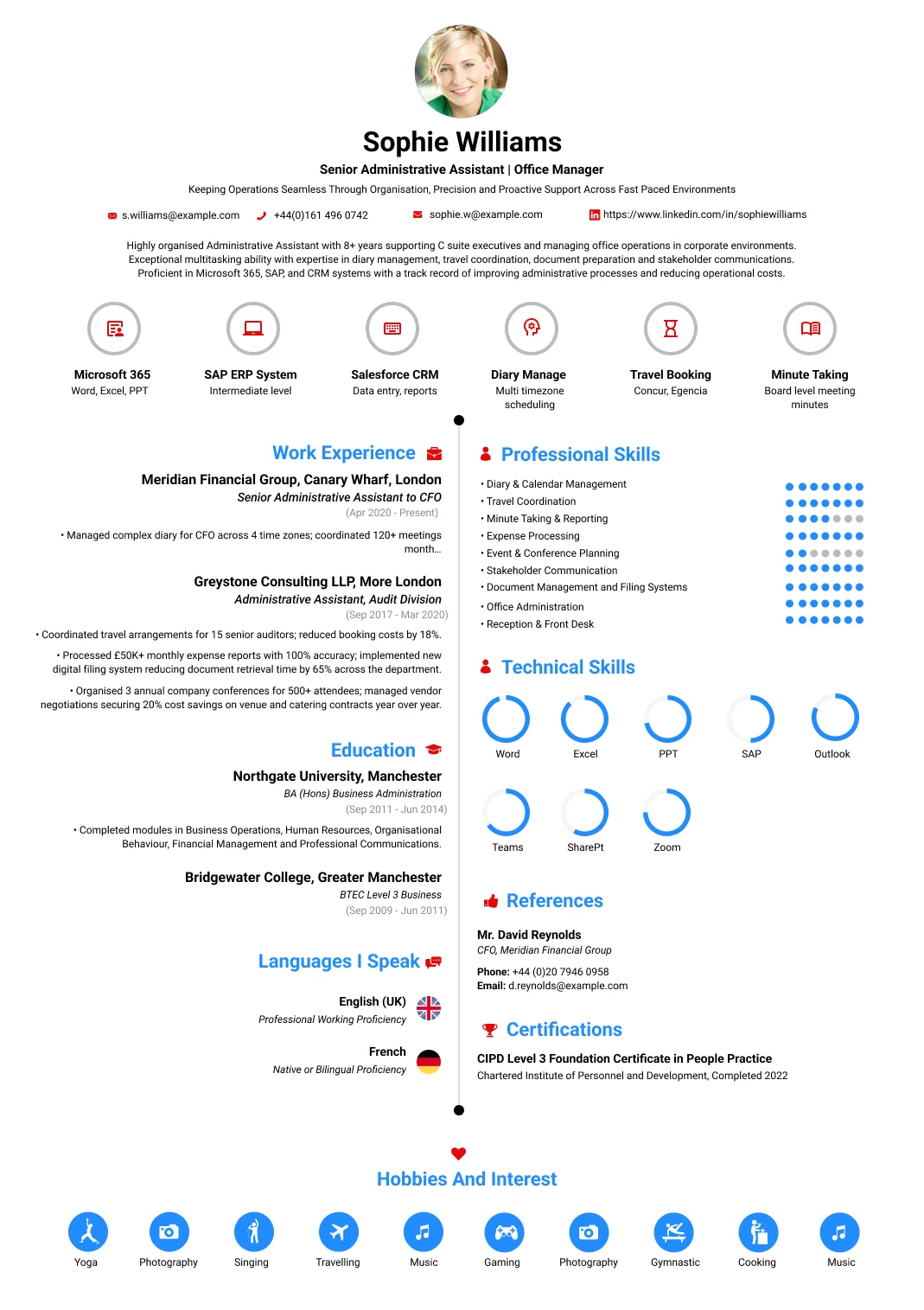
Yoga teacher with ten years teaching traditional hatha and ashtanga yoga, the last five running her own classes and teacher trainings in Rishikesh. Teaches yoga as more than exercise — grounding practice in breath, philosophy and tradition, guiding students deeper into the practice over time, training new teachers, and helping people find calm and steadiness as well as strength. Trained many qualified teachers and built retreats students travel to attend. Teaches asana, breath and philosophy, leads teacher trainings, mentors students, runs retreats, and grounds practice in tradition. Knowledgeable, grounded and devoted. Looking for a yoga-teaching or teacher-training role, in a school or studio, that values yoga taught with depth, tradition and genuine care for the student's whole practice.
Profesional Summary
Yoga Teacher & Teacher Trainer
Rishikesh Yoga School & Retreats, Rishikesh, India
Jan 2019 – Present
- Teach yoga as more than exercise, helping people find calm and steadiness as well as strength.
- Trained many qualified teachers and built retreats students travel from around the world to attend.
- Ground practice in breath, philosophy and tradition, teaching the why behind the practice, not only the poses.
- Guide students deeper over time, meeting each where they are and helping their practice genuinely develop.
- Lead teacher trainings, preparing new teachers to teach safely, knowledgeably and with real understanding.
- Run retreats and mentor students, holding longer, immersive practice that takes people deeper into yoga.
Yoga Teacher
India Yoga Studio, Rishikesh, India
Jul 2013 – Dec 2018
- Taught daily hatha and ashtanga classes at a yoga school, building deep teaching experience over many years.
- Led classes and began mentoring students, steadily developing the depth a teacher-trainer role demands.
- Learned class teaching, philosophy and student guidance on the job across more than five years.
- Gained the certification and experience that led into running her own classes and trainings of my own.
Qualification
500-Hour Yoga Teacher Training, Yoga
Rishikesh Yoga School
Jan 2012 – Jun 2013
- Comprehensive 500-hour training in traditional hatha and ashtanga yoga covering asana, pranayama, philosophy and teaching, with deep practice. The training built the foundation teaching yoga with depth requires. It led into teaching.
Yoga Therapy & Teacher-Trainer Certification, Yoga Therapy
Indian Yoga Association
Jan 2015 – Sep 2015
- Certification in yoga therapy and training teachers to a recognised standard. It deepened both the practice and the ability to train others. It supported leading teacher trainings and guiding students safely and deeply.
Highlights
Trained many teachers
- Trained many students who became qualified teachers. Teaching teachers multiplies a teacher's impact far beyond her own classes, so the teachers she has trained carry her depth and care into rooms all over the world.
Retreats people travel for
- Built retreats students travel from around the world to attend. People only travel far for a teacher they trust and learn from, so well-attended retreats reflect a reputation for genuine depth and care in her teaching.
Training
Yoga Therapy & Teacher-Trainer Certification
Indian Yoga Association
Sep 2015 – Present
- Holds 500-hour training and certification in yoga therapy and training teachers to a recognised standard, which deepened both the practice and the ability to train others, supporting leading teacher trainings and guiding students safely and deeply.
Recognition
A teacher of teachers
- Respected for teaching yoga with depth, tradition and genuine care, sought out as a teacher trainer and retreat leader and credited with training many of her students into qualified teachers of their own.
Languages
- Hindi — Native or Bilingual Proficiency
- English (UK) — Full Professional Proficiency
- Sanskrit — Professional Working Proficiency
Technical Skills
- Hatha & Ashtanga
- Pranayama
- Yoga Philosophy
- Teacher Training
- Yoga Therapy
- Asana Teaching
- Meditation
- Student Mentoring
- Retreat Leading
- Alignment & Safety
Personal Skills
- Depth of Knowledge
- Groundedness
- Devotion
- Patience
- Communication
Activities & Interests
- Socialising
- Kite Flying
- Badminton
- Cooking
- Drinking
Yoga Teacher Resume: The Essentials
Studio owners hire on schedule fit and room presence, and training schools hire on depth. Here is what decides a strong yoga teaching resume:
- Put your training hours and registration up top: 200-hour, 500-hour, RYT or E-RYT status, and the school you trained with. A studio checks this before it checks anything else.
- Name the styles and formats you can hold on your own, not the ones you have merely practised. Hatha, ashtanga, vinyasa, yin, restorative, prenatal and chair yoga are all separate hiring decisions.
- Give class numbers. Classes taught per week, average room size and how a slot grew under you are the closest thing yoga teaching has to sales figures.
- Show retention, not just attendance. Students coming back for a year is the metric a studio owner cares about, because it is what keeps the schedule funded.
- If you train teachers, separate that from teaching classes. Leading modules, assessing practicums and mentoring graduates is a different job and it commands a different rate.
- Say what you can cover at short notice. Teachers who reliably sub across several styles get offered the permanent slots when they open up.
Why This Yoga Teacher Resume Works
The sample above belongs to a teacher who moved from teaching daily classes into training other teachers, and the structure makes that arc legible fast.
- The summary names the lineage and the styles in the first line, traditional hatha and ashtanga, before mentioning anything else. For a school hiring a trainer, lineage is the credential that matters most.
- It separates teaching classes from training teachers rather than blending them. Those are two different rates and two different hiring conversations, and keeping them distinct signals seniority without claiming it.
- Depth is expressed through what is taught, breath, philosophy and tradition, rather than through adjectives. That gives a training school something concrete to assess.
- Retreats are framed by the fact that students travel to attend them. That is a reputation measure a reader can weigh, which is more useful than describing the retreats themselves.
- The 500-hour training and the yoga therapy certification are shown as two separate steps years apart, which reads as a practice that kept developing rather than one qualification carried for a decade.
- Sanskrit appears in the languages block alongside Hindi and English. On a traditional teaching resume that is a genuine working credential, not decoration.
How to Write a Yoga Teacher Resume That Gets Interviews
Studios and schools read a teaching resume for two things: can you hold this room, and will students come back. These moves answer both:
Open with hours, lineage and the styles you own
The first line should carry your training hours, where you trained and the styles you can teach unsupervised. Ten years teaching traditional hatha and ashtanga, 500-hour trained in Rishikesh, is a complete picture in one sentence. Leading with a philosophy statement instead means the reader has to hunt for the facts that decide the interview.
Quantify the room
Classes per week, average attendance, how a slot changed under you, private client count, retention past twelve months. Grew a Tuesday evening class from 6 to 21 over eight months is the single most persuasive line a class teacher can write, because a studio owner reads it as revenue. Without numbers the reader assumes small rooms.
List formats and populations separately from styles
Style is hatha or ashtanga. Format is a 75 minute mixed-level class, a Mysore-style self-practice room, a corporate lunchtime session, a private one to one. Population is prenatal, chair-based, back pain, absolute beginners. Studios recruit against a specific gap in the schedule, so spelling out all three makes you findable for the slot they are actually filling.
If you are pulling ten years of classes, workshops and trainings into one page for the first time, structure is the hard part. A free resume builder gives you a layout that keeps the teaching hours visible.
Make safety and adjustments explicit
Say how you handle hands-on adjustment consent, how you modify for common contraindications, and what you do with an injured student in a mixed room. Prop-led modification, consent cards, verbal-first cueing and a written contraindications process are all things a studio's insurer and its owner care about, and most applicants never mention any of them.
Split teaching from teacher training and retreat work
If you lead trainings, give the cohort sizes, the modules you personally teach, how many teachers have graduated, and whether you assess practicums. If you run retreats, give the length, the number of places and whether they filled. These are the lines that move you from a class rate to a training contract.
Show the practice behind the teaching
Schools with a traditional lineage want to see continued study: advanced modules, time with a named teacher, Sanskrit or philosophy study, yoga therapy training. A teacher whose last training was their initial 200 hours reads very differently from one who has kept studying, even if both have been teaching the same number of years.
What to Include in a Yoga Teacher Resume
Alongside the usual blocks, these are the sections that carry weight in yoga hiring:
A training block listing every certification with hours, school and year, since studios read hours the way other industries read degrees.
Registration status if you hold it, such as RYT 200, RYT 500, E-RYT 500 or YACEP, or the equivalent national registration where you teach.
A styles and formats line covering what you teach unsupervised, and a separate note on what you can cover at short notice.
Teaching statistics: weekly class count, typical room size, private clients, and any slot you grew.
Workshops and specialist sessions you have designed and sold, with the topic and how many attended.
Retreats and teacher trainings, kept separate from class teaching, with cohort sizes and outcomes.
Insurance and first aid status. Most studios require both, and stating them removes a question from the first conversation.
Booking and admin systems you have used, such as MindBody, Momence, Punchpass or Arketa, which matters more at small studios where teachers manage their own registers.
Extra tips
Studios almost always have an awkward slot they cannot fill, usually early morning or Sunday evening.
Put your exact availability on the resume rather than saying flexible, and you become the answer to a problem instead of one more application.
Yoga Teacher Resume Summary Examples
Three pronoun-free summaries at three points in a teaching career. Take the shape, then fill it with your own hours, styles and numbers:
Entry-level resume summary example
Newly qualified vinyasa and hatha teacher, 200-hour trained, teaching six classes a week across a community studio and a gym timetable. Holds mixed-level rooms of up to 20 students with layered cueing so beginners and regular practitioners are both served in the same 60 minutes. Grew an early Saturday slot from 5 students to 16 over four months by teaching a slower, more accessible sequence and following up with every newcomer. Covers yin and restorative at short notice, and holds current first aid and public liability insurance. Sequences around a peak pose with clear preparation and counter poses, and keeps written plans rather than improvising. Looking for a regular weekly slot at a studio with an established beginner pathway.
Mid-level resume summary example
Yoga teacher with eight years teaching hatha, vinyasa and yin across studio, corporate and private settings, currently holding 14 classes a week plus 18 regular private clients. Retains private clients past a year by rewriting each programme every eight weeks against their stated goals rather than repeating a sequence. Designed a chair-based practice for a retirement community that has run weekly for three years, and a six-week lower back programme delivered alongside a physiotherapist. Introduced consent cards for hands-on adjustments across a studio schedule and trained six other teachers in the protocol. E-RYT 200 with additional prenatal and trauma-informed training. Seeking a lead teacher role with workshop and mentoring scope.
Senior-level resume summary example
Senior yoga teacher and teacher trainer with fourteen years in traditional hatha and ashtanga, 500-hour trained and certified in yoga therapy. Has led six 200-hour teacher trainings for cohorts of 18 to 24, personally teaching the philosophy, pranayama and methodology modules and assessing every practicum before certification. Graduated 84 teachers with a completion rate above 90 percent, mentoring each through their first ten taught classes. Designed eight-day residential retreats that sold out at 18 places for three consecutive seasons. Built a 500-hour advanced module on adapting practice for injury that now runs twice yearly. Looking for a senior teaching or programme lead role at a school that teaches yoga with real depth.
Yoga Teacher Work Experience Examples
Three sets of bullets for three teaching contexts. Each carries the format, a number and what changed, which is how a studio owner judges a teacher on paper:
Studio and gym classes (early career)
- Taught 14 hatha and vinyasa classes a week across two studios, holding mixed-level rooms of 25 with layered cueing so beginners and long-time practitioners left the same class equally well served.
- Grew a quiet Tuesday evening slot from an average of 6 students to 21 over eight months by rebuilding it as a slower hatha class and following up personally with every first-time attendee.
- Covered more than 60 short-notice classes across five styles in two years, including yin, restorative and prenatal, and became first call on the studio sub list because plans were always ready.
- Introduced consent cards for hands-on adjustments across the studio schedule and trained six other teachers in the protocol, which became standard practice at the studio within a single term.
- Sequenced every 75 minute class around a peak pose with clear preparation and counter poses, keeping written plans so students could see how their own practice was developing month to month.
Private clients and specialist populations
- Built a private list of 18 regular clients taught weekly in homes and online, keeping 15 of them beyond a year by rewriting each programme every eight weeks against their own stated goals.
- Designed a chair-based practice for a group of 12 residents at a retirement community, adapting standing sequences into seated variants and running the class weekly for three years without a break.
- Worked with a physiotherapist on a six-week programme for eight clients with chronic lower back pain, adjusting sequences around movement restrictions and reporting progress after every session.
- Taught a weekly prenatal class of up to 14 students, modifying practice trimester by trimester and keeping a written contraindications list that let new students join confidently at any stage.
- Delivered a corporate contract of two lunchtime classes a week for 40 staff across a full year, holding average attendance at 22 in a setting where these programmes usually fade by month three.
Teacher trainer and retreat leader (senior)
- Led six 200-hour teacher trainings for cohorts of 18 to 24 students, personally teaching the philosophy, pranayama and methodology modules and assessing every practicum before certification.
- Graduated 84 teachers across five years with a completion rate above 90 percent, mentoring each of them through their first ten taught classes rather than ending contact at the certificate.
- Designed and ran eight-day residential retreats in Rishikesh that sold out at 18 places for three consecutive seasons, owning the programme, the teaching schedule and the daily practice rhythm.
- Built a 500-hour advanced module on yoga therapy and adapting practice around injury, which now runs twice a year and brings graduates back to the school as paying advanced students.
- Mentored twelve newly certified teachers through weekly observation and written feedback, taking most from nervous first classes to holding their own regular studio slot inside six months.
Best Skills for a Yoga Teacher Resume
Studios screen for styles and formats first, then for the safety and adaptation skills that keep a mixed room working. Write them the way a studio job advert writes them:
Hard skills
- Hatha yoga
- Ashtanga and Mysore-style self practice
- Vinyasa flow
- Yin and restorative yoga
- Prenatal and postnatal yoga
- Chair and accessible yoga
- Class sequencing and peak pose design
- Verbal cueing for mixed-level rooms
- Hands-on adjustments and consent protocol
- Prop-led modification (blocks, bolsters, straps)
- Functional anatomy and contraindications
- Pranayama and breath instruction
- Meditation and relaxation guidance
- Yoga philosophy (Yoga Sutras, Bhagavad Gita)
- Sanskrit asana names and chanting
- Yoga therapy and injury adaptation
- Teacher training module delivery and practicum assessment
- Retreat and workshop programme design
- Studio booking systems (MindBody, Momence, Punchpass)
Soft skills:
- Room presence
- Reading a group's energy
- Clear, unhurried instruction
- Patience with slow progress
- Boundaries with private clients
- Self-discipline in personal practice
- Steadiness when a class goes off plan
Yoga Teacher Certifications
Yoga teaching is unregulated in most countries, so credentials work as trust signals and insurance requirements rather than as legal licences. These are the ones studios and schools recognise:
-
RYT 200
— Yoga Alliance The baseline most studios ask for. It requires completing a 200-hour course at a registered yoga school and then registering personally.
-
RYT 500 and E-RYT 500
— Yoga Alliance The 500-hour level is what training schools look for in a lead trainer. E-RYT status additionally requires several years and a documented number of teaching hours.
-
YACEP
— Yoga Alliance Optional. Relevant if you deliver workshops or continuing education that other registered teachers need for their own hours.
-
C-IAYT
— International Association of Yoga Therapists The recognised credential for therapeutic work with clinical populations. It requires an 800-hour accredited training on top of a teaching qualification, and it is a serious differentiator.
-
Yoga Certification Board Level 2 Yoga Teacher
— Yoga Certification Board, Ministry of Ayush (India) India's national certification scheme. It carries real weight for schools teaching in a traditional lineage and for teaching roles within India.
-
Level 4 Diploma in Teaching Yoga
— British Wheel of Yoga The UK national governing body qualification. Some UK leisure centres and local authority contracts require it specifically rather than accepting an overseas 200-hour course.
How Much Does a Yoga Teacher Earn?
Yoga teachers are counted inside the broader fitness instructor category, and the spread below is wide for a reason: most teachers are paid per class or per client rather than on a salary, so income tracks the number of slots you hold:
USD 28,800 – USD 35,280 · entry · US
10th to 25th percentile. Newly qualified teachers piecing together a few studio and gym slots, usually paid per class.
USD 35,280 – USD 61,730 · mid · US
25th to 75th percentile, with the occupation median at 47,160. A full weekly schedule plus private clients sits in the upper half of this band.
USD 61,730 – USD 83,100 · senior · US
75th to 90th percentile. Teacher trainers, yoga therapists, retreat leaders and studio owners, where training and retreat income outweighs class rates.
Common Yoga Teacher Resume Mistakes
These are the errors that make a studio owner or training school skip an otherwise capable teacher:
- Writing a personal practice story instead of a teaching record. How yoga changed your life belongs on your website. A studio wants to know what you can teach, when, and how many people come back.
- Burying training hours at the bottom. Hours and school are the first thing checked, so a 500-hour training on page two is a wasted credential.
- Listing styles you practise as styles you teach. If you cannot hold a Mysore room or a prenatal class alone, do not list them. Studios find out in the trial class and it costs you the relationship.
- No numbers at all. Classes per week, average attendance and retention exist for every teacher who has taught for a year, and a page without them reads as very small rooms.
- Silence on adjustments and consent. Studios carry the liability for hands-on work, so a resume that never mentions consent or modification raises a question you would rather answer on your own terms.
- Mixing teacher training work into the class teaching bullets. Blending them makes senior work invisible and usually costs you the higher rate.
- Leaving insurance and first aid off. Both are commonly required before you can be added to a schedule, and stating them removes a delay.
- Describing retreats without outcomes. Ran retreats in Goa says nothing. Eight days, 18 places, sold out three seasons running is a business result.
Yoga Teacher Resume FAQs
The questions teachers most often search before applying to a studio or a training school:
Training hours and school, registration status, the styles and formats you teach unsupervised, weekly class numbers with average attendance, private clients, and your insurance and first aid status. Add workshops, retreats and teacher training work as separate blocks if you have them, because they command different rates.
No, yoga teaching is unregulated in the United States, the United Kingdom and most other countries, and plenty of respected teachers are not registered. In practice many studios, gyms and insurers ask for a 200-hour certificate from a registered school, so registration removes friction even where it is not legally required.
Build it around your training practicum and everything adjacent to it. Give the hours completed, the modules covered, the number of practice classes you taught and to whom, plus any donation, community or workplace classes you have run. Then list the styles you can hold alone and your availability to cover.
One page for class teaching roles, two only if you lead teacher trainings, retreats or a studio programme. Studio owners usually read applications between classes on a phone, so the training hours, styles and availability need to be visible in the first screen.
List every training with its hour count, school and year, including advanced modules and short specialist courses. Hours are the currency of yoga hiring, so a 200-hour foundation plus a 300-hour upgrade plus a 50-hour prenatal module tells a much stronger story than the word certified on its own.
Open with years teaching, styles, training hours and where you trained, then one teaching number and one differentiator. For example: eight years teaching hatha and vinyasa, 500-hour trained, 14 classes a week plus 18 private clients, with prenatal and back-care specialisation. Keep philosophy for the interview.
Yes, and give them their own section with real outcomes. Places offered, places filled, how many times a workshop has run and whether it repeats are all evidence that you can bring students in, which is the thing studios most want to buy.
Get Started With Our
Free Resume Creator today!
Free sign-up. No credit card required.