Was this sample helpful? Rate it!
Average: 4.6 (33 votes)


Contents
Key Takeaways for an English Teacher Resume
What This Resume Gets Right
How to Write an English Teacher Resume That Gets Interviews
Key Sections for an English Teacher Resume
English Teacher Resume Summary Examples
English Teacher Work Experience Examples
Best Skills for an English Teacher Resume
Key Certifications and Licences for an English Teacher
English Teacher Salary Expectations
Common English Teacher Resume Mistakes
Frequently Asked Questions

Summary
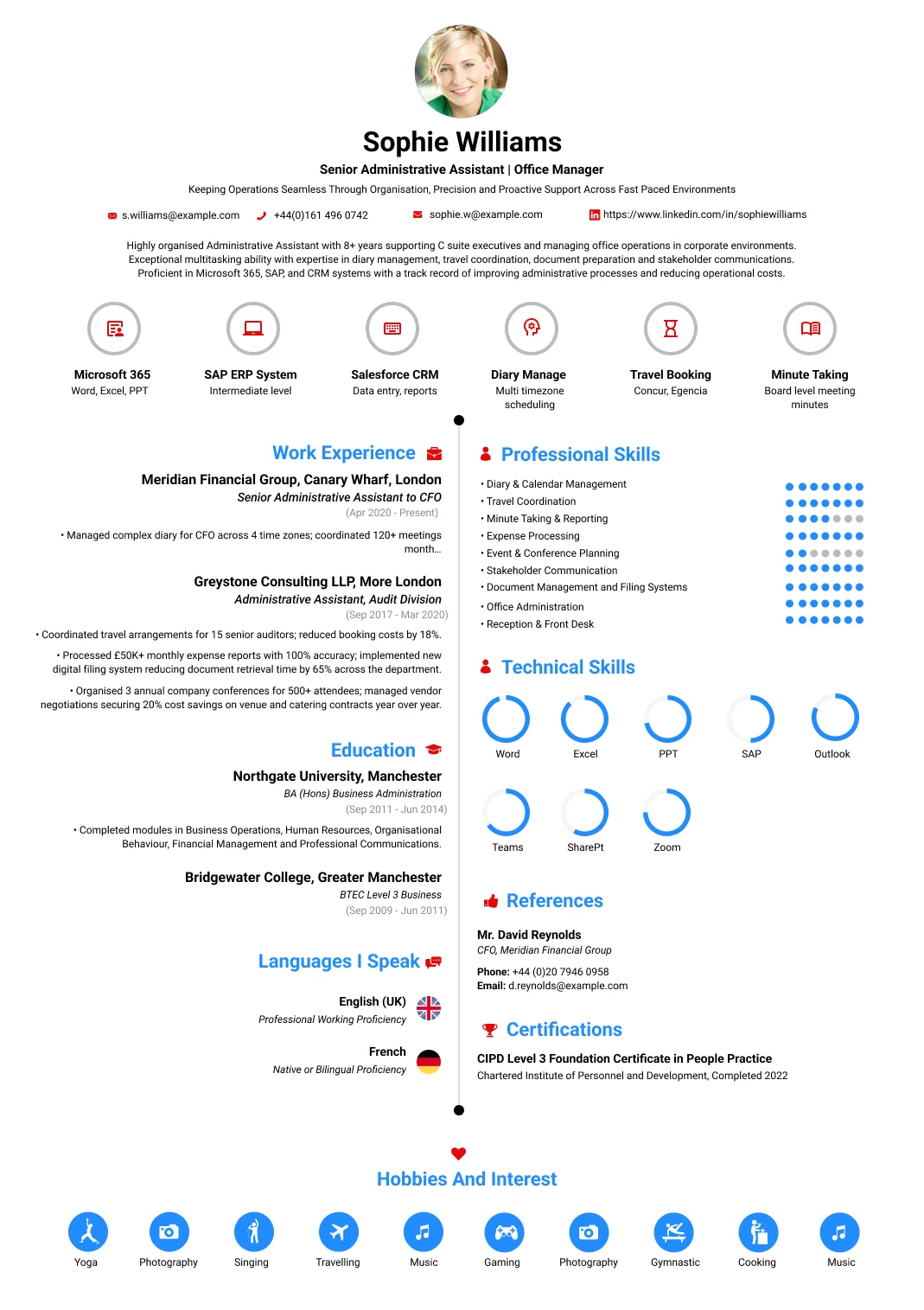
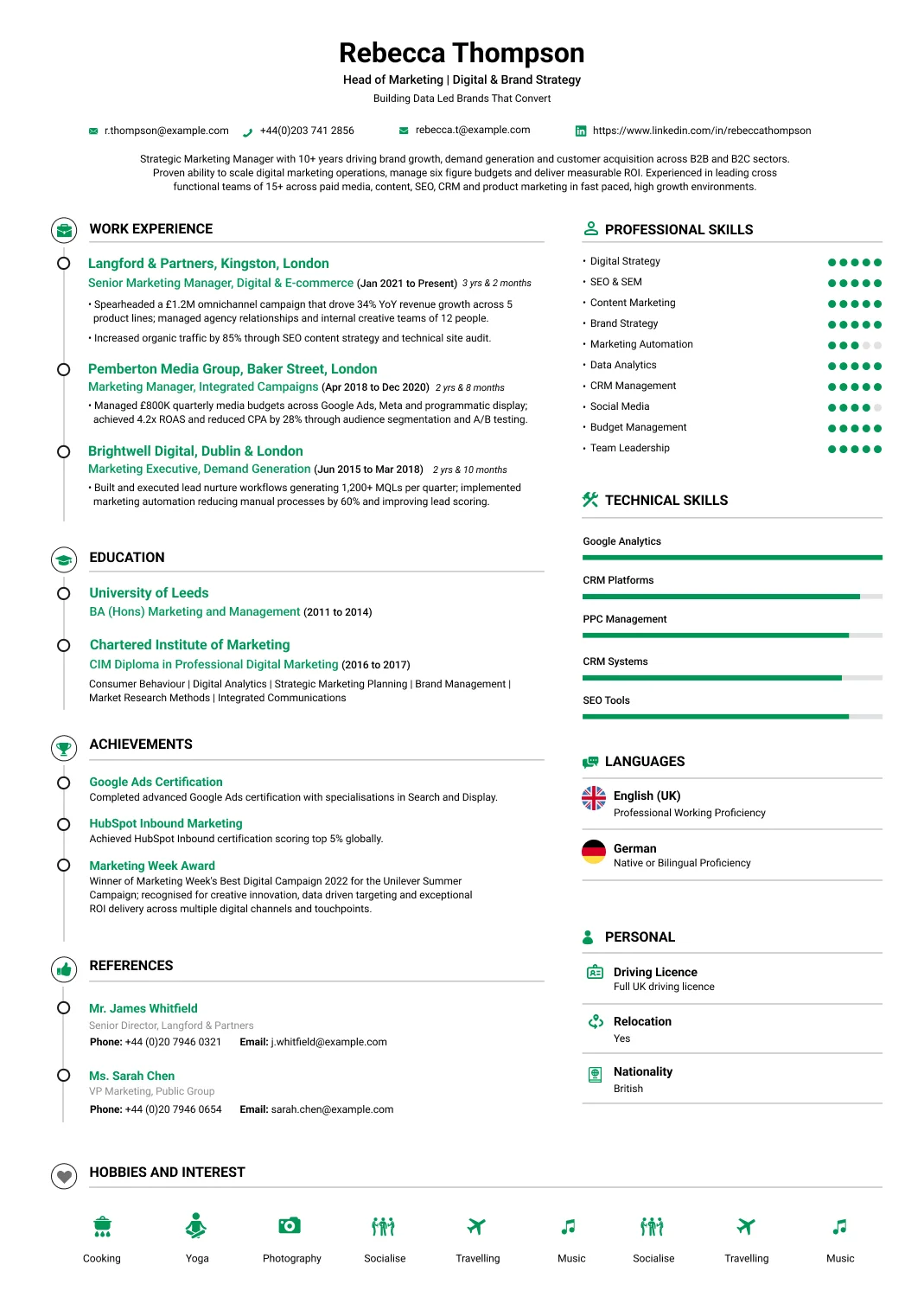
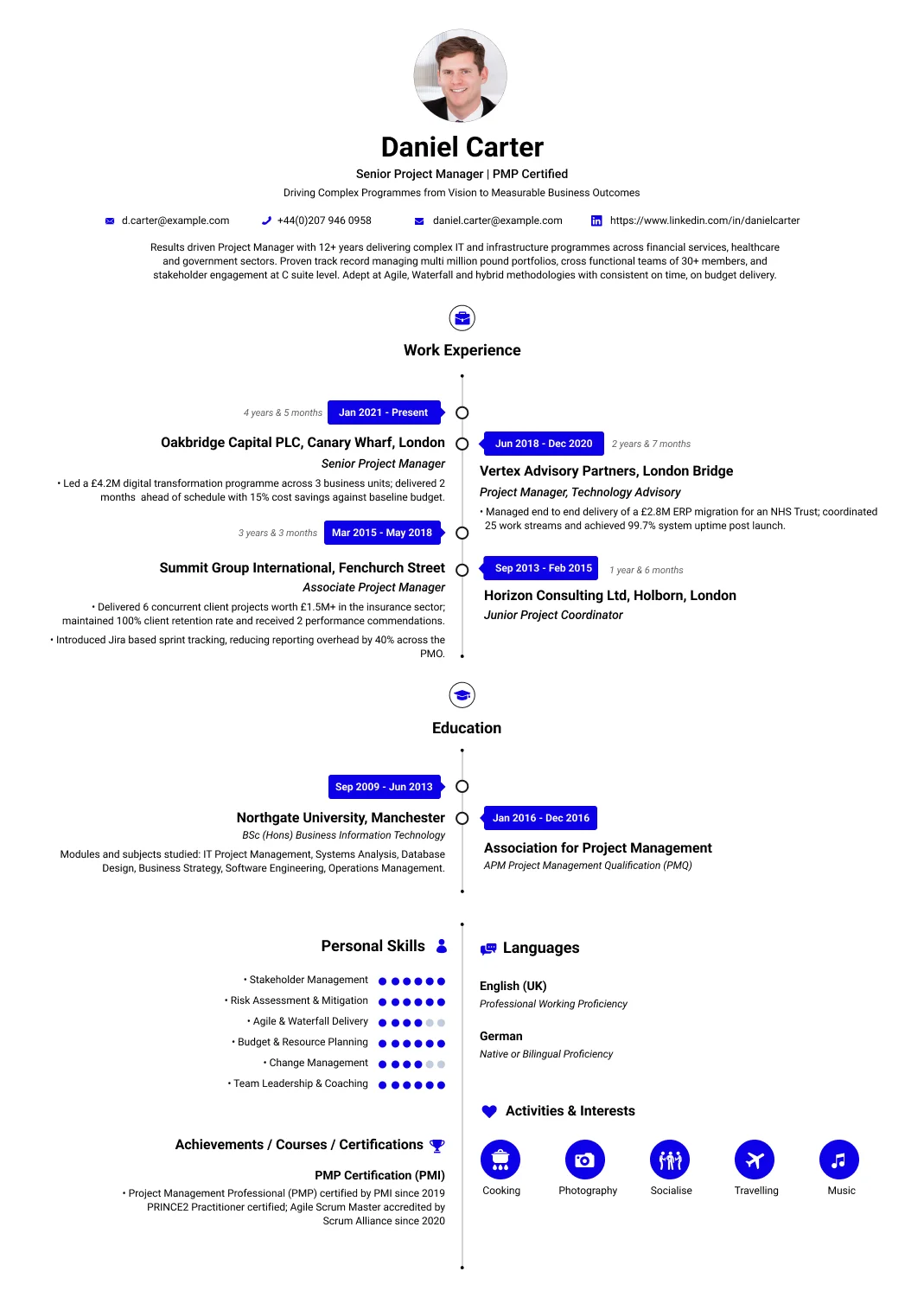
English teacher with eleven years teaching secondary English literature and language in schools across Manchester. Gets teenagers genuinely engaged with reading and writing, connecting a Shakespeare play or a piece of persuasive writing to their own lives so the work actually sticks. Consistently strong exam results and led a department initiative on reading for pleasure that lifted engagement across year groups. Plans and delivers lessons across the curriculum, prepares students for GCSE and A-level, marks and gives feedback that moves learning forward, and leads on literacy. Devoted to his subject and genuinely good with hard-to-reach students. Looking for a senior English-teaching or head-of-department role with a school that values great teaching of the subject.
Professional Summary
English Teacher
Pennine High School, Manchester, UK
Sep 2016 – Present
- Teach secondary English literature and language, connecting texts and writing to students' own lives so the learning actually sticks.
- Deliver consistently strong GCSE and A-level results and led a reading-for-pleasure initiative that lifted engagement across year groups.
- Plan and deliver engaging lessons across the curriculum, bringing Shakespeare, poetry and persuasive writing genuinely to life.
- Prepare students for exams with targeted teaching and practice, while marking and giving feedback that moves their learning forward.
- Lead on literacy across the department, sharing strategies that help colleagues raise standards in reading and writing.
- Reach and re-engage hard-to-reach students, finding the angle that gets a reluctant teenager invested in the work.
English Teacher
Salford Community School, Manchester, UK
Sep 2013 – Aug 2016
- Taught secondary English across year groups, planning and delivering lessons and preparing students for GCSE examinations.
- Built strong classroom routines and relationships that improved engagement and results in challenging classes.
- Learned exam preparation, differentiation and behaviour management on the job across three years of teaching.
- Built the track record that led into an English-teaching role with departmental responsibilities.
Qualification
BA (Hons) in English Literature, English Literature
University of Manchester
Sep 2009 – Jun 2012
- Degree in English literature covering poetry, prose, drama and critical theory, with a dissertation. The study built deep subject knowledge and a love of the subject. It set the foundation for a career teaching English.
PGCE in Secondary English, Education
Manchester Metropolitan University
Sep 2012 – Jul 2013
- Postgraduate teaching qualification covering secondary pedagogy, classroom practice and assessment, with school placements. It qualified teaching in secondary schools. It combined subject expertise with the craft of the classroom.
Highlights
Reading for pleasure initiative
- Led a department initiative on reading for pleasure that lifted engagement across year groups. Getting teenagers to read for enjoyment, not just for exams, builds the kind of skill and curiosity that lasts well beyond school.
Reaches reluctant students
- Finds the angle that gets even reluctant, hard-to-reach teenagers genuinely invested in reading and writing. Re-engaging a student who had given up on the subject is some of the most rewarding work a teacher does.
Qualification
Qualified Teacher Status (QTS)
Department for Education
Jul 2013 – Present
- Qualified Teacher Status with a PGCE in secondary English, covering pedagogy, assessment and safe practice. It is the credential required to teach in schools and underpins the classroom practice and subject teaching applied daily.
Reading for Pleasure Programme
Reading for Pleasure Programme
Sep 2020 – Jul 2021
- Led a whole-department reading-for-pleasure programme, introducing class libraries, reading time and student book recommendations, which lifted reading engagement and attainment across several year groups.
Languages
- English (UK) — Native or Bilingual Proficiency
- French — Limited Working Proficiency
Technical Skills
- Teaching Literature
- Teaching Writing
- GCSE & A-Level Prep
- Lesson Planning
- Marking & Feedback
- Literacy Leadership
- Differentiation
- Behaviour Management
- Student Engagement
- Curriculum Design
Personal Skills
- Passion
- Patience
- Communication
- Creativity
- Dedication
Activities & Interests
- Family
- Friends
- Walking
- Rugby
- Gardening
Key Takeaways for an English Teacher Resume
Subject teaching posts are filled on evidence, not enthusiasm. Here is what decides an English teacher resume:
- Name your key stages and your exam board. AQA English Literature at GCSE reads differently from Edexcel or OCR, and a head of department is planning who can pick up which class.
- List the texts you have actually taught. Macbeth, An Inspector Calls, Jekyll and Hyde, the Power and Conflict anthology and A Level Paper 3 coursework are concrete; 'the curriculum' is not.
- Give outcomes in the currency schools use: Progress 8 or subject progress score, percentage at grade 5 and above, A level A star to B, or value added against target grades.
- Say whether you have taught A level literature and whether you have marked for a board. Both open doors that classroom experience alone does not.
- Whole-school responsibility belongs near the top: literacy lead, KS4 coordinator, second in department, NEA moderation, or running an intervention cohort.
- State QTS, your induction status and safeguarding training plainly. UK application sifting stops at anything unclear on those three.
What This Resume Gets Right
The sample above belongs to a teacher moving from classroom English toward departmental leadership. These are the structural decisions worth copying:
- The first line pins down phase, subject split and region straight away, which tells a head of department that this is secondary English literature and language rather than primary literacy or a language-support post.
- Exam outcomes and a whole-department initiative sit in the same opening block, so leadership potential and classroom results arrive together instead of being separated by a page.
- The reading-for-pleasure programme gets its own project entry rather than being lost in a bullet, which lets the reader see scope, duration and the year groups affected.
- Both teaching posts are in the same city with an unbroken run of years, so the reader is not left calculating dates. Continuity in one region reads as commitment on a UK teaching application.
- The BA in English literature and the PGCE in secondary English are shown as a pair, which answers subject knowledge and pedagogy in one glance.
- Reaching disengaged students is presented as a specific practice with an outcome rather than as a personal quality, which is what separates a claim from evidence on a teaching resume.
How to Write an English Teacher Resume That Gets Interviews
English posts attract large fields, and the sift is often done by the head of department in a free period. These moves get you onto the shortlist:
How do you show subject knowledge, not just teaching ability?
List texts and periods by name. A head of department reading 'taught GCSE English Literature' learns nothing; reading 'Macbeth, A Christmas Carol, An Inspector Calls and the Power and Conflict anthology at GCSE, with Othello and The Handmaid's Tale at A level' learns exactly which classes you can take in September. If you have a specialism, whether that is Romantic poetry, post-colonial fiction or linguistics, say so. It is often the deciding factor for A level allocation.
{TIP}
Which results should an English teacher put on a resume?
Use the measure your school reported. Percentage of a cohort at grade 5 and above in English Language and Literature, subject progress score against Progress 8, A level grades against minimum target grades, or the gap closed for a disadvantaged cohort. Give the class context too: a set 4 GCSE group moving from 31 percent to 58 percent at grade 4 and above is more impressive than a top set at 95 percent, and an experienced reader knows it.
How do you demonstrate assessment expertise?
Assessment is where English teaching gets technical, so use its vocabulary. Say that you mark to AO1 to AO4, moderate NEA coursework for the spoken language endorsement, run standardisation for a year team, or have examined GCSE English Language Paper 1 for a board. Examining experience in particular signals that you understand exactly how marks are awarded, and it is a genuine hiring advantage in a department planning intervention.
What responsibilities should you list beyond your timetable?
Schools appoint on capacity for whole-school work. Literacy coordination, KS3 curriculum rewriting, running the school library or a book club, leading a debating team, organising theatre trips, mentoring trainees and ECTs, or contributing to the department's assessment calendar all count. Attach a scale where you can: mentoring two trainee teachers a year, or rewriting the entire KS3 scheme of work across three year groups.
How do you write about behaviour and engagement without cliché?
Describe a practice and its result. Rebuilding a bottom-set Year 10 scheme around short contemporary texts and cutting persistent disruption incidents from twelve a fortnight to three is a teaching claim. Being 'great with challenging classes' is not. Name the framework if your school uses one, since a school running a specific behaviour system will look for the vocabulary.
How should you handle the personal statement alongside the resume?
Keep them doing different jobs. In England most schools ask for an application form and a supporting statement, and your resume is the evidence sheet the statement refers to: timetable, key stages, texts, results, responsibilities, training. Repeating your statement in prose on the resume wastes the one page a head of department will skim in the sift.
Key Sections for an English Teacher Resume
Alongside experience and education, these blocks do real work on a subject-teaching application:
A teaching profile line: key stages taught, exam boards, and whether you have carried A level literature.
A texts and curriculum block naming set texts, anthologies and any KS3 units you wrote yourself.
Outcomes with cohort context, given in the school's own reporting measure rather than a personal estimate.
QTS and teacher reference number, induction or ECT status, and the date you completed it.
Safeguarding and statutory training, including your most recent Keeping Children Safe in Education update and any designated safeguarding lead training.
Examining and moderation work for AQA, Pearson Edexcel, OCR or Eduqas, with the paper and the years.
Enrichment that belongs to English specifically: debating, school magazine, poetry slams, theatre trips, reading intervention programmes.
Professional development that shows subject depth, such as an MA in English, a research-informed reading course, or NPQ study.
English Teacher Resume Summary Examples
Three summaries at different career points, each written for a slightly different school context so none echoes the sample above:
Entry-level resume summary example
Early career English teacher with QTS and a PGCE in secondary English, completing induction at an eleven to sixteen comprehensive in Leeds with a timetable across Years 7 to 11. Teaches AQA English Language and Literature at GCSE, including Macbeth, A Christmas Carol and the Power and Conflict anthology, alongside a KS3 curriculum built on the novel and transactional writing. Redesigned a Year 8 poetry unit around spoken performance after two terms of low engagement, lifting the proportion of pupils meeting the end-of-unit standard from 54 to 76 percent. Runs a Year 7 reading club of eighteen pupils and supports the school library refresh. Seeking a second post in a department with A level literature and a structured route into curriculum work.
Mid-level resume summary example
English teacher with seven years across two eleven to eighteen schools, teaching Edexcel English Literature and Language to GCSE and A level and moderating NEA coursework for the spoken language endorsement. Took a Year 11 set from 38 to 61 percent at grade 4 and above in Literature over one academic year by rebuilding the revision programme around timed extract analysis and whole-class feedback. Teaches Othello, The Handmaid's Tale and the Romantic poets at A level, with a subject specialism in nineteenth-century fiction. Has marked GCSE English Language Paper 2 for a board across three summer series. Looking for a second in department post with responsibility for KS4 outcomes and assessment design.
Senior-level resume summary example
Head of English with fourteen years in secondary teaching and five leading a department of nine teachers across a two thousand pupil eleven to eighteen academy. Rewrote the KS3 curriculum around a canonical and contemporary text spine, then aligned KS4 assessment to it, moving the subject progress score from minus 0.21 to plus 0.34 across three cohorts. Line manages six teachers, runs standardisation and moderation for both Language and Literature, and has grown A level literature uptake from 22 to 41 students a year. Continues to teach a full A level group and a Year 11 intervention set. Seeking a senior leadership post retaining oversight of English and whole-school literacy.
English Teacher Work Experience Examples
Four sets covering different points in an English career. Take the phrasing pattern, then swap in your own texts, cohorts and figures:
Early career: KS3 and GCSE English
- Taught a full timetable of English Language and Literature across Years 7 to 11 at an eleven to sixteen comprehensive, covering Macbeth, A Christmas Carol and the AQA Power and Conflict poetry anthology.
- Rebuilt a Year 8 poetry unit around spoken performance and annotation modelling after two terms of weak engagement, raising pupils meeting the end-of-unit standard from 54 to 76 percent of the cohort.
- Introduced weekly low-stakes vocabulary retrieval across three KS3 classes, closing the gap between disadvantaged pupils and their peers on end-of-year reading assessments by nine percentage points.
- Marked and returned fortnightly extended writing with whole-class feedback rather than individual comments, cutting marking time by roughly four hours a week without reducing pupil response rates.
- Ran a Year 7 reading club of eighteen pupils and rebuilt the form-time reading list alongside the school librarian, increasing library loans across the whole year group by 40 percent over two terms.
GCSE literature and language specialist
- Taught four GCSE classes across the ability range on the Edexcel Literature and Language specifications, including Othello extract work, An Inspector Calls and unseen poetry comparison for Paper 2.
- Raised a Year 11 set 4 group from 31 to 58 percent at grade 4 and above in English Language by restructuring the year around timed Paper 1 Question 5 practice with modelled openings.
- Designed and ran a twelve-week intervention for 26 borderline grade 4 pupils, using fortnightly walking-talking mocks, with 21 of the group meeting or exceeding their target grade in the summer series.
- Moderated non-examined assessment for the spoken language endorsement across a cohort of 180, standardising judgements with three colleagues and preparing the sample for external moderation.
- Led department standardisation of Literature mock marking twice a year, bringing marker variation on the same scripts down to within two marks across a team of six English teachers.
- Examined GCSE English Language Paper 2 for an awarding body across three summer series, then fed the mark scheme insight back into the department's revision booklets and mock papers for the following cohort.
A level English literature
- Taught A level English Literature across both years, covering tragedy through Othello, the Romantic poets, and a comparative modern prose unit built on The Handmaid's Tale and Never Let Me Go.
- Supervised NEA coursework for twenty-two students from proposal to submission, negotiating text pairings and critical frameworks so that no two candidates submitted overlapping comparative arguments.
- Moved the cohort from 34 to 62 percent at grades A star to B over two years by replacing generic essay frames with critical-anthology reading and weekly timed paragraph redrafting for every student.
- Ran a Saturday critical theory seminar series for eleven Oxbridge and Russell Group applicants, six of whom received offers to read English or joint honours at their first-choice university.
- Grew A level literature uptake from 22 to 41 students a year by running Year 11 taster lessons on unseen poetry and rebuilding the option evening material around the actual set texts.
Literacy lead and second in department
- Led whole-school literacy across eleven subject departments, introducing a shared academic vocabulary list and a common marking code for written accuracy used in every lesson from Year 7 upward.
- Rewrote the KS3 English curriculum across three year groups around a text spine pairing canonical and contemporary writing, then aligned the assessment calendar to the GCSE assessment objectives.
- Line managed three English teachers and mentored two trainees a year through weekly coaching cycles, with both trainees passing induction and one appointed permanently to the department.
- Introduced a reading age screening programme for every Year 7 pupil and a small-group phonics catch-up for the lowest 15 percent, lifting the group's mean reading age by fourteen months in a year.
- Chaired fortnightly department meetings on assessment and moderation, rewriting the feedback policy so that marked extended pieces carried one improvement task rather than sentence-level correction.
Best Skills for an English Teacher Resume
English departments hire on subject and assessment expertise. These are the skills worth naming explicitly, in the language the specifications use:
Hard skills
- GCSE English Literature teaching
- GCSE English Language teaching
- A level English Literature
- AQA, Edexcel and OCR specifications
- Assessment objectives AO1 to AO4
- Unseen poetry and prose analysis
- Shakespeare and pre-1900 texts
- Nineteenth-century novel teaching
- Transactional and creative writing
- Essay structure and argument coaching
- NEA coursework supervision
- Spoken language endorsement moderation
- Whole-class feedback and marking policy
- Standardisation and moderation
- Examining for an awarding body
- KS3 curriculum design
- Reading age screening and intervention
- Whole-school literacy leadership
- Differentiation and adaptive teaching
- Data analysis against target grades
Soft skills:
- Classroom presence
- Patience with reluctant readers
- Clarity of explanation
- Departmental collaboration
- Consistency on behaviour
- Mentoring trainees
- Parental communication
Key Certifications and Licences for an English Teacher
English teaching is a regulated profession in the UK, so one credential is required and the rest are career accelerants:
-
QTS
— Department for Education Required to teach in maintained schools in England. State it with your teacher reference number and the year awarded.
-
PGCE Secondary English
— Accredited initial teacher training provider The usual route to QTS and the credential that evidences subject pedagogy. Name the provider and the phase you trained in.
-
NPQ Leading Teaching
— Department for Education Optional. The clearest signal that you are moving toward second in department or head of English.
-
Chartered Teacher Status
— Chartered College of Teaching Optional. Evidences research-informed practice and carries weight in departments that run their own subject research groups.
-
Examiner or assessor accreditation
— AQA, Pearson Edexcel, OCR or Eduqas Optional but persuasive. Board marking experience tells a head of department you understand exactly how marks are awarded.
English Teacher Salary Expectations
In England, teacher pay is set nationally by pay range rather than negotiated by subject, so your position on the scale matters more than your specialism. Published figures as of 2024:
GBP 31,650 – GBP 43,607 · entry · England, outside London
The main pay range from September 2024. New teachers start at the bottom point and move up annually.
GBP 45,646 – GBP 49,084 · senior · England, outside London
The upper pay range, reached after passing threshold. Departmental responsibility is paid on top as a TLR allowance.
GBP 38,766 – GBP 50,288 · entry · Inner London
The inner London main pay range, which carries the largest of the four regional uplifts.
USD 52,000 – USD 85,000 · mid · US
The BLS median for high school teachers sits around the middle of this band, with wide variation between states and districts.
Common English Teacher Resume Mistakes
These are the recurring problems on English applications, and most of them cost a shortlist place before anyone reads the personal statement:
- Never naming a single set text. A head of department is timetabling classes and cannot do that from the phrase 'taught the GCSE curriculum'.
- Omitting the exam board. Moving between AQA, Edexcel, OCR and Eduqas is manageable, but the reader wants to know what they are onboarding.
- Blurring English literature teaching with English language support. Teaching Macbeth to a mixed-ability Year 10 and teaching English to new arrivals are different jobs and should never be described in the same words.
- Giving results without cohort context, so a 92 percent pass rate with a top set looks identical to hard-won progress with a low prior-attainment group.
- Listing marking as a duty rather than showing a feedback approach, when whole-class feedback and workload management are now openly discussed at interview.
- Leaving QTS, induction status or the teacher reference number ambiguous, which stalls the application at the compliance check.
- Padding with universal teaching qualities instead of the English-specific work: NEA moderation, unseen analysis, essay coaching, reading intervention.
- Hiding A level teaching at the bottom of the page when it is often the single reason a department picks one candidate over another.
Frequently Asked Questions
What English teaching candidates most often search before applying:
Lead with subject and assessment skills: literature and language teaching by key stage, the exam board specifications you know, assessment objectives, essay coaching, unseen analysis, NEA moderation and reading intervention. Add curriculum design and literacy leadership if you have them. General classroom skills belong underneath, not at the top.
Two pages is standard for UK teaching, and one page is enough in your first two years. Schools usually ask for an application form plus a supporting statement, so the resume works as an evidence sheet: key stages, texts, boards, outcomes, responsibilities and training, laid out so a head of department can skim it in a free period.
Yes, and it is one of the highest-value things you can add. Naming Macbeth, An Inspector Calls, Jekyll and Hyde, the poetry anthology and your A level set texts lets a department see immediately which classes you could take. Group them by key stage so the list stays readable.
Usually yes in the UK, or a degree with substantial English content. Providers expect a relevant degree before a PGCE in secondary English, though a subject knowledge enhancement course can bridge a related degree such as history or drama. Put the degree title and dissertation topic on the resume if your subject knowledge needs evidencing.
Use your school's reported measure and give the cohort context. Percentage at grade 4 and grade 5 and above, subject progress score, or A level grades against minimum target grades all work, provided you say whether the group was a top set, a mixed cohort or an intervention class.
Yes, list it with the paper and the number of series you marked. Board experience tells a head of department that you can standardise a team, predict where marks are lost and build revision from the mark scheme rather than guesswork. It also strengthens any application involving KS4 outcomes.
If you are stepping up to second in department or head of English, the resume has to carry leadership evidence as well as classroom evidence. Our professional resume writing service is a sensible option when the post is competitive.
Open with years taught, phase, key stages and exam boards, then one result and one responsibility. For example: eleven years secondary English, KS3 to A level on AQA, moving a Year 11 cohort from 38 to 61 percent at grade 4 and above, and leading whole-school literacy.
Get Started With Our
Free Resume Creator today!
Free sign-up. No credit card required.