Was this sample helpful? Rate it!
Average: 4.9 (24 votes)



Contents
Key Takeaways for a Nursing Assistant Resume
Why This Nursing Assistant Resume Works
How to Write a Nursing Assistant Resume
What to Include in a Nursing Assistant Resume
Nursing Assistant Resume Summary Examples
Nursing Assistant Work Experience Examples
Top Nursing Assistant Skills
Certifications for a Nursing Assistant
Nursing Assistant Salary
Common Nursing Assistant Resume Mistakes
Nursing Assistant Resume FAQs

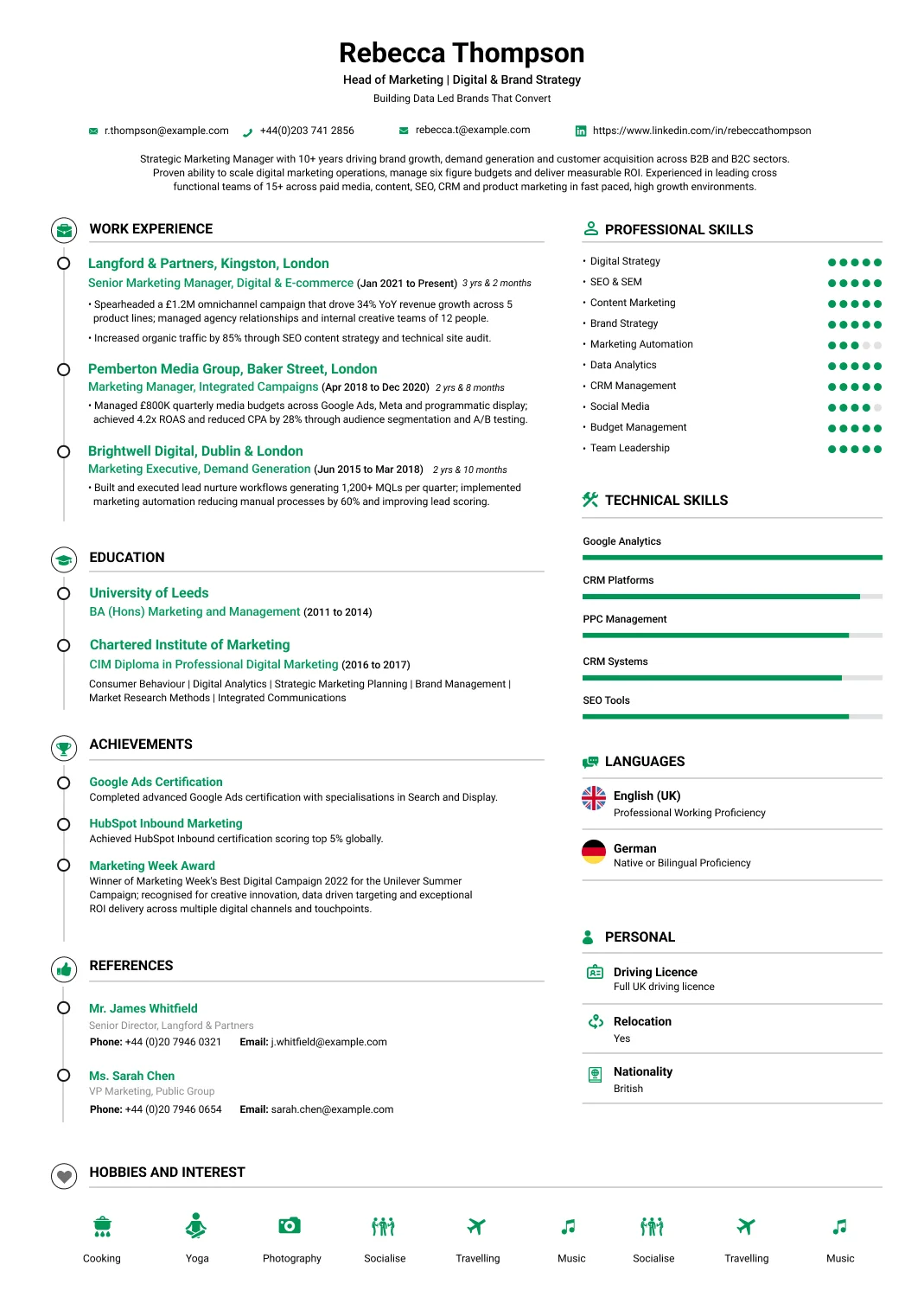
Amara Okafor
Nursing Assistant (Home Health)
deenal.com | 3364833947393
Summary
Nursing assistant with seven years providing home health care to elderly and recovering clients across their own homes in Birmingham. Brings hospital-standard personal care into people's living rooms — helping with daily living, monitoring health, supporting recovery and medication routines, and giving clients the dignity and independence of staying in their own homes. Helped clients recover safely after hospital discharge and supported several to remain at home rather than move into care. Provides personal and mobility care, monitors and reports on health, supports medication and recovery, and liaises with families and nurses. Caring, reliable and independent. Looking for a home-health or community nursing-assistant role with a provider that genuinely puts clients first.
PROFESSIONAL SUMMARY
Home Health Nursing Assistant
Birmingham Home Care Services, Birmingham, UK
Jan 2019 – Present
- Bring hospital-standard personal care into clients' own homes, giving them dignity and independence.
- Helped clients recover safely after hospital discharge and supported several to stay home rather than enter care.
- Provide personal and mobility care in the home, helping clients wash, dress and move safely and comfortably.
- Monitor health and report changes to nurses and families, catching problems early when no one else is there.
- Support medication routines and recovery plans, helping clients follow their care safely between nurse visits.
- Work independently and reliably across visits, often the one professional a housebound client sees each day.
Care Assistant
Midlands Community Care, Birmingham, UK
Aug 2017 – Dec 2018
- Provided personal care to clients in their homes and a day centre, learning community care hands-on.
- Helped with daily living and monitored wellbeing, building care skills and independence over time.
- Learned personal care, medication support and reporting on the job during this first role.
- Gained the certification and experience that led into a home-health nursing-assistant role of my own.
Qualification
Health & Social Care Diploma, Health & Social Care
Birmingham College
Sep 2016 – Jun 2017
- Diploma in health and social care covering personal care, safeguarding, health monitoring and community care, with a placement. The programme built the foundation safe, independent home health care requires.
Medication Support & First Aid Certificate, Care Safety
Care Training UK
Aug 2017 – Nov 2017
- Certification in medication support and first aid to a recognised standard. It built safe medication handling and emergency response in the home. It supported caring for clients safely without direct supervision.
Highlights
Safe recovery at home
- Helped clients recover safely at home after hospital discharge. Good home care after discharge prevents readmissions and complications, so supporting safe recovery at home genuinely changes how well clients heal.
Kept clients in their homes
- Supported several clients to stay in their own homes rather than move into residential care. Helping someone keep their independence and stay where they want to be is the deepest value home care can offer.
Certifications
Medication Support & First Aid Certificate
Care Training UK
Nov 2017 – Present
- Certification in medication support and first aid to a recognised standard, which built safe medication handling and emergency response in the home and supports caring for clients safely without direct supervision.
Recognition
Trusted in clients' homes
- Trusted by clients and families to provide care independently in the home, frequently requested by name and praised for the reliability, warmth and respect she brings into people's private lives every day.
Languages
- English (UK) — Full Professional Proficiency
- Igbo — Native or Bilingual Proficiency
Technical Skills
- Personal Care
- Mobility Support
- Health Monitoring
- Medication Support
- Post-Discharge Care
- Safeguarding
- Observation & Reporting
- Lone Working
- First Aid
- Family Liaison
Personal Skills
- Compassion
- Reliability
- Independence
- Patience
- Communication
Activities & Interests
- Grow Moustache
- Ice Hockey
- Watching Tv
- Gardening
- Motor Bike
Key Takeaways for a Nursing Assistant Resume
Certification currency and patient load are what nurse managers screen on:
- State your certification and registry status with dates, since an expired certification stops an application immediately.
- Name the setting you worked, because long-term care, acute and rehabilitation are genuinely different working environments.
- Give your patient load per shift alongside the acuity, as twelve residents and six acute patients are not comparable.
- Show the clinical tasks you performed including vitals, transfers, catheter care and specimen collection where applicable.
- Describe how you report changes in condition, since the nursing assistant is who notices a patient deteriorating first.
- Name the electronic health record you charted in, because system familiarity removes real orientation time on a unit.
Why This Nursing Assistant Resume Works
This sample belongs to a certified nursing assistant, and it is written around certification and load.
- Certification and registry status appear with dates, which is the first thing checked and the fastest reason for rejection.
- The setting is named specifically, since a long-term care assistant and an acute floor assistant work quite differently.
- Patient load and acuity are stated together, giving a nurse manager a direct comparison against their own unit.
- Clinical tasks are listed individually, which matters because scope of practice varies between settings and states.
- Reporting changes in condition appears, and that observation role is what nurses most rely on assistants to perform well.
- The electronic health record is named, which shortens orientation on a unit that is already short of staff right now.
How to Write a Nursing Assistant Resume
A nurse manager is filling a shift safely. Answer their three questions in the first six lines.
Lead with certification
Certification, state registry status, issue and expiry dates, plus CPR and any additional credentials. An expired certification or an unverifiable registry entry ends an application before anything else is read.
Name the setting and acuity
Long-term care, skilled nursing, acute medical or surgical, rehabilitation, memory care, home health. Each has different loads and different expectations, and managers hire against the unit they actually run.
Give the patient load
Patients or residents per shift, shift length, whether days or nights. Load is the clearest evidence of the pace you can sustain, and nurse managers compare it directly against their own staffing ratios.
List clinical tasks precisely
Vital signs, blood glucose, transfers and mechanical lifts, catheter and ostomy care, specimen collection, intake and output, wound observation. Scope varies by setting and state, so be specific about yours.
Show clinical observation
How you noticed and reported changes in condition, skin integrity, intake, behaviour or mental status. Assistants spend the most time with patients, so this observation role is what nurses depend on most heavily.
Name the systems and training
The electronic health record, safe patient handling training, dementia care training, restorative programmes. All of these reduce orientation time on a unit that is already working short of staff.
Certification status and patient load are what a nurse manager screens on first. You can build a free nursing assistant resume and keep your certification, setting and shift load easy to find.
What to Include in a Nursing Assistant Resume
Beyond the standard sections, a nurse manager screens specifically for these:
Certification and state registry status with issue and expiry dates, alongside current CPR certification.
Setting and acuity named specifically, covering long-term care, skilled nursing, acute, rehabilitation or memory care.
Patient load per shift with shift length and whether you worked days, evenings or nights on the unit.
Clinical tasks listed individually, from vital signs and blood glucose through transfers, catheter care and specimens.
Observation and reporting practice, covering how you escalated changes in condition to the nurse on duty.
Electronic health record named, plus safe patient handling, dementia care and any restorative training completed.
Extra tips
Write the expiry date next to your certification and your CPR card rather than only that you hold them.
Nurse managers need to know you can be scheduled now, and a credential without a date cannot answer that.
Nursing Assistant Resume Summary Examples
Two summaries at different stages, both leading with certification and load:
Entry-level resume summary example
Certified nursing assistant with a year in skilled nursing, holding current certification and an active state registry entry alongside current CPR. Cares for around twelve residents on a day shift, supporting activities of daily living including bathing, dressing, toileting and meals with attention to dignity throughout. Takes and records vital signs, monitors intake and output, and reports changes in condition to the nurse promptly rather than waiting for the end of a shift. Uses mechanical lifts and transfer belts according to safe handling training, and charts in PointClickCare. Available for evening and weekend shifts, and seeking a position in an acute or rehabilitation setting.
Senior-level resume summary example
Certified nursing assistant with seven years across skilled nursing, memory care and acute medical units, currently carrying eight to ten acute patients on a twelve hour shift. Performs vital signs, blood glucose monitoring, specimen collection, catheter care and intake and output recording within scope, and escalates changes in condition to the nurse early and specifically. Uses mechanical lifts and two person transfers correctly and has no handling injuries recorded across the period. Holds dementia care and restorative training, and precepts new assistants through their first weeks on the unit. Charts in Epic, and seeking a lead assistant or patient care technician position.
Nursing Assistant Work Experience Examples
Three sets covering the shape of the role, since direct care, clinical tasks and observation are judged separately.
Direct patient care
- Cared for eight to ten acute patients across twelve hour shifts, supporting activities of daily living including bathing, dressing, toileting and feeding while maintaining dignity through every single interaction.
- Performed transfers and repositioning using mechanical lifts and two person technique according to safe handling training, with no handling injuries to patients or to staff recorded across seven years.
- Repositioned patients on schedule and monitored skin integrity at every opportunity, since pressure injuries develop quietly and are far easier to prevent than they are to treat once they have formed.
- Supported patients with mobility, walking programmes and restorative exercises as directed, which maintains function that is very difficult to recover once it has been lost during an extended admission.
- Assisted with meals and monitored intake carefully for patients at nutritional risk, because poor intake in an older patient becomes a clinical problem considerably faster than families usually expect.
Clinical tasks and documentation
- Took and recorded vital signs across the full patient assignment each shift, flagging readings outside the expected parameters to the nurse immediately rather than simply entering them into the record.
- Performed blood glucose monitoring, specimen collection and catheter care within the scope permitted in the setting, following procedure exactly because shortcuts in these tasks create infection risk.
- Recorded intake and output accurately for patients on fluid monitoring, since these figures drive clinical decisions and an estimated entry is worse than no entry at all for the nurse relying on it.
- Charted care in the electronic health record promptly during the shift rather than reconstructing it at the end, which keeps the record accurate and available to whoever needs it during the shift.
- Followed infection control procedure including isolation precautions and hand hygiene consistently, which protects a patient population that is considerably more vulnerable than the general public.
Observation, escalation and team
- Reported changes in condition to the nurse early and specifically, describing what had changed rather than offering an impression, since assistants spend more time with patients than anybody else does.
- Noticed early signs of deterioration including confusion, reduced intake, skin changes and altered behaviour, which is the observation role nurses depend on most heavily from an experienced assistant.
- Communicated with families about routine care and comfort while directing clinical questions to the nurse, staying carefully within scope rather than answering something that was not mine to answer.
- Precepted new nursing assistants through their first weeks on the unit, covering procedure, documentation and the judgement about when something needs reporting rather than simply noting it down.
- Supported the unit during short staffing by taking additional assignments where it remained safe to do so, and by saying clearly when an assignment had stopped being safe rather than absorbing it quietly.
Top Nursing Assistant Skills
What nurse managers screen for, weighted toward safe load handling and clinical observation:
Hard skills
- Activities of Daily Living Support
- Vital Signs Measurement
- Blood Glucose Monitoring
- Safe Patient Transfers & Mechanical Lifts
- Repositioning & Pressure Injury Prevention
- Catheter Care
- Specimen Collection
- Intake & Output Recording
- Electronic Health Record Charting
- Infection Control & Isolation Precautions
- Feeding Assistance & Nutritional Monitoring
- Restorative & Mobility Programmes
- Dementia & Memory Care
- Wound Observation
- End of Life Comfort Care
- Change of Condition Reporting
Soft skills:
- Compassion
- Physical Stamina
- Observation
- Patience
- Clear Handover
- Dignity in Care
Certifications for a Nursing Assistant
Certification is a hiring prerequisite here rather than an advantage:
-
Certified Nursing Assistant
— Your state nurse aide registry Required for almost all clinical positions and verified against the state registry before hire. State your certification number, your registry status and the expiry date rather than only that you are certified.
-
Basic Life Support Certification
— American Heart Association Required in virtually every clinical setting and must be current. Keep the expiry date visible on the page, since an expired card is one of the most common reasons an otherwise strong application stalls.
-
Certified Medication Aide
— Your state licensing authority Available in many states and a meaningful step up in both scope and pay. It is the clearest single advancement available to an experienced assistant who wants to stay in direct bedside care.
-
Dementia Care Training
— Alzheimer's Association or an equivalent provider Directly valuable in long-term care and memory care settings, where a large share of residents are affected. It evidences that you have been trained in approach rather than relying only on instinct.
Nursing Assistant Salary
Pay varies with setting and shift, with acute hospitals generally above long-term care:
USD 33,000 – USD 52,000 · Nursing assistant · US
National median is around $42,260. Acute hospitals, night shifts and unionised settings pay above it, while some long-term care positions sit below.
USD 40,000 – USD 60,000 · Patient care technician or medication aide · US
Usual next steps, both adding clinical scope beyond the standard nursing assistant role.
Common Nursing Assistant Resume Mistakes
These cost interviews in a field where verification comes first:
- Omitting certification dates and registry status, which is verified before hire and is the fastest reason for rejection.
- Not naming the setting, since long-term care and acute floors have different loads, acuity and expectations entirely.
- Leaving out patient load, when it is the clearest evidence available that you can sustain the pace of their unit.
- Writing assisted patients without listing clinical tasks, which leaves scope of practice completely unclear to a reader.
- Never mentioning change of condition reporting, despite that observation role being what nurses rely on most heavily.
- Letting a CPR certification lapse on the page, which stalls an application that would otherwise have moved forward.
Nursing Assistant Resume FAQs
The questions nursing assistants most often search when applying, answered directly:
Certification and CPR first, then patient load and setting. Add vital signs, transfers and safe handling, catheter and specimen work, intake and output, charting system and change of condition reporting.
Yes, with the state and expiry date. Employers verify against the registry before hiring, so including it removes a verification step and demonstrates that your credential is current rather than assumed.
Patient load per shift, shift length, handling injuries avoided, pressure injury rates on your unit, and precepting new assistants. Facilities track most of these and will confirm them for a reference.
A patient care technician usually holds additional scope such as phlebotomy or electrocardiograms, most often in hospital settings. It is a common advancement step for an experienced nursing assistant.
Emphasise acuity, clinical tasks and observation rather than daily living support alone, and add BLS and any technician training. Hospitals screen for whether you can handle a faster changing patient picture.
Lead with certification, registry status and clinical placement hours, naming the settings and tasks performed. Then state your shift availability, since night and weekend cover is the hardest gap to fill.
Get Started With Our
Free Resume Creator today!
Free sign-up. No credit card required.