Was this sample helpful? Rate it!
Average: 4.6 (40 votes)




Contents
Chiropractor Resume: The Essentials
Why This Chiropractor Resume Works
How to Write a Chiropractor Resume That Gets Interviews
What to Include in a Chiropractor Resume
Chiropractor Resume Summary Examples
Chiropractor Work Experience Examples
Top Chiropractor Skills
Key Certifications & Licences for a Chiropractor
Common Chiropractor Resume Mistakes
Chiropractor Resume FAQs

Summary
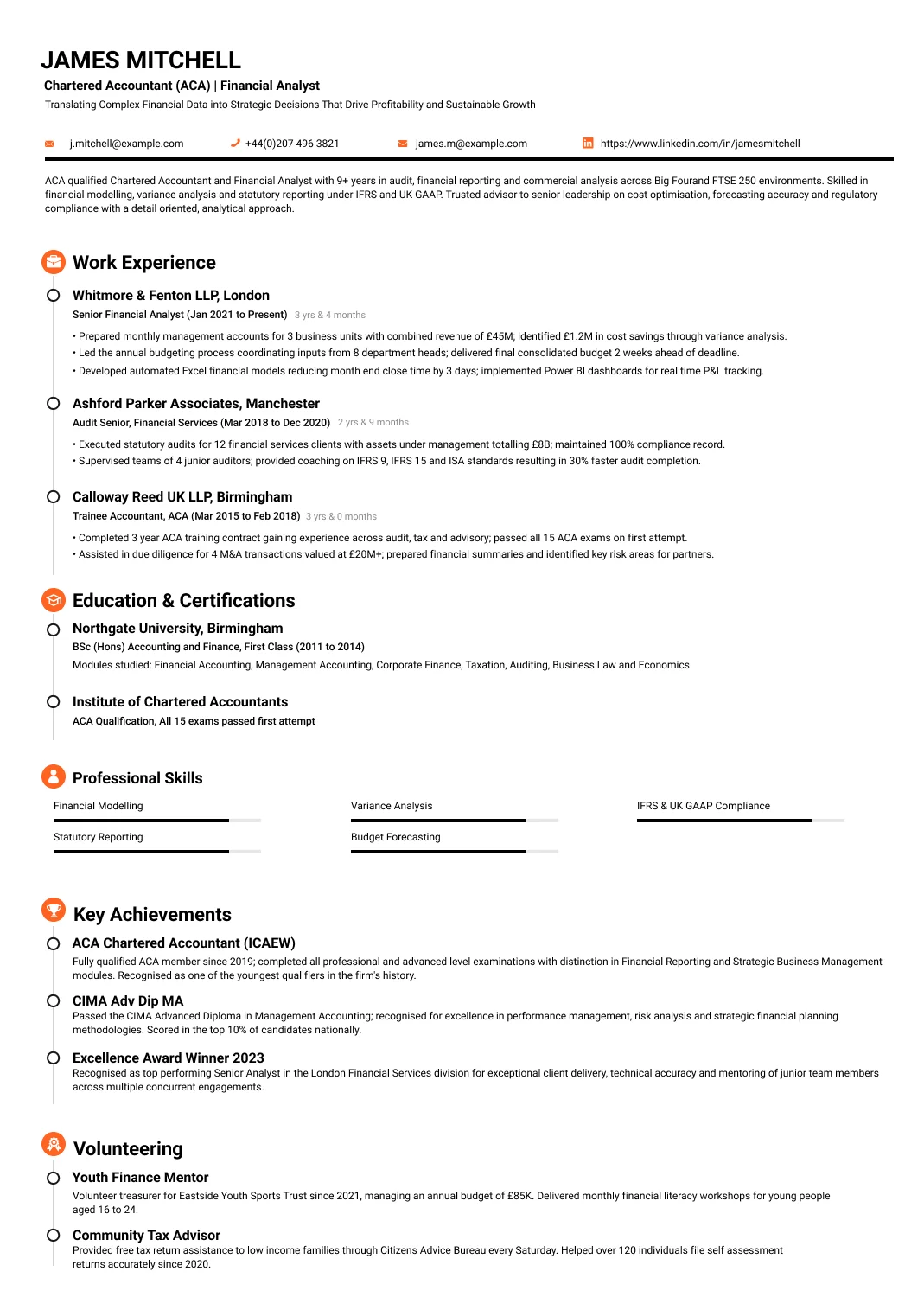
Registered chiropractor with ten years treating musculoskeletal pain and dysfunction in private practice in Bristol. Assesses, diagnoses and treats back, neck and joint problems through manual adjustment, soft-tissue work and rehabilitation, helping people move and live without pain. Built a busy practice through results and word of mouth, with a strong base of returning and referred patients. Takes detailed histories and examinations, builds tailored treatment and rehab plans, educates patients on posture and prevention, and refers on when needed. Strong on both the hands-on clinical skill and the communication that helps patients understand and stick with their care. Caring, evidence-led and genuinely invested in outcomes. Registered with the relevant council. Looking for a chiropractor role in a clinic or practice that puts patient outcomes first.
Professional Summary
Chiropractor
Bristol Spine & Joint Clinic, Bristol, UK
Apr 2015 – Present
- Assess, diagnose and treat the back, neck and joint pain with manual and rehab care.
- Built a busy practice through real results, word of mouth and a base of returning patients.
- Take all the detailed histories and the examinations and build tailored treatment plans for patients.
- Deliver all the manual adjustment, the soft-tissue work and the full rehabilitation exercises very carefully.
- Educate all the patients on the posture, prevention and the self-management at home between visits.
- Refer the patients on appropriately and always work within the scope and the clinical guidelines.
Associate Chiropractor
South West Health Clinic, Bristol, UK
Aug 2013 – Mar 2015
- Treated the musculoskeletal patients under an established and busy practice each day.
- Built up the clinical skills, the caseload and the patient-management experience there.
- Gained the rehabilitation and the sports-injury certification to broaden the clinical care.
- Then moved into a full chiropractor role with a growing patient base.
Chiropractic Intern
South West Health Clinic, Bristol, UK
Jun 2011 – Jul 2013
- Completed the clinical training and the internship treating the patients under supervision.
- Built the assessment, adjustment and the patient-care skills on real cases.
- Qualified and registered with the GCC to practise as a chiropractor.
- Then earned the move into a full associate-chiropractor role from there.
Qualification
Master of Chiropractic (MChiro), Chiropractic
AECC University College, Bournemouth
Sep 2009 – Jun 2013
- Integrated master's in chiropractic covering anatomy, diagnosis and manual technique, with clinical placements. The placements built real patient-treatment competence. Led to registration and clinical practice.
Certification in Rehabilitation & Sports Injury, Rehabilitation
Royal College of Chiropractors
Jan 2016 – Aug 2016
- Certification in rehabilitation and sports-injury management covering exercise, recovery and prevention. It deepened a specialist clinical area. Applied directly to rehab plans and sports-injury patients.
Certifications
GCC Registered Chiropractor
General Chiropractic Council
Aug 2013 – Present
- Registration with the General Chiropractic Council, the legal requirement to practise in the UK. It is maintained through ongoing professional development. Underpins all clinical practice in the role.
Diagnostic Imaging & Clinical Assessment
Royal College of Chiropractors
Apr 2019 – Present
- Certification in diagnostic imaging and musculoskeletal clinical assessment. It supports the accurate examination, diagnosis and safe treatment planning at the heart of the practice.
Highlights
Built a busy practice
- Built a busy practice through real results and word of mouth, with returning and referred patients. Patients who recommend you are the clearest proof that the care works.
Patients who stick with it
- Educates patients so they understand and stay with their treatment and prevention plan. Lasting recovery depends on patients being part of their own care.
Dry Needling & Sports Rehabilitation
Dry Needling & Sports Rehabilitation
Royal College of Chiropractors
Jan 2018 – Jun 2018
- Completed a dry-needling and sports-rehabilitation course covering advanced soft-tissue and recovery techniques. It widened the treatment options offered to patients and improved outcomes for sports and chronic musculoskeletal cases.
Pregnancy & Pediatric Chiropractic
ICPA
Mar 2021 – Present
- Course in pregnancy and pediatric chiropractic care covering gentle, age-appropriate techniques and safety. It widened the range of patients the practice could confidently treat and care for.
Languages
- English (UK) — Native or Bilingual Proficiency
- Spanish — Limited Working Proficiency
Technical Skills
- Musculoskeletal Assessment
- Diagnosis
- Manual Adjustment
- Soft-Tissue Therapy
- Rehabilitation
- Treatment Planning
- Sports Injury
- Patient Education
- Posture & Prevention
- Clinical Records
Personal Skills
- Empathy
- Communication
- Manual Dexterity
- Attention to Detail
- Patience
Activities & Interests
- Rugby
- Ice Skating
- Games
- Horror Movies
- Ghost Hunting
Chiropractor Resume: The Essentials
Before the detail, here is what actually decides whether a chiropractor resume earns an interview at a clinic or practice:
- Lead with your license and registration status-DC plus state board / NBCE in the US, or GCC registration in the UK-because no clinic reads further without it.
- Show patient volume and continuity: patients seen per day or week, retention, and the share of new patients arriving by referral or word of mouth.
- Name your technique systems explicitly (Diversified, Gonstead, Activator, drop-table, flexion-distraction) so a practice owner knows your hands match their patient base.
- Prove outcomes, not effort-pain reduction, return-to-activity, plan adherence and completed care plans, not 'treated patients daily'.
- Signal safe scope: documented histories and exams, imaging judgment, and a clear pattern of referring out when a case is outside chiropractic care.
- Add the specialties that widen who you can treat-sports injury and rehab, pregnancy and pediatric, dry needling-since they directly expand a practice's caseload.
Why This Chiropractor Resume Works
This sample is a UK-registered chiropractor with ten years in private practice who moved intern → associate → owner-operator. Here is what makes its structure land with a hiring practice:
- The summary leads with registration and a defined patient base (musculoskeletal pain in private practice), so a clinic confirms eligibility and fit in the first line instead of hunting for the license at the bottom.
- The work history traces a credible clinical arc-intern under supervision, then associate building caseload, then running a busy practice-which signals both clinical maturity and the ability to retain patients without spelling out years.
- It quantifies the right thing for this role: a practice grown through results, word of mouth and a returning-patient base, because referral and retention are the numbers a practice owner actually cares about.
- Credentials are layered rather than dumped-the MChiro and council registration sit alongside post-qualification certificates in rehab and sports injury, dry needling and pregnancy/pediatric care, each one widening the caseload the clinic can take on.
- It frames patient education and self-management as clinical work, not soft skill, which tells a recruiter the candidate produces adherence and lasting outcomes rather than one-off visits.
- Scope and safety are stated plainly-detailed histories, examinations and appropriate referral-so the resume reads as a clinician who works within guidelines, not a cavalier adjuster.
How to Write a Chiropractor Resume That Gets Interviews
A chiropractor resume is read by a practice owner or clinic director who needs proof of license, safe clinical judgment and the ability to keep a column of patients full. Build it in these moves:
Put license and registration in the first two lines
State your DC plus the states you are licensed in and your board status (NBCE Parts I-IV, Physiotherapy where applicable), or your GCC / CCA registration in the UK. A clinic legally cannot schedule you without it, so it belongs in the summary and a dedicated credentials block-never buried under hobbies.
Quantify caseload, retention and referral
Replace 'treated patients daily' with the numbers a practice runs on: new patients per week, total visits per day, plan-completion or retention rate, and the share of growth from referrals or word of mouth. For example, '24-30 patient visits per day with roughly 60% of new patients arriving by referral'.
Name your technique systems and modalities
List the adjusting systems you actually use-Diversified, Gonstead, Activator, Thompson drop, flexion-distraction-plus soft-tissue and rehab tools (instrument-assisted soft tissue, dry needling, e-stim, ultrasound, traction, corrective exercise). This lets an owner match your hands to their patient demographic before they call.
Show diagnostic and imaging judgment
Demonstrate that you take histories, perform orthopedic and neurological exams, order and interpret X-rays appropriately, and refer out for red flags. This is what separates a safe clinician from a technician, and it is what a malpractice-conscious practice screens for.
Frame patient education as outcome work
Describe how you build tailored care plans, coach posture, ergonomics and home exercise, and drive adherence between visits. Tie it to results-faster return to activity, fewer re-presentations-so education reads as clinical effectiveness, not bedside manner.
Layer specialties that expand the caseload
Group post-qualification training-sports injury and rehab, pregnancy and pediatric, dry needling, extremity adjusting-and tie each to the patients it lets you treat. A practice hires the clinician who broadens the column, not just the one who fills it. If you would rather not build the layout from scratch, you can start from a clinician-ready template and drop your own credentials and specialties into place.
What to Include in a Chiropractor Resume
A chiropractor resume needs a specific set of clinical and regulatory sections that a generic template will not prompt you to add:
Licensure and registration: DC license states and board status (NBCE) in the US, or GCC registration in the UK, with current standing.
Education: Doctor of Chiropractic (DC) or Master of Chiropractic (MChiro), institution and graduation year, with clinical placement hours.
Technique systems and modalities: the adjusting methods, soft-tissue and rehab tools you actually use day to day.
Clinical experience: caseload, patient volume, retention and referral, plus the settings (private practice, multidisciplinary clinic, sports, associate vs. owner).
Post-qualification certifications: sports rehab, dry needling, pregnancy/pediatric, diagnostic imaging-each one a caseload-widener.
Outcomes and practice growth: results that prove your care works and keeps patients coming back.
Continuing education / CPD status, since licensure depends on it and clinics check it.
Extra tips
Owners hire on collections, not just adjustments.
Note comfort documenting for insurance reimbursement and personal-injury lien cases, since that is what keeps a practice solvent.
Chiropractor Resume Summary Examples
Your summary should confirm license, define your patient base and prove outcomes inside the first few lines. These examples cover different stages and settings so you can borrow the angle that fits you, not the sample's wording:
Entry-level resume summary example
Newly licensed chiropractor (Doctor of Chiropractic) with NBCE Parts I-IV completed and 1,200+ supervised clinical hours across spine, extremity and sports-injury cases. Trained in Diversified, Activator and drop-table technique alongside soft-tissue and corrective-exercise rehabilitation, with hands-on experience taking histories, running orthopedic and neurological exams, and building tailored care plans under supervision. Comfortable ordering and reading plain-film X-rays and flagging red-flag presentations for referral. Eager to join an established practice where mentorship and a steady new-patient flow allow rapid growth into a full caseload, and committed to evidence-led, patient-education-first care that turns first visits into completed treatment plans.
Mid-level resume summary example
Licensed chiropractor with six years in multidisciplinary and private practice, carrying a column of 25-30 patient visits per day with a 70% plan-completion rate. Skilled across Diversified, Gonstead and flexion-distraction technique, instrument-assisted soft-tissue work, dry needling and progressive rehab programming for low-back, neck and sports-injury patients. Takes thorough histories and exams, interprets imaging, and coordinates care with physical therapists and primary-care physicians where cases call for it. Known for converting acute pain visits into adherent, outcome-focused care plans, and for steady new-patient growth driven by patient referral. Seeking an associate or lead role in a practice that measures success by patient outcomes and retention.
Senior-level resume summary example
Chiropractor and practice owner with twelve years treating musculoskeletal pain, having built a single-location clinic to 120+ active patients and three treating providers. Expert in spinal and extremity adjustment across Diversified, Gonstead and Activator systems, sports and pregnancy/pediatric care, and rehabilitation programming, with deep diagnostic and imaging judgment and a disciplined referral network. Has mentored associate chiropractors from first caseload to full columns and built referral relationships with GPs, sports clubs and physical therapists that supply a majority of new patients. Looking to bring clinical leadership and a proven, retention-driven model to a growing group practice focused on long-term patient outcomes.
Chiropractor Work Experience Examples
Each work-history bullet should pair a clinical action with the number that proves it worked-caseload, retention, referral or recovery. These labeled sets show the level of specificity to aim for across different settings and seniority:
Associate chiropractor (multidisciplinary clinic)
- Carried a daily column of 22-28 patient visits across low-back, neck and extremity cases, taking full histories and orthopedic-neurological exams and building tailored treatment plans for each new patient.
- Delivered Diversified, Activator and drop-table adjustments alongside instrument-assisted soft-tissue work and corrective exercise, lifting plan-completion from 58% to 71% over eighteen months.
- Coordinated shared care with on-site physiotherapists and referred out red-flag presentations to primary care, keeping the clinic within guideline scope and audit-clean across two compliance reviews.
- Grew a personal new-patient base from referral and word of mouth, contributing roughly 30% of the clinic's new bookings within the first year as an associate and steadily extending column hours to meet rising demand.
Owner-operator / lead chiropractor (private practice)
- Built and ran a private practice from a standing start to 110+ active patients, with around 60% of new patients arriving by patient referral rather than paid acquisition, sustaining a full daily column within two years.
- Designed and standardized care-plan protocols across acute and maintenance phases, raising six-week plan adherence to 74% and cutting early drop-off through structured patient education and home-exercise coaching.
- Introduced sports-injury and rehabilitation services after post-qualification certification, opening a new patient stream and widening the conditions the practice could confidently treat.
- Maintained full registration and CPD, supervised an associate from first caseload to a full column, and embedded a clear referral pathway with local GPs and physical therapists for out-of-scope cases.
Sports & rehabilitation focus
- Managed musculoskeletal and sports-injury caseloads for amateur and semi-pro athletes, combining manual adjustment, dry needling and progressive loading programs to return players to play safely.
- Cut average return-to-activity time for common low-back and hamstring presentations by structuring phased rehab and clear self-management between sessions, tracked against documented baseline assessments.
- Ran pitch-side and clinic-based assessments, ordering and interpreting imaging where indicated and escalating fractures and serious pathology to appropriate medical care without delay.
- Built referral relationships with two local sports clubs and a physiotherapy group that supplied a steady stream of new patients and roughly a third of the season's new bookings across the competitive period.
Top Chiropractor Skills
A chiropractor resume should pair the hands-on clinical skills a practice owner screens for with the human skills that drive patient adherence and retention:
Hard skills
- Spinal & extremity manipulation / adjustment
- Diagnosis & patient assessment
- Technique systems (Diversified, Gonstead, Activator)
- Soft-tissue & rehabilitation therapy
- X-ray ordering & interpretation
- Orthopedic & neurological examination
- Treatment planning & care plans
- Postural & gait analysis
- Modalities (ultrasound, e-stim, traction)
- Dry needling / instrument-assisted soft tissue
- Sports injury management
- Pregnancy & pediatric chiropractic
- Pain management & wellness care
- SOAP notes & EHR documentation
- Patient education & ergonomics
- Referral & scope-of-practice judgment
- Practice / clinic operations
- Continuing education / CPD compliance
Soft skills:
- Empathy
- Patient communication
- Manual dexterity
- Clinical attention to detail
- Patience
- Trust-building
- Time management
Key Certifications & Licences for a Chiropractor
A chiropractor's credentials split cleanly into what the law requires to practise and the optional specialty diplomates that widen your caseload. List required licensure first, then the elective certifications that let a practice treat more patient types.
-
DC State Licence
— State Chiropractic Licensing Board (directory via FCLB) Required. You must hold an active licence in each US state where you treat; the Federation of Chiropractic Licensing Boards maintains the board directory and CIN-BAD standing records.
-
NBCE Board Certification
— National Board of Chiropractic Examiners (NBCE) Required for licensure. Passing NBCE Parts I-IV (plus Physiotherapy where applicable) is the standard prerequisite state boards use to grant a DC licence.
-
DACBSP
— American Chiropractic Board of Sports Physicians (ACBSP) Optional specialty diplomate. The top-tier sports-chiropractic credential; signals advanced competence with athletic and musculoskeletal injury caseloads.
-
CCSP
— American Chiropractic Board of Sports Physicians (ACBSP) Optional. Post-graduate sports-injury certification (a step below DACBSP) that widens your caseload into athletic and rehab work.
-
Webster Technique Certification
— International Chiropractic Pediatric Association (ICPA) Optional. Recognised training in a sacral/pelvic technique used for pregnancy care; opens a prenatal and pediatric patient stream.
-
Graston Technique
— Graston Technique, LLC Optional. Certified instrument-assisted soft-tissue training that adds a documented modality for chronic and soft-tissue presentations.
Common Chiropractor Resume Mistakes
These are the errors that quietly sink chiropractor resumes-all specific to how clinics actually screen clinicians:
- Burying or omitting license and registration-DC state licenses and NBCE status, or GCC registration-so a clinic cannot confirm you are legally able to treat.
- Listing 'patient care' and 'treated patients' with no numbers: leaving out caseload, retention and referral gives an owner nothing to gauge whether you can keep a column full.
- Naming no technique systems, so a practice owner can't tell whether your hands suit their patient base.
- Treating patient education and adherence as a soft afterthought instead of the outcome driver that distinguishes chiropractic care.
- Ignoring scope and referral-no mention of imaging judgment or referring red flags reads as a safety risk to a malpractice-aware practice.
- Padding with unrelated hobbies and generic 'computer skills' while leaving out CPD status and caseload-widening certifications that actually matter.
Chiropractor Resume FAQs
The questions candidates most often search when writing a chiropractor resume, answered for the role: Licensure, technique systems and patient outcomes are easy to undersell when you write your own clinical resume. If the framing feels flat, a professional resume writing service can position your caseload and credentials for the practices you want.
In the US you list a Doctor of Chiropractic (DC), the states you are licensed in, and your National Board of Chiropractic Examiners (NBCE) status (Parts I-IV and Physiotherapy where applicable); in the UK you list General Chiropractic Council (GCC) registration. State or name the governing body and current standing high in the resume, since no clinic can schedule a clinician without it.
A chiropractor diagnoses and treats neuromusculoskeletal conditions primarily through spinal and joint adjustment and holds a DC or MChiro with adjusting privileges, while a physical therapist (DPT) focuses on rehabilitation, movement and exercise without performing manipulation as the core treatment. On a resume, make the distinction obvious by leading with adjustment/manipulation technique systems and your DC/MChiro credential so recruiters don't mistake your scope.
Lead with spinal and extremity adjustment, diagnosis and patient assessment, named technique systems (Diversified, Gonstead, Activator), soft-tissue and rehabilitation therapy, and X-ray interpretation. Then add treatment planning, modalities, SOAP/EHR documentation, patient education and referral judgment, plus soft skills like empathy and patient communication that drive adherence.
Yes. An associate resume should emphasize clinical breadth, technique range, caseload carried and ability to grow a personal patient base under an established practice, while an owner-operator resume should foreground practice growth, retention, referral networks, protocol-building and supervising other providers. Match the emphasis to the role you're applying for-associate, lead, or partner.
Name the specific adjusting systems you use-Diversified, Gonstead, Activator, Thompson drop, flexion-distraction-rather than writing 'manual adjustment' generically. List them in your skills section and reference them in experience bullets tied to the patient populations they suit, so a practice owner can match your hands to their caseload before interviewing.
Show the most recent 10-15 years of clinical experience, which is enough to demonstrate a credible arc from intern or associate to a full caseload or practice ownership. New graduates should foreground supervised clinical hours, board status and technique training instead of years, since early-career clinics expect to hire on potential and credentials.
Yes-continuing education (CPD) is tied to keeping your license active, so list current CPD status and any post-qualification certifications such as sports rehab, dry needling, or pregnancy and pediatric care. Each certification doubles as proof of compliance and a caseload-widener that lets a practice treat more patient types.
Get Started With Our
Free Resume Creator today!
Free sign-up. No credit card required.