
Was this sample helpful? Rate it!
Average: 4.9 (23 votes)


Contents
Salesforce Business Analyst Resume: The Essentials
Why This Salesforce Business Analyst Resume Works
How to Write a Salesforce Business Analyst Resume That Gets Interviews
What to Include in a Salesforce Business Analyst Resume
Salesforce Business Analyst Resume Summary Examples
Salesforce Business Analyst Work Experience Examples
Best Skills for a Salesforce Business Analyst Resume
Salesforce Business Analyst Certifications
Salesforce Business Analyst Salary
Common Salesforce Business Analyst Resume Mistakes
Salesforce Business Analyst Resume FAQs

Summary
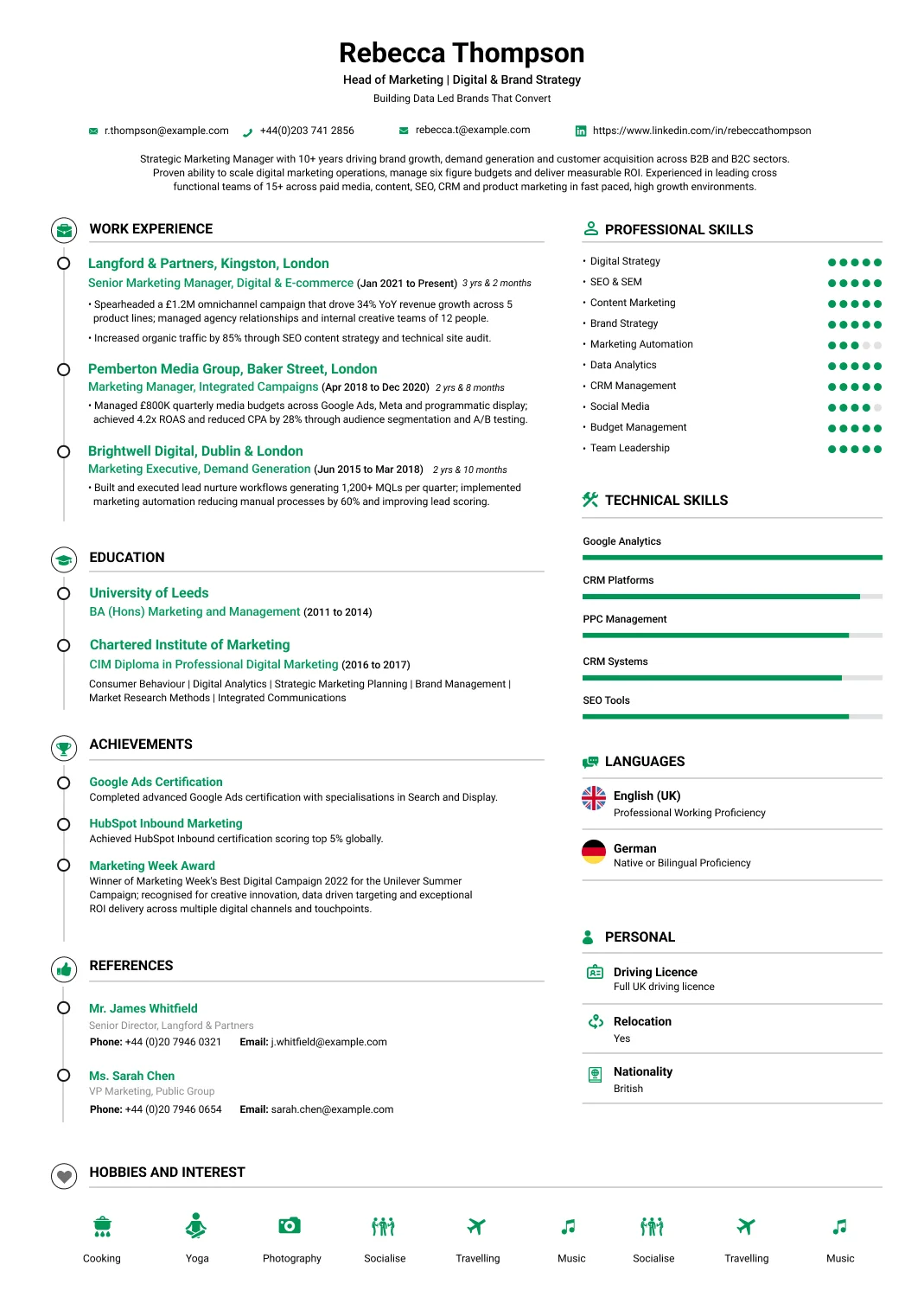
Salesforce business analyst with seven years bridging business teams and Salesforce delivery for companies in Berlin. Sits between what the business needs and what gets built — eliciting requirements, mapping processes, translating them into Salesforce solutions, and making sure what ships actually solves the problem and gets used. Led the requirements for a CRM rollout adopted across the sales org and redesigned a process that cut handling time sharply. Gathers and documents requirements, maps and improves processes, designs Salesforce solutions, supports testing and rollout, and trains users. Analytical, clear and business-minded. Looking for a Salesforce-BA role with a company that wants its CRM built around real business needs.
Work Experience
Salesforce Business Analyst
Berlin Technology Company, Berlin, Germany
Jan 2019 – Present
- Sit between what the business needs and what gets built, making sure the solution solves the real problem.
- Led the requirements for a CRM rollout adopted across the sales org and redesigned a process that cut handling time.
- Elicit and document requirements with business users, getting to the real need behind what they first ask for.
- Map and improve processes, redesigning how work flows before it is ever built into the Salesforce platform.
- Translate requirements into Salesforce solutions, working with admins and developers to build the right thing.
- Support testing, rollout and training, making sure what ships is correct, adopted and genuinely used.
Business Analyst (CRM)
Germany Software Services, Berlin, Germany
Jul 2017 – Dec 2018
- Supported CRM projects gathering requirements and mapping processes, learning Salesforce analysis hands-on each day.
- Wrote requirements and supported testing, steadily building BA and platform skills over the period.
- Learned requirements, process mapping and Salesforce on the job across more than a year.
- Gained the certification and experience that led into a full Salesforce-BA role of my own.
Education
BSc in Business Information Systems, Business Information Systems
Technical University of Berlin
Sep 2012 – Jun 2016
- Degree in business information systems covering process analysis, requirements, data and business applications, with a placement. The programme built the dual business-and-technical foundation a Salesforce analyst requires.
Salesforce Administrator & BA Certification, Salesforce
Salesforce
Jan 2017 – Jun 2017
- Salesforce administrator and business-analyst certification covering platform, requirements and configuration to a recognised standard. It sharpened the Salesforce-BA toolkit. It supported turning business needs into platform solutions.
Certifications
Salesforce Administrator & BA Certification
Salesforce
Jun 2017 – Present
- Salesforce administrator and business-analyst certification covering platform, requirements and configuration to a recognised standard, which sharpened the Salesforce-BA toolkit and supports turning business needs into platform solutions.
Recognition
A bridge both sides trust
- Trusted by business users to understand what they really need and by the delivery team to spec it clearly, valued for CRM solutions that get adopted and processes that genuinely work better.
Highlights
Led an adopted CRM rollout
- Led the requirements for a CRM rollout that the sales org actually adopted. Many rollouts fail on adoption, so getting one genuinely used reflects requirements built around how the business really works.
Cut process handling time
- Redesigned a process that cut handling time sharply. Improving the process before building it into Salesforce means the system speeds up real work rather than automating an inefficient way of doing things.
Languages
- German — Native or Bilingual Proficiency
- English (UK) — Full Professional Proficiency
Technical Skills
- Requirements Elicitation
- Process Mapping
- Salesforce Solution Design
- User Story Writing
- Process Improvement
- Testing & UAT
- Stakeholder Management
- Salesforce Configuration
- Training & Rollout
- Documentation
Personal Skills
- Analytical Thinking
- Clarity
- Business Acumen
- Communication
- Problem Solving
Activities & Interests
- Online Shop
- Ice Skating
- Baking
- Games
- Drinking
Salesforce Business Analyst Resume: The Essentials
Before the detail, here is what decides a strong Salesforce business analyst resume:
- Name the clouds. Sales Cloud, Service Cloud, Experience Cloud, CPQ and Marketing Cloud are different jobs, and a hiring manager filters on the one their org actually runs.
- Show the requirements artefacts you produce: user stories with acceptance criteria, process maps, data dictionaries, solution design documents. That is the evidence of a real BA rather than a project coordinator.
- Prove adoption, not delivery. Most CRM projects go live; far fewer get used. Login rates, record completeness and how many users still work in the old tool are the numbers that matter.
- Know the platform's shape. Objects, record types, flows, validation rules, permission sets and governor limits should appear naturally, because a BA who cannot judge feasibility sends every request back to the developers.
- Give the org some scale: users supported, records held, integrations in play, releases per quarter. A 60-user org and a 4,000-user multi-org estate are not comparable roles.
- Certifications gate the shortlist. Salesforce Administrator is close to mandatory and the Business Analyst credential is now the differentiator on this exact title.
Why This Salesforce Business Analyst Resume Works
This sample gets the balance right between business analysis and platform knowledge, which is the whole difficulty of the role. Here is what it does well:
- The summary defines the job as sitting between what the business needs and what gets built, which is exactly how hiring managers describe the vacancy to themselves.
- It leads with an adopted CRM rollout rather than a completed one. Naming adoption as the outcome shows the candidate understands where these projects usually fail.
- The process redesign appears before the build, which signals a BA who improves a workflow rather than automating an inefficient one into the platform.
- One bullet is about getting to the real need behind the first request, and that instinct is the difference between an analyst and an order taker.
- Testing, rollout and training are claimed as part of the role, so the candidate is visibly present after go-live instead of handing over at the requirements document.
- The Salesforce administrator and business analyst certifications back the platform claim, which matters because the title attracts many applicants whose Salesforce exposure is secondhand.
How to Write a Salesforce Business Analyst Resume That Gets Interviews
Hiring managers for this role are usually screening out two groups: generic BAs with no platform depth, and admins who have never run a requirements workshop. Prove you are neither:
How do you open a Salesforce BA summary?
State years, clouds and org scale in the first sentence: 'Salesforce business analyst with seven years across Sales Cloud and Service Cloud, supporting a 900-user org.' Then one outcome about adoption or process. A summary that says experienced business analyst with strong stakeholder skills could describe a BA in any system at all.
Which Salesforce detail proves you know the platform?
Use the vocabulary a solution conversation actually runs on: custom objects and record types, flows replacing legacy workflow rules, validation rules, permission sets, sharing model, sandbox strategy, data loads. Mentioning that you scoped a change against governor limits or a sharing rule tells a manager you can judge feasibility in the room.
How do you write requirements bullets that carry weight?
Name the artefact, the volume and what it enabled. '110 user stories with acceptance criteria across three releases' or 'process maps for a 14-step quote-to-cash flow reduced to nine steps' both land. Gathered requirements from stakeholders is the single most replaceable line on a BA resume.
How do you show a project actually succeeded?
Adoption metrics. Weekly active users as a share of licences, opportunity field completeness, cases logged in Salesforce rather than by email, or the spreadsheet that finally got retired. Delivery dates prove a project shipped; usage numbers prove it was worth shipping.
If you are rebuilding your resume around those numbers, a free online resume builder keeps the certifications, clouds and project bullets in a clean ATS-readable structure while you focus on the content.
How should you handle certifications and Trailhead?
Put Salesforce Administrator and Salesforce Business Analyst near the top with the year. Trailhead badges and Superbadges are worth a single line, not a list. Superbadges such as Business Process Automation carry more weight than a badge count, because they are assessed against a working org.
How do you tailor to the job advert?
Match the delivery model first. An in-house BA on a long-lived org needs backlog grooming, release management and change control; a consultancy BA needs discovery workshops, fit-gap analysis and multiple client rollouts a year. Rewrite your summary and top three bullets to whichever the advert describes.
What to Include in a Salesforce Business Analyst Resume
This title sits across two disciplines, so the resume has to satisfy two different readers, a delivery lead and a platform owner.
Make sure yours carries all of these:
The clouds and major features you have worked in: Sales Cloud, Service Cloud, Experience Cloud, CPQ, Field Service, Marketing Cloud.
Org scale for each role: licensed users, record volume, number of orgs, and integrated systems such as ERP, marketing automation or telephony.
The requirements artefacts you personally produce, from discovery notes and process maps to user stories, acceptance criteria and solution design documents.
Delivery method and tooling: Scrum or Kanban, sprint length, Jira or Azure DevOps, and how releases move through sandboxes.
Testing involvement: writing test scripts, running UAT, coordinating business testers, and triaging defects before go-live.
Adoption and training work, including materials produced, sessions run, and the usage numbers afterwards.
Salesforce certifications with dates, plus any BA credential such as ECBA or CBAP.
Data work, which quietly dominates these projects: field mapping, deduplication rules, migration validation and data quality reporting.
Extra tips
Add a one-line org profile under each role: licences, clouds, integrations, release cadence.
It answers the first question every Salesforce hiring manager asks and saves a screening call.
Salesforce Business Analyst Resume Summary Examples
A hiring manager decides in the first three lines whether you are a platform BA or a general one. These three examples cover the routes into the role that come up most often:
Entry-level resume summary example
Salesforce business analyst with two years supporting Sales Cloud delivery for a 240-user manufacturing org, having moved across from a sales operations role where the CRM data was already a daily responsibility. Holds Salesforce Certified Administrator and Salesforce Certified Business Analyst, plus the Business Process Automation superbadge. Wrote 60 user stories with acceptance criteria across four sprints, mapped the existing lead handover process across three teams, and cut duplicate account creation by 44% by specifying matching rules with the admin team. Runs UAT sessions with business testers, logs and retests defects, and writes the quick reference guides sales managers actually open. Comfortable in Jira, Lucidchart and Salesforce reports and dashboards. Looking for a Salesforce business analyst role in a growing in-house team.
Mid-level resume summary example
Salesforce business analyst with six years across Sales Cloud and Service Cloud in a 900-user financial services org spanning two production instances and an integrated ERP. Runs discovery workshops with sales, service and operations, converts findings into process maps and user stories, and works alongside two admins and a developer through a two-week release cycle. Led requirements for a case management redesign that moved 78% of inbound customer contact out of shared mailboxes and into Salesforce within one quarter, cutting average first response time from eleven hours to under three. Owns the backlog, chairs the change advisory call, and writes the UAT scripts business testers execute before every release. Certified Administrator, Business Analyst and Platform App Builder. Seeking a lead BA role on a complex multi-cloud org.
Senior-level resume summary example
Lead Salesforce business analyst with eleven years across consultancy and in-house delivery, covering Sales Cloud, Service Cloud, CPQ and Experience Cloud implementations for organisations from 150 to 4,000 users. Has taken nine full implementations from discovery through fit-gap analysis, solution design and hypercare, including a CPQ rollout that reduced quote turnaround from four days to seven hours across a distributed sales team of 320. Mentors three analysts, sets the requirements standards the practice works to, and is usually the person brought in when a stalled programme needs its scope re-cut. Fluent in governor limits, sharing model design and sandbox strategy, so feasibility gets judged in the workshop rather than two sprints later. Looking for a principal BA or product owner role on an enterprise Salesforce estate.
Salesforce Business Analyst Work Experience Examples
Every bullet should name a platform object, a process or an adoption number, otherwise it could belong to a business analyst in any system. These three sets cover the common specialisations:
Sales Cloud implementation BA
- Led requirements for a Sales Cloud rollout across 340 sellers in six countries, running fourteen discovery workshops and producing 110 user stories with acceptance criteria across three release waves.
- Mapped a 14-step quote-to-cash process down to nine before any configuration began, removing two approval stages and a manual spreadsheet handover that had been adding three days to every deal.
- Specified matching and duplicate rules with the admin team after a data audit found 8,400 overlapping account records, cutting duplicate creation by 44% within the first two months after go-live.
- Ran UAT with 28 business testers across two sandboxes, triaging 96 defects and getting all severity one and two issues closed before the go-live gate without slipping the published launch date.
- Drove adoption after launch to 91% weekly active users within one quarter by pairing role-specific training with a report that showed each sales manager their own team's pipeline data quality.
Service Cloud / support transformation BA
- Redesigned case management for a 120-agent support centre, defining record types, queues, assignment rules and escalation paths that moved 78% of inbound contact out of shared mailboxes into Salesforce.
- Cut average first response time from eleven hours to under three by specifying an omni-channel routing model and the case priority matrix that decided which queue each channel fed into.
- Built the requirements for a self-service knowledge base in Experience Cloud, deflecting 22% of tier-one case volume within six months and freeing agents for the escalations that needed them.
- Wrote the CSAT and case-ageing dashboards service leads now review weekly, replacing a monthly spreadsheet that had been compiled by hand from three separate system exports each cycle.
- Coordinated a Service Cloud release every two weeks with two admins and a developer, grooming the backlog and running change advisory sign-off so no production deployment was rolled back in eighteen months.
Consultancy / multi-client Salesforce BA
- Delivered discovery and fit-gap analysis for nine client implementations across manufacturing, insurance and professional services, each spanning between 150 and 4,000 licensed Salesforce users.
- Reduced quote turnaround from four days to seven hours on a CPQ rollout for a 320-person sales team by reworking the product bundling rules and approval matrix during the design phase.
- Rescued a stalled programme by re-cutting scope into three releases after a workshop with the client executive sponsor, restoring a delivery date that had already slipped twice in five months.
- Judged feasibility live in client workshops against governor limits, sharing model and licence constraints, which removed the design rework that had previously surfaced two sprints into build.
- Mentored three junior analysts and wrote the requirements templates now used across the practice, covering user story format, acceptance criteria and the solution design document structure.
Best Skills for a Salesforce Business Analyst Resume
The strongest resumes on this title show analysis skills and platform skills side by side, because a manager is checking that you can do both:
Hard skills
- Requirements elicitation and workshops
- User story writing and acceptance criteria
- Business process mapping (BPMN)
- Fit-gap analysis
- Salesforce Sales Cloud
- Salesforce Service Cloud
- Salesforce Experience Cloud
- Salesforce CPQ
- Declarative configuration (objects, fields, record types)
- Flow and process automation design
- Validation rules and sharing model
- Reports, dashboards and Einstein analytics
- Data migration and field mapping
- Data quality and deduplication rules
- UAT planning and test script writing
- Defect triage and release management
- Sandbox and deployment strategy
- Jira and Azure DevOps backlog management
- Agile and Scrum delivery
- Change management, training and adoption
Soft skills:
- Asking the second question
- Stakeholder facilitation
- Written clarity
- Negotiating scope
- Commercial judgement
- Patience with ambiguity
Salesforce Business Analyst Certifications
Salesforce credentials are checkable on the public verification page, which is why recruiters on this title lean on them so heavily:
-
Salesforce Certified Administrator
— Salesforce Close to mandatory for this role. It proves you understand the configuration options before you write a requirement that cannot be built.
-
Salesforce Certified Business Analyst
— Salesforce The credential aimed squarely at this job title, covering discovery, process mapping, user stories and stakeholder engagement on the platform.
-
Salesforce Certified Platform App Builder
— Salesforce Optional but valuable. It shows you can judge declarative feasibility, which is what turns a BA into a partner for the build team.
-
Salesforce Certified Sales Cloud Consultant
— Salesforce Worth taking if you work implementation projects, since it covers the design decisions that come up repeatedly in sales process discovery.
-
ECBA
— IIBA Platform-neutral BA foundation. Useful early on to show your analysis technique is grounded in something beyond Salesforce.
-
CBAP
— IIBA Senior credential requiring several thousand hours of documented BA work. It carries most weight in large enterprises and regulated sectors.
Salesforce Business Analyst Salary
US federal wage data has no Salesforce business analyst category, so the fair reference is the median for the two occupations this job is classified under:
USD 99,410 – USD 103,790 · mid · US
Median annual wages in May 2023: 99,410 for management analysts and 103,790 for computer systems analysts. These are midpoints, not a full range, so individual pay sits well above and below depending on certifications, cloud specialism and sector.
Common Salesforce Business Analyst Resume Mistakes
Most rejections on this title come from a resume that could have been written by a business analyst who has never opened a Salesforce org:
- Writing platform-free bullets such as gathered requirements from stakeholders, which read identically for a BA working in SAP, Workday or a spreadsheet.
- Never naming the clouds, so a manager hiring for Service Cloud cannot tell whether your experience is anywhere near their org.
- Listing Salesforce as a skill with no configuration vocabulary behind it, no objects, flows, permission sets or sharing model, which reads as exposure rather than depth.
- Reporting go-live dates instead of adoption, when every experienced hiring manager knows a shipped CRM project and a used one are different things.
- Leaving out org scale, so nobody can tell whether you supported 60 users on one instance or 4,000 across a multi-org estate.
- Padding with a long Trailhead badge list while omitting the certifications and superbadges that are actually assessed.
- Claiming admin work without saying whether you built it or specified it, which unravels quickly in a technical interview.
- Ignoring data entirely, when field mapping, deduplication and migration validation are where most of the real BA hours on these projects go.
Salesforce Business Analyst Resume FAQs
The questions candidates search most often when moving into or up within this role:
The clouds you have worked in, org scale in licensed users, the requirements artefacts you produce, and adoption results after go-live. Add your Salesforce certifications with dates near the top, since recruiters can verify them and often screen on them first.
Pair analysis skills with platform skills: requirements elicitation, user story writing and process mapping alongside declarative configuration, flows, reports and dashboards, and UAT. A list weighted entirely to one side is the most common reason these resumes get filtered out.
Not legally, but practically yes. Salesforce Certified Administrator is the expected baseline and the Salesforce Certified Business Analyst credential is the one written for this exact job. Without either, you are competing against applicants a recruiter can verify in seconds.
Name the object or feature and the business outcome together: 'Defined case record types, queues and assignment rules that moved 78% of inbound contact into Salesforce.' Vague lines about working on Salesforce projects give a hiring manager nothing to evaluate.
Two to three years is the usual floor for a standalone BA role, and five or more for lead positions on multi-cloud orgs. Sales operations, support and admin backgrounds convert well, because the process knowledge transfers and the certifications close the platform gap.
Yes. An admin resume proves what you built and maintain; a BA resume proves what you specified and why. If yours is mostly configuration tasks, rewrite the bullets around the requirement, the process decision and the adoption result instead.
Two pages once you have three or more years and several implementations, one page before that. Consultancy BAs should group smaller client engagements under a single practice heading rather than listing every project separately.
Get Started With Our
Free Resume Creator today!
Free sign-up. No credit card required.