
Was this sample helpful? Rate it!
Average: 4.7 (23 votes)




Contents
What Matters Most
Why This RF Engineer Resume Works
How to Write an RF Engineer Resume That Gets Interviews
What to Include in an RF Engineer Resume
RF Engineer Resume Summary Examples
RF Engineer Work Experience Examples
Top RF Engineer Skills
Certifications for an RF Engineer
Common RF Engineer Resume Mistakes
RF Engineer Resume FAQs

Summary
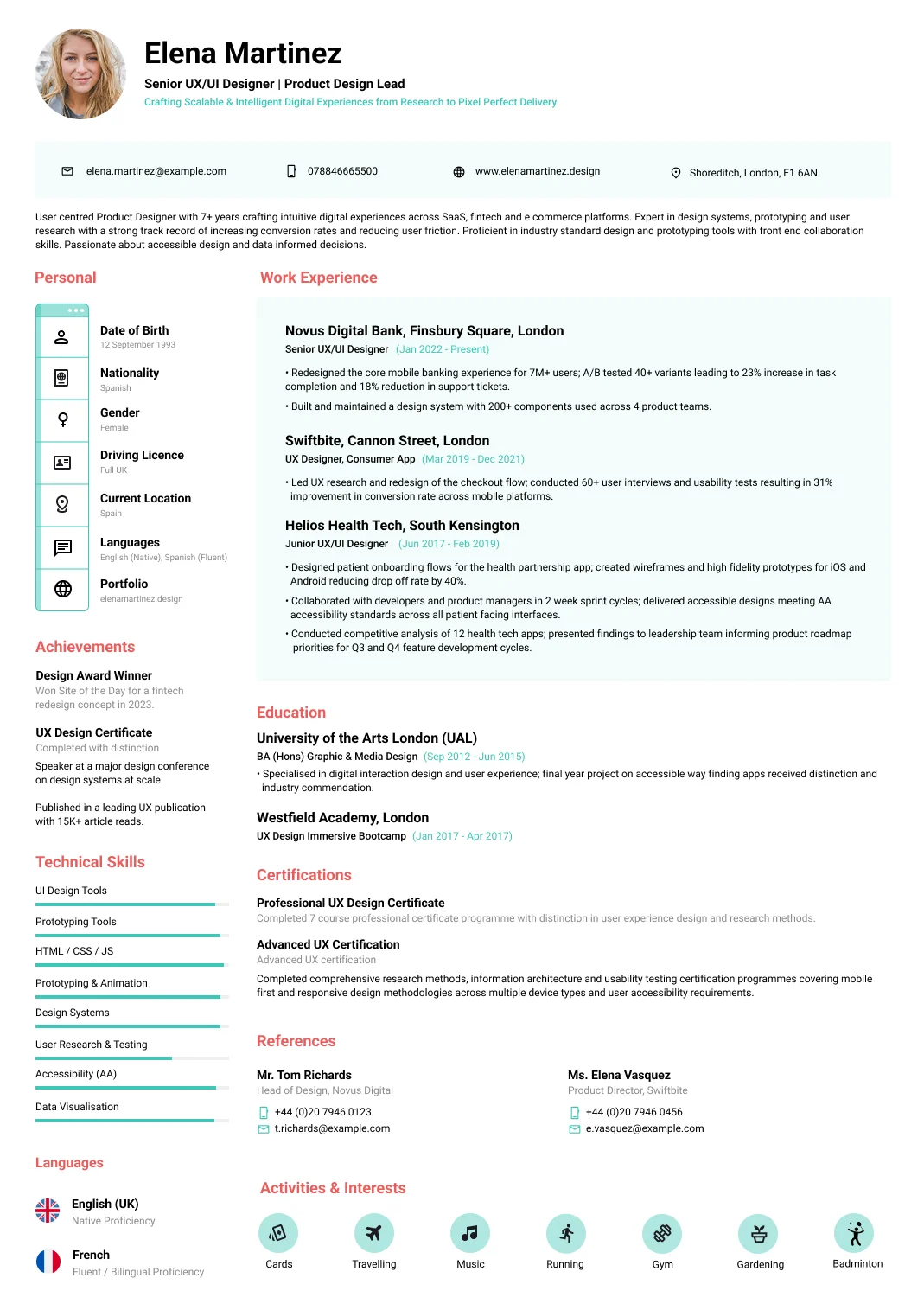
RF engineer with eight years planning, optimising and troubleshooting mobile networks for operators and vendors in the UK. Designs cell layouts, tunes RF parameters, and analyses drive-test and performance data to squeeze the best coverage and capacity from the network. Led the RF optimisation on a 4G/5G rollout that lifted key performance indicators and cut dropped-call rates across the cluster. Handles antenna planning, interference analysis and the move toward 5G NR, working closely with planning and field teams. Strong on the maths and the tools, and methodical chasing down a tricky coverage or interference problem. Looking for an RF or network-optimisation engineering role with an operator or vendor pushing network performance.
Work Experience
RF Engineer
Britcom Network Services, Birmingham, UK
Apr 2017 – Present
- Plan cell layouts and tune RF parameters to optimise coverage and capacity across the network clusters.
- Led RF optimisation on a 4G/5G rollout that lifted KPIs and cut dropped-call rates across the cluster.
- Analyse drive-test and performance data to find and fix coverage, capacity and interference issues quickly.
- Handle antenna planning, tilt and azimuth changes and interference analysis on the live networks.
- Work closely with the planning and field teams through deployment, integration and final acceptance.
- Support the network's migration toward 5G NR with new-site planning and careful parameter tuning.
Network Optimisation Engineer (Junior)
Midlands Telecom Engineering, Birmingham, UK
Aug 2015 – Mar 2017
- Supported RF optimisation with drive testing, data analysis and parameter changes.
- Learned planning tools, KPI analysis and interference troubleshooting on the job.
- Assisted on site integration and acceptance for new cells across the network.
- Ran drive tests and processed the data that guided optimisation decisions.
- Gained an RF planning certification and progressed to a full RF-engineer role.
Drive-Test Technician
Midlands Telecom, Birmingham, UK
Jun 2013 – Jul 2015
- Carried out RF drive testing and collected network-performance data across regions.
- Logged coverage, interference and dropped-call data for the RF optimisation team.
- Learned the RF basics, test equipment and network KPIs on the job.
- Built the grounding that led into a full network-optimisation role.
Education
BEng (Hons) Electronic & Communications Engineering, Communications Engineering
University of Birmingham
Sep 2011 – Jun 2015
- Engineering degree covering RF, communications systems and signal processing, with a placement year. The placement led into mobile-network engineering. Built the technical foundation behind RF work.
Certification in RF Planning & Optimisation (5G NR), RF Engineering
Mobile Networks Training Institute
Jan 2018 – Jun 2018
- Certification in RF planning, optimisation and 5G NR fundamentals. It deepened the optimisation and 5G skills central to the role. Applied directly to the network rollout work.
Highlights
Lifted network KPIs
- Led RF optimisation on a 4G/5G rollout that improved key performance indicators and cut dropped-call rates across the cluster. Better RF tuning translated directly into a network customers could feel.
Solved tough RF problems
- Tracked down stubborn coverage and interference issues through careful drive-test and data analysis. Methodical RF troubleshooting is what keeps a live network performing.
Certifications
RF Planning & Optimisation (5G NR)
Mobile Networks Training Institute
Jun 2018 – Present
- Certification in RF planning, optimisation and 5G NR fundamentals. It deepened the optimisation and 5G skills central to the role. Applied directly to the network rollout work.
Antenna Systems & Drive-Test Tools
Mobile Networks Training Institute
Apr 2019 – Present
- Certification in antenna systems, drive-test tools and RF measurement for mobile networks. It supports the planning, tuning and interference analysis carried out on live 4G and 5G networks.
Key Projects
Metro 5G NR Rollout
Jan 2020 – Jun 2021
- Planned and optimised the RF for a metro-wide 5G NR rollout, dimensioning sites, tuning parameters and drive-testing the cluster to acceptance against the KPI targets.
In-Building DAS Deployment
Jan 2022 – Aug 2022
- Designed and commissioned a distributed-antenna system for a large venue, modelling coverage and balancing the cells so capacity held up under full crowd load.
Languages
- English (UK) — Native or Bilingual Proficiency
- Spanish — Limited Working Proficiency
Technical Skills
- RF Planning
- Network Optimisation
- Drive-Test Analysis
- Antenna Planning
- Interference Analysis
- 4G / 5G NR
- KPI Analysis
- Planning Tools (Atoll)
- Site Integration
- Parameter Tuning
Personal Skills
- Analytical Thinking
- Problem Solving
- Attention to Detail
- Communication
- Reliability
Activities & Interests
- Galleries
- Friends
- Meet People
- Shooting
- Online Shop
What Matters Most
Before the detail, here is what actually decides a strong RF engineer resume:
- Lead with the radio access technologies and layers you own - GSM, UMTS, LTE, 5G NR - and the cluster or region size, so a recruiter places your RF scope in the first line.
- Quantify the optimisation win with the metrics operators track: dropped-call rate, RRC and E-RAB drop, handover success, accessibility, retainability and PRB utilisation, before and after.
- Name the tools by product, not category: Atoll or Planet for planning, TEMS Investigation or Nemo for drive test, and Actix, MapInfo or OSS counters for post-processing.
- Show the full optimisation loop - dimensioning, physical and logical parameter planning, site integration, drive test, then tuning to KPI acceptance - not a list of disconnected tasks.
- Signal current 5G NR fluency: beamforming, SSB, massive MIMO, and sub-6 GHz versus mmWave trade-offs, because that is what operators and vendors are hiring for right now.
- Put credentials near the top - iNARTE Certified RF Engineer, chartered CEng status, and vendor RF certifications gate many operator and vendor roles.
Why This RF Engineer Resume Works
This sample is a mid-level UK operator-and-vendor RF engineer with eight years across drive test, optimisation and 5G planning. Here is what its choices get right:
- The summary opens with the three verbs that define the job - planning, optimising, troubleshooting - then names operators and vendors, so a recruiter reads the RF scope before any soft skills.
- It quantifies the outcome operators actually care about - lifted KPIs and a lower dropped-call rate across a cluster - instead of listing duties, which is what separates an RF CV from a generic telecoms one.
- The three roles trace a clean radio-career arc: drive-test technician, then junior optimisation, then RF engineer - showing a hiring manager the candidate learned the layer from the ground up.
- Tools are named specifically, with Atoll for planning, and the projects prove both worlds - a metro-wide 5G NR rollout for macro coverage and an in-building DAS for indoor capacity under crowd load.
- Antenna work is concrete: tilt, azimuth and interference analysis on live networks, signalling the candidate can touch the physical layer, not just read counters and reports.
How to Write an RF Engineer Resume That Gets Interviews
An RF engineer resume is read by an RF lead or resourcing manager who is scanning for radio scope, tool depth and a measurable KPI story. Build it around these moves:
Lead with your RATs, layers and cluster scope
State the radio access technologies and bands you work - LTE, 5G NR sub-6 and mmWave, legacy GSM/UMTS - plus whether you cover macro, small-cell or in-building, and the cluster or city size. A line like 'LTE and 5G NR optimisation across a 400-site metro cluster' places your scope instantly. If you are starting the resume from scratch, you can build it on a proven layout and drop your own RF scope in with the free RealtimeCV resume builder.
Quantify the KPI you actually moved
Recruiters screen RF engineers on results, so lead each optimisation bullet with the counter that changed: dropped-call or drop-call rate, RRC setup success, E-RAB retainability, handover success rate, accessibility, or PRB utilisation. 'Cut cluster CDR from 1.8% to 0.6%' or 'raised HOSR to 99.4% across 60 cells' beats 'improved network performance' every time.
Name the planning and drive-test tools
List the actual products, because ATS filters and RF leads search for them: Atoll, Planet or Asset for planning and prediction; TEMS Investigation, Nemo Outdoor or XCAL for drive test; Actix, Nemo Analyze, MapInfo and vendor OSS counters for post-processing. Add scripting - Python or MATLAB for KPI automation - if you have it; it is increasingly a differentiator.
Show the optimisation loop end to end
Prove you own the full cycle, not one slice: dimensioning and link budget, physical planning (site, sector, antenna, tilt, azimuth), logical parameter planning (neighbours, PCI/PRACH, power), integration, drive test, then iterative tuning to KPI acceptance. Showing you take a cluster from plan to signed-off acceptance is what reads as a complete RF engineer.
Foreground your 5G NR skills
Operators are staffing NR programmes, so surface the modern skills explicitly: beam management and SSB, massive MIMO and beamforming, sub-6 GHz versus mmWave propagation, NSA versus SA architecture, and TDD frame configuration. Even one delivered NR cluster or DAS makes the resume far more competitive than an LTE-only profile.
Put certifications and chartered status near the top
RF is a credential-aware field, so place iNARTE Certified RF Engineer, chartered CEng registration, and any vendor RF certification (Nokia, Ericsson) high on the page. If a role lists a security clearance or a specific vendor OSS, mirror that wording so the resume clears the first screen.
What to Include in an RF Engineer Resume
Beyond the standard experience and education blocks, an RF engineer resume earns its interviews on a few role-specific sections a hiring manager looks for:
A split technical-skills block that separates planning and prediction tools from drive-test and post-processing tools, so an RF lead can scan tool depth in seconds.
A projects section naming real deliveries - a 5G NR cluster, an in-building DAS, a swap or refarm programme - with the KPI targets you drove them to.
A certifications and professional-registration line (iNARTE, CEng, vendor RF certs) placed high, since these gate many operator and vendor roles.
Radio-domain specifics: bands and RATs owned, macro versus small-cell versus DAS, and the vendor RAN you worked (Nokia, Ericsson, Huawei, Samsung).
A measurable KPI narrative in the experience bullets - the before-and-after counters - rather than a generic 'optimised the network' summary.
Extra tips
Drive-test roles put you behind the wheel of the test vehicle, so a full clean licence is a real filter.
Leaving it off quietly loses field-based RF jobs before the technical screen.
RF Engineer Resume Summary Examples
Your summary should state your RATs, your tools and one quantified optimisation win in the first three lines. These examples show how that reads at different levels and specialisms:
Whichever level fits you, the summary has to land your RATs, your tools and one quantified KPI win inside the first three lines. If a blank page is slowing that down, you can draft yours on a proven RF layout and drop your cluster size and drive-test tools straight in.
Entry-level resume summary example
Graduate RF engineer with a BEng in Communications Engineering and eighteen months of drive-test and optimisation support across an LTE metro cluster. Runs TEMS Investigation and Nemo Outdoor drive tests, processes logs in Actix and MapInfo, and prepares KPI reports on accessibility, retainability and handover success for the optimisation team. Contributed parameter-change recommendations that helped cut cluster dropped-call rate from 2.1% to 1.3% over two tuning cycles. Comfortable with Atoll predictions, neighbour and PCI planning basics, and RF fundamentals including link budget and antenna tilt. Looking to grow into a full RF optimisation role with an operator or vendor delivering LTE and 5G NR.
Senior-level resume summary example
Senior RF engineer with twelve years planning and optimising GSM, UMTS, LTE and 5G NR networks for tier-one operators and RAN vendors across the UK and Middle East. Owns clusters end to end - dimensioning, link budget, physical and logical parameter planning, integration, drive test and acceptance - and mentors junior optimisation engineers. Led the RF optimisation of a 600-site 5G NR sub-6 rollout that reached 99.5% accessibility and lifted average cell throughput by 34% against the KPI baseline. Deep with Atoll, Planet, TEMS, Nemo Analyze and vendor OSS counters, and automates KPI post-processing in Python. Seeking a lead RF or network-optimisation role driving large NR and small-cell programmes.
Specialist-level resume summary example
RF engineer specialising in in-building and DAS coverage design with nine years across large venues, transport hubs and enterprise campuses. Models indoor propagation in iBwave, dimensions passive and active DAS, and balances sectors so capacity holds under full crowd load on LTE and 5G NR. Designed and commissioned a stadium DAS serving 40,000 users that sustained sub-1% dropped-call rate at peak and passed acceptance drive testing on the first pass. Fluent in link budget, MIMO planning, interference analysis and multi-operator neutral-host design, and works closely with structural and fit-out teams through survey, install and commissioning. Targeting a senior in-building RF design role with an integrator or neutral-host operator.
RF Engineer Work Experience Examples
Strong RF bullets pair the radio action with the counter it moved. These labeled sets show how that reads across different RF engineer specialisms - write yours the same way, verb first and quantified:
Senior RF optimisation engineer
- Owned RF optimisation for a 420-cell LTE cluster end to end, driving accessibility from 98.1% to 99.6% and cutting the dropped-call rate from 1.7% to 0.5% across two structured tuning and drive-test cycles.
- Resolved a persistent overshooting and interference problem on 18 sites by re-planning tilt, azimuth and PCI, lifting handover success rate to 99.3% and clearing the top ten worst-cell list within one month.
- Automated daily KPI post-processing in Python across 400 cells, cutting the reporting effort from four hours to twenty minutes and surfacing degrading sectors a full day earlier for the optimisation team.
- Mentored three junior optimisation engineers on Atoll prediction, neighbour planning and TEMS drive-test analysis, raising the team's first-pass acceptance rate on new-site integration from 82% to 96%.
5G NR planning engineer
- Dimensioned and planned RF for a 300-site 5G NR sub-6 GHz rollout, setting SSB beam configuration, TDD frame pattern and power parameters that delivered 99.4% accessibility at cluster acceptance against the KPI target.
- Modelled massive-MIMO beamforming coverage in Atoll for a dense urban grid, optimising beam sets and antenna tilt to raise average cell-edge throughput by 31% over the initial nominal plan across 120 sites.
- Led NSA-to-SA migration planning across 90 gNodeBs, aligning neighbour lists, PRACH and mobility parameters so retainability held above 99.5% through the cutover with zero rollback on the live network.
- Ran acceptance drive testing on the NR cluster with Nemo Outdoor and analysed logs in Nemo Analyze, closing 140 coverage and interference actions to sign the whole cluster off two weeks ahead of schedule.
In-building / DAS designer
- Designed and commissioned a passive DAS for a 45,000-seat stadium in iBwave, dimensioning sectors and antennas so the network sustained a sub-1% dropped-call rate and 98% coverage probability under full crowd load.
- Surveyed and modelled indoor propagation for a 30-floor commercial tower, planning an active DAS that met -85 dBm RSRP on 95% of floor area and passed first-pass acceptance drive testing with no re-work.
- Balanced multi-operator neutral-host sectors across a transport hub, tuning power and antenna placement so all four operators cleared their individual KPI acceptance thresholds on LTE and 5G NR simultaneously.
- Coordinated survey, install and commissioning with structural and fit-out teams on eight enterprise sites, keeping every RF design signed off within the fit-out programme and avoiding costly post-install re-cabling.
Top RF Engineer Skills
An RF engineer resume should read as radio-domain first: name the planning and drive-test tools, the RATs, and the physical-layer and parameter-planning skills that prove you can take a cluster to acceptance.
Hard skills
- RF planning and dimensioning
- Link budget analysis
- Network optimisation
- Drive testing (TEMS Investigation, Nemo Outdoor)
- Post-processing (Actix, Nemo Analyze, MapInfo)
- Atoll / Planet / Asset prediction
- LTE optimisation
- 5G NR (SSB, massive MIMO, beamforming)
- GSM / UMTS legacy RAN
- Antenna planning (tilt, azimuth, VSWR)
- Interference and PIM analysis
- Neighbour and PCI/PRACH planning
- KPI analysis and acceptance
- Site integration and commissioning
- In-building / DAS design (iBwave)
- Parameter tuning and audits
- Vendor OSS counters (Nokia, Ericsson, Huawei)
- Python / MATLAB KPI automation
Soft skills:
- Analytical thinking
- Methodical troubleshooting
- Attention to detail
- Field-team coordination
- Clear reporting
- Reliability under deadline
Extra tips
Write the exact NR bands you have tuned, n78 for sub-6 or n258 for mmWave, not just '5G NR'.
Operators and ATS filters search on the band number.
Certifications for an RF Engineer
RF is a credential-aware field, and the right certifications open operator and vendor doors. These are the ones that genuinely carry weight for an RF engineer:
-
iNARTE Certified RF Engineer
— iNARTE (Exemplar Global) The marquee independent RF credential; optional but widely recognised by operators and vendors.
-
CEng (Chartered Engineer)
— Engineering Council via the IET UK professional registration; optional but expected for senior and lead RF roles.
-
Nokia RF / RAN certification
— Nokia Vendor RAN certification; valuable when the role uses Nokia infrastructure. Optional.
-
Ericsson RAN certification
— Ericsson Vendor-specific RAN and RF certification; relevant for roles on Ericsson infrastructure. Optional.
Common RF Engineer Resume Mistakes
A few mistakes quietly sink otherwise strong RF resumes. Watch for these before you send it:
- Listing 'network optimisation' with no KPI numbers - an RF lead wants the before-and-after on dropped-call rate, accessibility or handover success, not a duty statement.
- Naming tool categories instead of products - write 'Atoll' and 'TEMS Investigation', not 'planning tools' and 'drive-test tools', because ATS and RF leads search for the product names.
- Hiding 5G NR experience in a skills list - if you have delivered an NR cluster or DAS, make it a headline achievement, since that is what operators are hiring for.
- Blurring the layers - be explicit about which RATs and bands you own (LTE, NR sub-6, mmWave, legacy GSM/UMTS) rather than a vague 'mobile networks'.
- Omitting the acceptance angle - showing you take a cluster to signed-off KPI acceptance, not just 'ran drive tests', is what separates an engineer from a technician.
RF Engineer Resume FAQs
The questions candidates most often ask when writing an RF engineer resume:
Lead with radio-domain hard skills: RF planning and link budget, drive testing (TEMS, Nemo), post-processing (Actix), Atoll or Planet prediction, LTE and 5G NR optimisation, antenna and interference analysis, and KPI acceptance. Add Python or MATLAB for KPI automation if you have it - it is an increasingly common differentiator.
Lead with your degree, any drive-test or intern work, and the tools you have touched - TEMS, Nemo, Atoll, MapInfo. Frame academic or placement RF projects (link budget, coverage prediction, a measurement campaign) as achievements with numbers, and list an RF fundamentals or vendor foundation certification to show intent.
The iNARTE Certified RF Engineer credential is the marquee independent one, and chartered CEng registration carries weight for senior UK roles. Vendor RAN certifications from Nokia or Ericsson matter when the employer runs that infrastructure. List them high on the page since several roles gate on them.
One page for under five years of experience, two pages once you have multiple clusters, RATs and vendor programmes to show. Keep the projects and KPI results prominent and trim older drive-test detail to a line so the current RF planning and 5G NR work dominates the page.
Make it a headline achievement, not a skills-list entry: name the NR band (sub-6 or mmWave), the architecture (NSA or SA), and the features you tuned - SSB, massive MIMO, TDD frame - then quantify the accessibility, throughput or acceptance result you drove across a stated number of sites.
They overlap heavily; RF engineer resumes lean more on planning, link budget, antenna and physical-layer design, while optimisation-engineer resumes lean on drive test, KPI tuning and parameter changes. If you do both, say so - cover the full loop from dimensioning to KPI acceptance to fit either title.
Get Started With Our
Free Resume Creator today!
Free sign-up. No credit card required.