Was this sample helpful? Rate it!
Average: 4.6 (28 votes)


Contents
Key Takeaways for a Technical Lead Resume
Why This Technical Lead Resume Works
How to Write a Technical Lead Resume That Gets Interviews
Key Sections for a Technical Lead Resume
Technical Lead Resume Summary Examples
Technical Lead Work Experience Examples
Top Technical Lead Skills
Technical Lead Certifications
Technical Lead Salary Expectations
Common Technical Lead Resume Mistakes
Technical Lead Resume FAQs

Summary
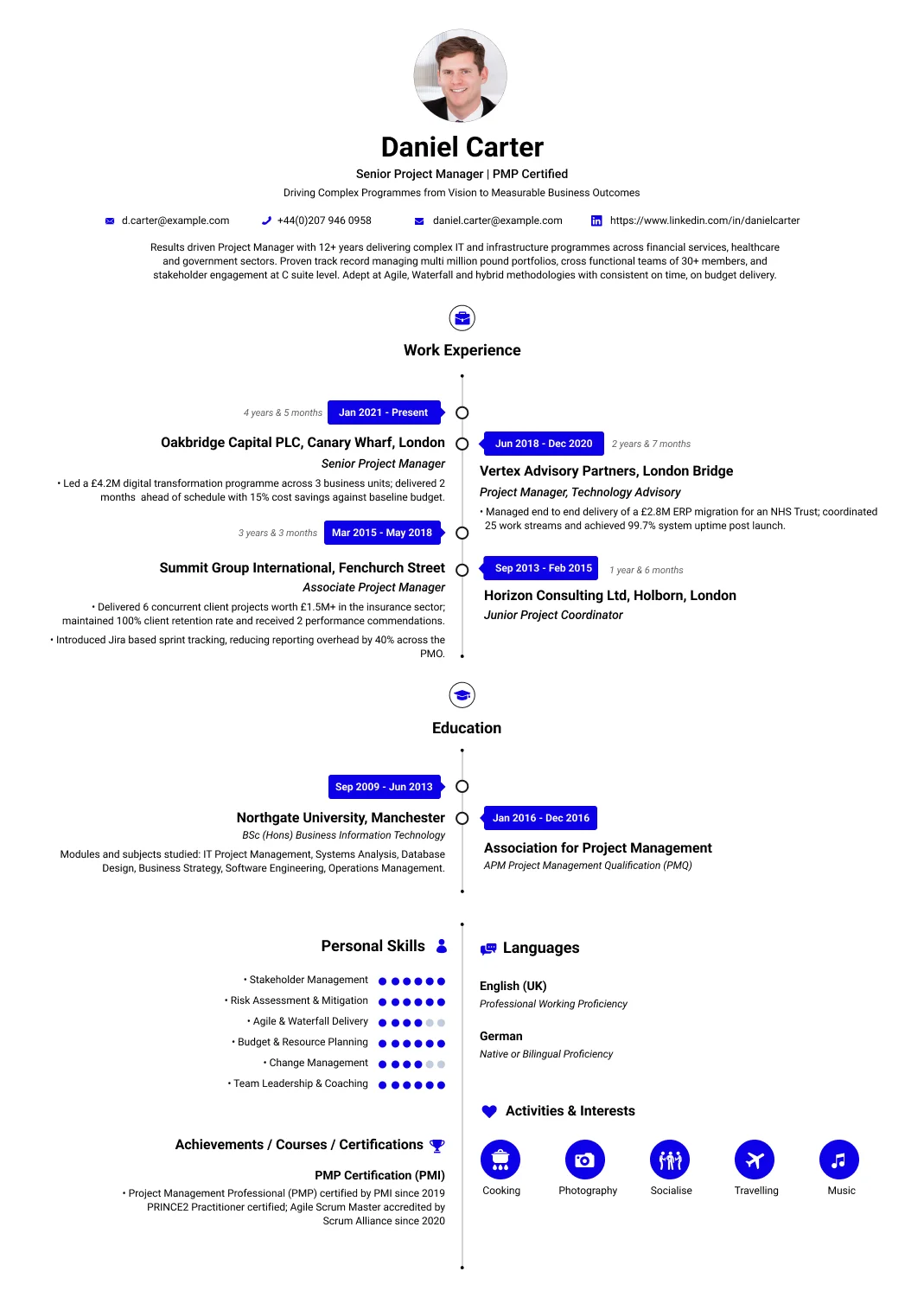
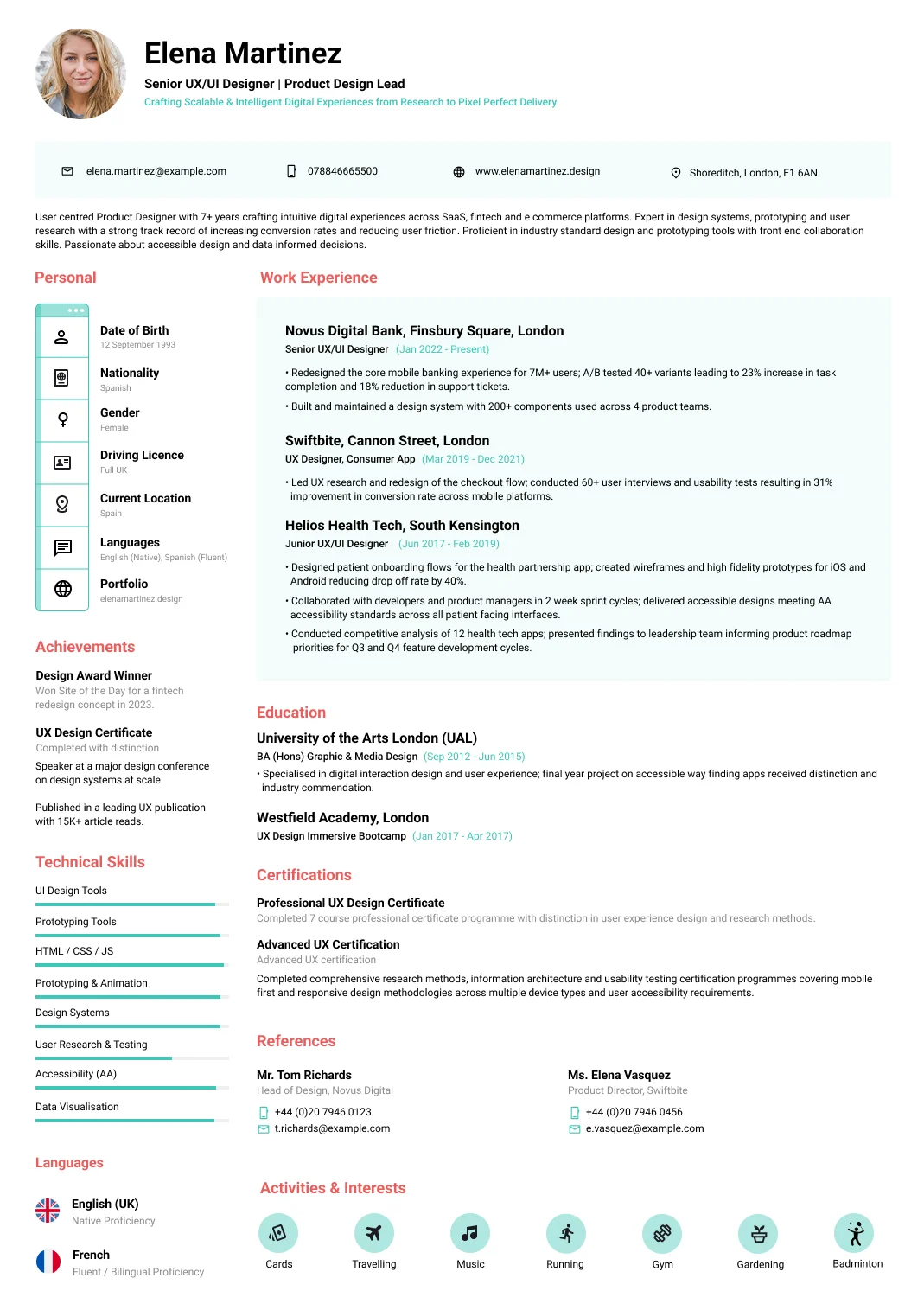
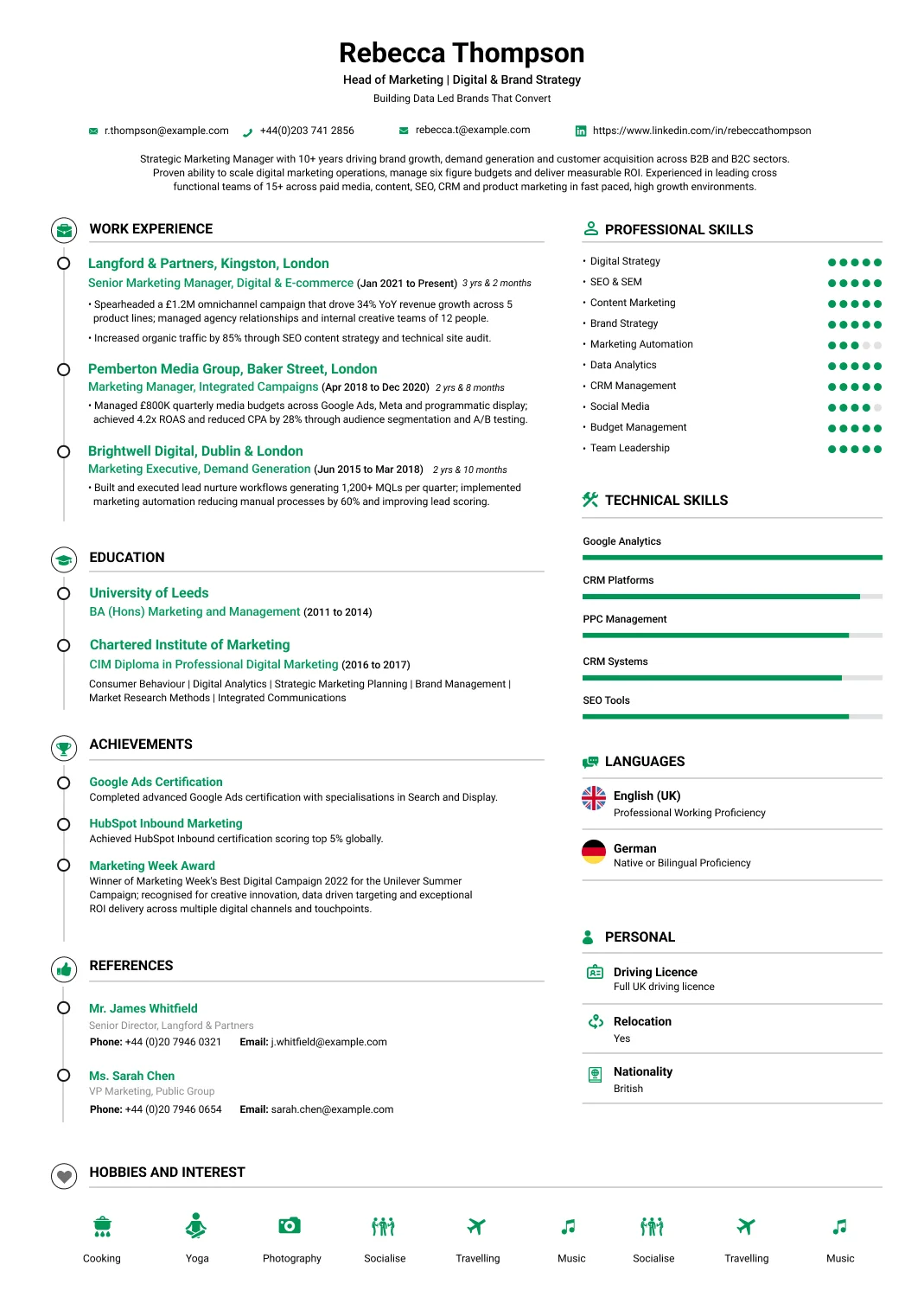
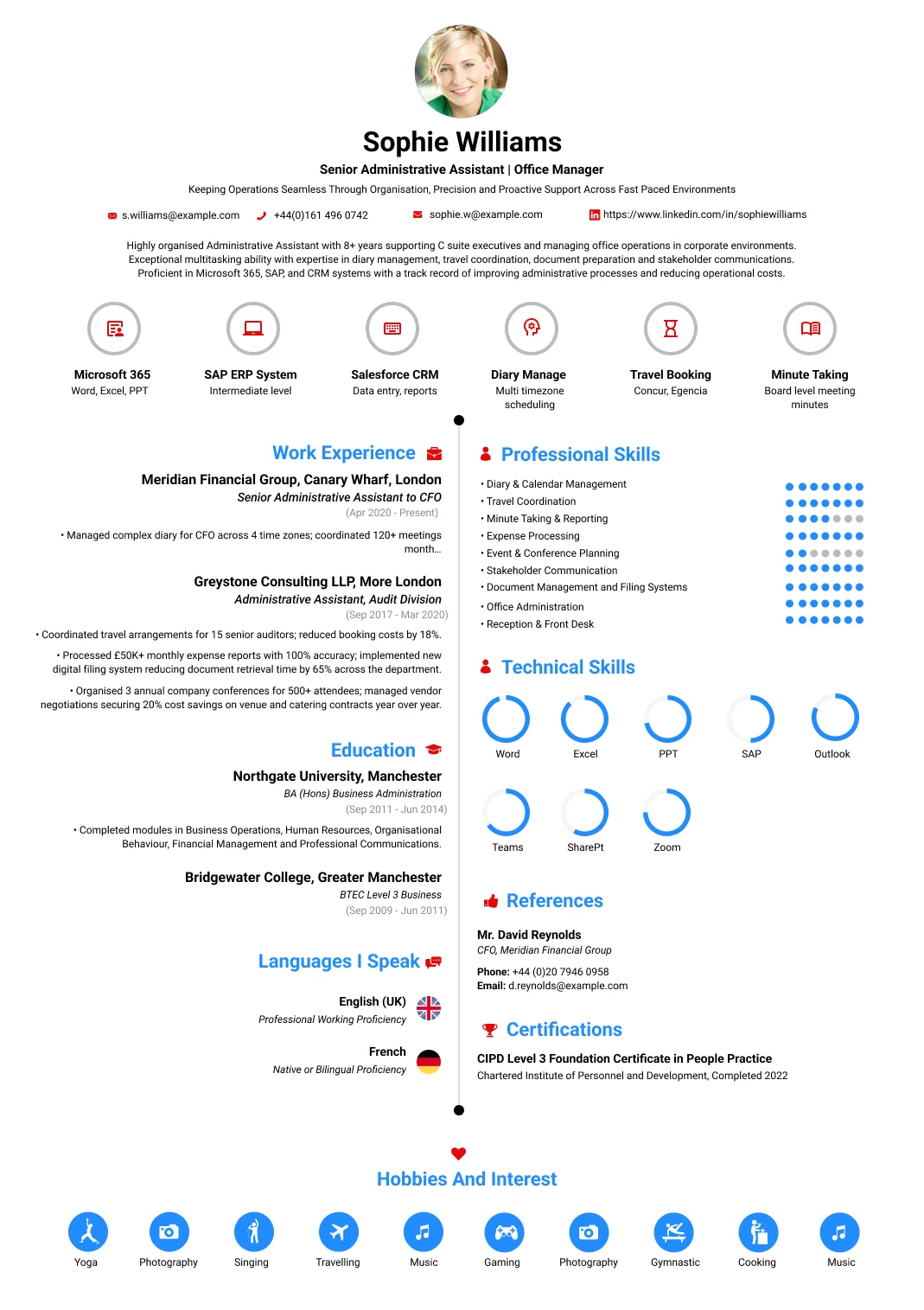
Technical lead with twelve years in software engineering, the last five leading the technical side of teams at a product company in Bangalore. Leads from the front, hands still on the code — setting the technical direction, making the architecture calls, reviewing and raising the quality of the team's work, and unblocking engineers so the team ships solid software. Led the technical design of a major product and grew several engineers into senior roles. Sets technical direction, designs architecture, reviews code, mentors engineers, and stays hands-on building the hardest parts. Deep, pragmatic and people-aware. Looking for a technical-lead role with a team that wants a lead who is both a strong engineer and someone who lifts the people around them.
Work Experience
Technical Lead
Bangalore Product Company, Bangalore, India
Jan 2018 – Present
- Lead from the front with hands still on the code, unblocking engineers so the team ships solid software.
- Led the technical design of a major product and grew several engineers into senior roles over the years.
- Set the technical direction for the team, making the architecture and design calls that keep the system sound.
- Review code and raise quality, keeping the codebase healthy and lifting the standard of the team's work.
- Mentor engineers, growing their skills and judgement so the team gets stronger and the next leads emerge.
- Stay hands-on building the hardest parts, leading by example rather than only from the whiteboard.
Senior Software Engineer
India Software Company, Bangalore, India
Jul 2011 – Dec 2017
- Built systems and led features as a senior engineer, building deep engineering experience over many years.
- Designed and built complex features and mentored juniors, steadily developing the leadership a lead role demands.
- Learned system design, code quality and mentoring on the job across more than six years.
- Gained the certifications and track record that led into a technical-lead role of my own.
Education
BE in Computer Science, Computer Science
PES University, Bangalore
Aug 2007 – Jun 2011
- Degree in computer science covering software engineering, systems and architecture, with a placement. The programme built the technical foundation a technical lead requires. It led through senior engineering into technical leadership.
Architecture & Technical Leadership Certificate, Software Engineering
Industry / AWS
Jan 2015 – Jun 2015
- Certifications in architecture and technical leadership to recognised standards. They sharpened the lead's toolkit on top of the engineering. They supported setting technical direction and leading teams to ship solid software.
Certifications
Architecture & Technical Leadership Certificate
Industry / AWS
Jun 2015 – Present
- Certifications in architecture and technical leadership to recognised standards, which sharpened the lead's toolkit on top of the engineering and support setting technical direction and leading teams to ship solid software.
Recognition
A lead who is still an engineer
- Relied on by the team for sound technical direction and for getting hands-on with the hardest problems, valued for leading a major product's design and for growing the engineers around him into seniors.
Highlights
Led a major product's design
- Led the technical design of a major product end to end. Owning the architecture and key decisions on a big build, and getting them right, is exactly where a technical lead's depth and judgement decide success.
Grew engineers into seniors
- Grew several engineers into senior roles. Developing the people on the team multiplies a lead's impact, building the senior engineers the company will rely on for years to come.
Languages
- English (UK) — Full Professional Proficiency
- Malayalam — Native or Bilingual Proficiency
- Hindi — Professional Working Proficiency
Technical Skills
- Technical Leadership
- Software Architecture
- System Design
- Code Review
- Hands-On Engineering
- Mentoring
- Technical Direction
- Quality & Standards
- Delivery
- Problem Solving
Personal Skills
- Technical Depth
- Pragmatism
- Mentorship
- Decisiveness
- Communication
Activities & Interests
- Running
- Shooting
- Dog Walking
- Reading
- Dreaming
Key Takeaways for a Technical Lead Resume
An engineering hiring manager makes most of this call in the first twenty seconds. These are the signals they read for:
- Stay technical on the page. A lead resume that reads like a manager resume gets screened out by the engineering director and the recruiter both, for opposite reasons.
- Architecture decisions are your strongest evidence. Name the call you made, the alternative you rejected, and what it cost or saved in latency, spend or engineering time.
- Show the system, not the org chart. Team size matters less than the scale you operated at: request volume, data size, service count, deploy frequency.
- Quantify the code review and standards work. Review turnaround, defect escape rate and test coverage movement are the numbers that prove you raised a bar rather than policed one.
- Technical debt work belongs on the resume, framed as a tradeoff you managed deliberately rather than a mess you inherited.
- Mentoring counts when it has an outcome attached. Engineers promoted, onboarding time reduced, or a design review culture that outlived you.
Why This Technical Lead Resume Works
The sample above belongs to a technical lead with twelve years of engineering and five leading, and several of its structural choices are worth stealing.
- The summary states the split explicitly: twelve years in engineering, the last five leading. That single construction answers the question every hiring manager has about a lead candidate, which is whether the leadership sits on top of real depth or replaced it.
- Hands-on engineering is asserted early and then backed by a separate bullet about building the hardest parts. Claiming to be a hands-on lead is cheap, so the resume spends a line proving it rather than repeating the adjective.
- Architecture ownership and code review sit as distinct bullets instead of merging into one leadership blur. Those are two different jobs with two different failure modes, and separating them signals someone who understands both.
- Mentoring is tied to an outcome (engineers grown into senior roles) rather than described as a disposition, which is the only version of that claim a reader can act on.
- The six-year senior engineer role is kept compact but explicitly framed as where the design and mentoring judgement was built, so the career reads as one continuous escalation of technical responsibility.
- The skills block leads with technical leadership, architecture and system design rather than a list of languages, which correctly positions the candidate for a lead vacancy instead of a senior engineer one.
Extra tips
Engineering directors look for one sentence proving the lead still ships: a system you personally built or a bug you personally found.
If your resume has no such line, add it before you add anything else.
How to Write a Technical Lead Resume That Gets Interviews
The hard part of this resume is holding two audiences at once: a recruiter scanning for scope and an engineering director looking for depth. These moves satisfy both:
Anchor the opening in engineering years, then leadership years
Write the split in the first line: 'Technical lead with eleven years building backend systems, the last four leading a six-engineer platform team'. Hiring managers discount leads whose engineering experience is thin or stale, so the sequence matters. Follow it with the domain and the scale, since leading payments infrastructure and leading an internal tooling team are different jobs.
Write architecture decisions as decisions, not as nouns
'Designed a microservices architecture' tells a reader nothing. 'Split a monolithic order service into four bounded contexts after event storming with the domain team, cutting deploy blast radius and taking release cadence from fortnightly to daily' tells them how you think. Include at least one decision where you chose the less fashionable option and say why, because judgement under constraint is what a lead is hired for.
Prove you are still in the code
Name the hard thing you personally built. A lead who wrote the rate-limiting layer, fixed the connection pool exhaustion that caused three incidents, or drove the migration script for a 400 million row table is instantly more credible than one who only describes direction. Keep your primary languages and runtime versions current on the page, because staleness is read as drift into management.
Turn code review and standards into numbers
Quality ownership is measurable. 'Introduced a design review document for changes touching more than two services, which cut post-release rollbacks from six a quarter to one' works. So do review turnaround times, defect escape rate, test coverage on critical paths, and flaky test reduction. Avoid claiming you 'maintained high standards', which no reader has ever been persuaded by.
Frame technical debt as a managed tradeoff
Leads are hired partly to decide what not to fix. Show one debt call in both directions: something you paid down with a measured payoff, and something you deliberately deferred with the reasoning attached. 'Deferred the ORM migration for two quarters to protect the compliance deadline, then landed it in three sprints once the release pressure lifted' reads as seniority, not as tidiness.
Make mentoring concrete and bounded
Attach outcomes to the people work: engineers promoted to senior, onboarding time for new joiners cut from six weeks to three, a design review habit that the team kept after you moved on. Keep it to one or two bullets. A technical lead resume that spends more space on people development than on systems starts reading like an engineering manager resume, which is a different vacancy.
Key Sections for a Technical Lead Resume
These are the blocks that carry weight for lead vacancies, and the ones candidates most often leave off:
A tech stack block split by depth: languages you would take a live coding interview in, versus tools you have operated. Conflating them is the fastest way to fail a screen.
System scale markers under each role: request volume, dataset size, number of services, deploy frequency, or uptime target.
A short architecture or selected-projects section for the two or three systems you designed, each with the constraint you were solving for.
Team shape: how many engineers, how senior, and whether they were co-located or distributed across time zones.
Design documents, RFCs or architecture decision records you introduced or authored, since written technical communication is a screened skill for leads.
On-call and incident ownership, including whether you ran postmortems and what changed as a result.
Open source contributions, conference talks or internal tech talks, which are the cheapest available proof of technical credibility.
Cloud and platform certifications where they are current, kept in a compact block rather than given headline space.
Technical Lead Resume Summary Examples
The worked example above is a product-company lead with a long engineering tail. These three move the emphasis elsewhere: a first-time lead, a platform specialist, and a lead spanning several teams.
Entry-level resume summary example
Technical lead with eight years in backend engineering, recently stepped up to lead a five-engineer team building the billing platform for a subscription business serving 400,000 customers. Sets the technical direction for the service, runs design review before any change crossing a service boundary, and still writes the hardest parts personally, including the idempotency layer that removed duplicate charge incidents entirely. Took release cadence from fortnightly to twice weekly by rebuilding the deployment pipeline and adding contract tests across four services. Mentors two mid-level engineers through structured code review rather than ad hoc feedback. Looking for a technical lead role in a product team where architecture ownership and hands-on engineering are expected in the same person.
Mid-level resume summary example
Technical lead with eleven years in distributed systems, leading a seven-engineer platform team responsible for the event pipeline behind a marketplace processing 90 million events a day. Owns the architecture, the code review bar and the technical debt roadmap, and remains the primary author on the consumer framework the rest of engineering builds against. Cut p99 processing latency from 1.8 seconds to 340 milliseconds by redesigning partition strategy and consumer group allocation, and reduced on-call pages by 60% over three quarters through better backpressure handling and alert tuning. Grew two engineers into senior roles and introduced the architecture decision record practice now used across four teams. Seeking a lead role on infrastructure that carries real scale.
Senior-level resume summary example
Principal technical lead with sixteen years in software engineering, setting technical direction across three product teams and roughly twenty-five engineers at a healthcare software company operating under HIPAA constraints. Owns cross-cutting architecture, chairs the design review forum, and reviews every change touching the patient data layer while continuing to prototype the difficult integrations personally. Led the decomposition of a fifteen-year-old clinical monolith into eight services over two years with zero unplanned downtime, cutting mean time to recovery from four hours to twenty minutes. Built the internal staff engineer track and mentored five engineers into senior or lead positions. Looking for a principal or staff-level technical leadership role in regulated software.
Technical Lead Work Experience Examples
Each bullet pairs a technical decision with the constraint behind it and the measured result, which is how an engineering director reads for judgement rather than for keywords:
First-time lead / product engineering team
- Set the technical direction for a five-engineer billing team, replacing a shared mutable state model with an event-sourced ledger that eliminated duplicate charge incidents and made every balance dispute independently reconstructible.
- Introduced a design review document for any change crossing a service boundary, which cut post-release rollbacks from six a quarter to one and gave the team a written record of why each tradeoff was taken.
- Rebuilt the deployment pipeline with contract tests across four services, moving release cadence from fortnightly to twice weekly while holding the change failure rate under 5% across eighteen months.
- Wrote the idempotency and retry layer personally after two payment incidents, then paired three engineers through the rollout so the team could operate it without the original author in the room.
Platform / infrastructure technical lead
- Led seven engineers on an event pipeline handling 90 million events daily, redesigning partition strategy and consumer group allocation to cut p99 processing latency from 1.8 seconds to 340 milliseconds.
- Owned the technical debt roadmap and negotiated a fixed 20% capacity allocation with product, retiring three legacy consumers and removing roughly 40,000 lines of unmaintained code over four quarters.
- Reduced on-call pages by 60% across three quarters by adding backpressure handling at ingest, rewriting eleven noisy alerts around symptom-based thresholds, and enforcing runbook links on every alert definition.
- Ran the build versus buy evaluation for stream processing, documenting the cost model that kept the workload self-hosted and saved an estimated 310,000 dollars a year against the managed alternative.
- Raised code review quality by capping pull requests at 400 changed lines and publishing a review checklist, which took median review turnaround from 26 hours to under 6 without increasing defect escape rate.
Principal / multi-team technical lead
- Set architecture across three product teams and twenty-five engineers, decomposing a fifteen-year-old clinical monolith into eight services over two years with no unplanned downtime during the migration window.
- Cut mean time to recovery from four hours to twenty minutes by introducing distributed tracing, standardising structured logging across services, and rewriting the incident escalation path with the on-call rotation.
- Chaired the design review forum and authored the architecture decision record template now used company-wide, giving 40 engineers a consistent way to record tradeoffs and stopping repeated relitigation of settled calls.
- Reviewed every change touching the patient data layer under HIPAA constraints, catching two access-control regressions before release and driving the threat model refresh that closed the annual security audit clean.
- Built the staff engineer career track with the VP of Engineering and mentored five engineers into senior or lead positions, which cut external senior hiring for those teams by roughly half over two years.
Top Technical Lead Skills
Lead vacancies screen for architecture judgement first and stack familiarity second. List what you could defend in a whiteboard session, not what you have read about:
Hard skills
- Software architecture
- Distributed systems design
- API and interface design
- Code review and standards
- Technical debt management
- Design documents and architecture decision records
- Service decomposition
- Database schema and query design
- Performance profiling and optimisation
- Observability, tracing and alerting
- CI/CD pipeline design
- Cloud architecture on AWS
- Kubernetes and containerisation
- Test strategy and automation
- Incident response and postmortems
- Threat modelling and security review
- Release and rollout strategy
- Build versus buy evaluation
- Technical mentoring and pairing
- Capacity planning and cost modelling
Soft skills:
- Technical judgement
- Pragmatism
- Written communication
- Mentorship
- Decisiveness
- Influence without authority
Technical Lead Certifications
Certifications carry less weight for lead roles than a defensible architecture story, but a current cloud or platform credential is a useful filter-passer when the stack is named in the job ad:
-
AWS Certified Solutions Architect (Associate)
— Amazon Web Services Optional. The most commonly named cloud credential in lead job ads; useful when your architecture experience is mostly on one team's stack.
-
AWS Certified Solutions Architect (Professional)
— Amazon Web Services Optional. Worth the effort only if you are leading multi-account or multi-region design; otherwise the associate level is enough signal.
-
Certified Kubernetes Administrator
— Cloud Native Computing Foundation Optional. Practical and hands-on rather than multiple choice, which makes it credible for leads owning platform or deployment concerns.
-
Google Professional Cloud Architect
— Google Cloud Optional. Relevant where the target company runs on Google Cloud; do not list cloud certifications for three providers at once, since breadth here reads as shopping rather than depth.
Technical Lead Salary Expectations
The US Bureau of Labor Statistics does not report technical lead as a separate occupation, so the closest official benchmark is software developers, where leads generally sit in the upper half of the distribution:
USD 105,210 – USD 171,980 · mid · US
Middle 50 percent of software developers nationally, with a median of 135,980 dollars across 1.69 million jobs.
USD 171,980 – USD 214,670 · senior · US
75th to 90th percentile of the same occupation. Equity and bonus at product companies sit outside these BLS figures, which cover wages only.
Common Technical Lead Resume Mistakes
These are the failure patterns that get lead resumes rejected by engineering hiring managers, most of them self-inflicted:
- Drifting into manager language. Once the bullets are about headcount, one-to-ones and roadmap sign-off with no architecture in sight, the resume is competing for a different job and losing.
- Listing architectures as nouns. 'Event-driven microservices with CQRS' proves nothing without the constraint that made it the right call and the result it produced.
- Dropping the hands-on evidence. If no bullet names something you personally built or debugged, an engineering director will assume you stopped coding three years ago.
- A twenty-item language list with no depth signal. Naming Go, Rust, Python, Java, Scala and Elixir with equal weight invites an interviewer to pick the one you are weakest in.
- Claiming credit for team outcomes without stating your decision. 'Delivered the platform migration' is ambiguous; 'chose the strangler pattern over a rewrite and sequenced the cutover' is not.
- Ignoring technical debt entirely, which reads as either a greenfield-only career or an unwillingness to talk about tradeoffs.
- Stale versions on the page. Listing Python 2 idioms or an unsupported framework release quietly dates you more than any employment gap would.
- Burying scale. Without request volume, data size or service count, a reader cannot tell whether you led at a scale where your decisions were hard. A lead resume has to satisfy a recruiter and an engineering director who want different things from the same page, and that balance is genuinely difficult to strike alone. If the stakes are high, a professional resume writing service can hold both audiences without flattening your technical detail.
Technical Lead Resume FAQs
The questions engineers most commonly search when moving into or between lead roles:
A technical lead owns engineering decisions such as architecture, design tradeoffs, code quality and technical direction, and stays hands-on in the codebase. A team lead owns people and day-to-day supervision. The resumes look different: a technical lead resume is built on systems and decisions, a team lead resume on people and delivery.
Yes. Technical specificity is the whole point of the role, so name the languages, systems, scale figures and design decisions. Do not paste code, but do name what you personally built. A lead resume stripped of technical detail reads as someone who left engineering, which is the single most common reason strong candidates get rejected.
Architecture and system design first, then code review and standards, technical debt management, and the cloud and platform stack you have actually operated. Add mentoring and written technical communication, since design documents and architecture decision records are screened for at this level. Keep languages honest about depth.
Two pages is normal, and appropriate once you have ten or more years of engineering behind you. Give the most recent lead role the majority of the space, compress engineering roles older than about a decade into one line each, and drop early internships entirely.
No. Lead roles are won on demonstrated architecture judgement and a track record of shipped systems, not credentials. A current cloud certification helps you pass automated screens when the job ad names a specific platform, but it will never substitute for a decision you can defend in a design interview.
Attach leadership to technical artefacts. Write about the design review process you introduced, the review standard you raised, or the engineers you grew through pairing on real problems. Two bullets of people impact against six of technical ownership keeps the balance right for a lead vacancy.
Most technical lead postings ask for seven to ten years of engineering, with two or more at senior level. What actually matters is whether you have owned a system end to end through a difficult migration or scaling event, since that is the experience the interview will probe.
Get Started With Our
Free Resume Creator today!
Free sign-up. No credit card required.