Was this sample helpful? Rate it!
Average: 4.4 (37 votes)



Contents
What Matters Most
Why This Optometrist Resume Works
How to Write an Optometrist Resume That Gets Interviews
What to Include in an Optometrist Resume
Optometrist Resume Summary Examples
Optometrist Work Experience Examples
Top Optometrist Skills
Certifications and Licences for an Optometrist
Optometrist Salary
Common Optometrist Resume Mistakes
Optometrist Resume FAQs

Summary
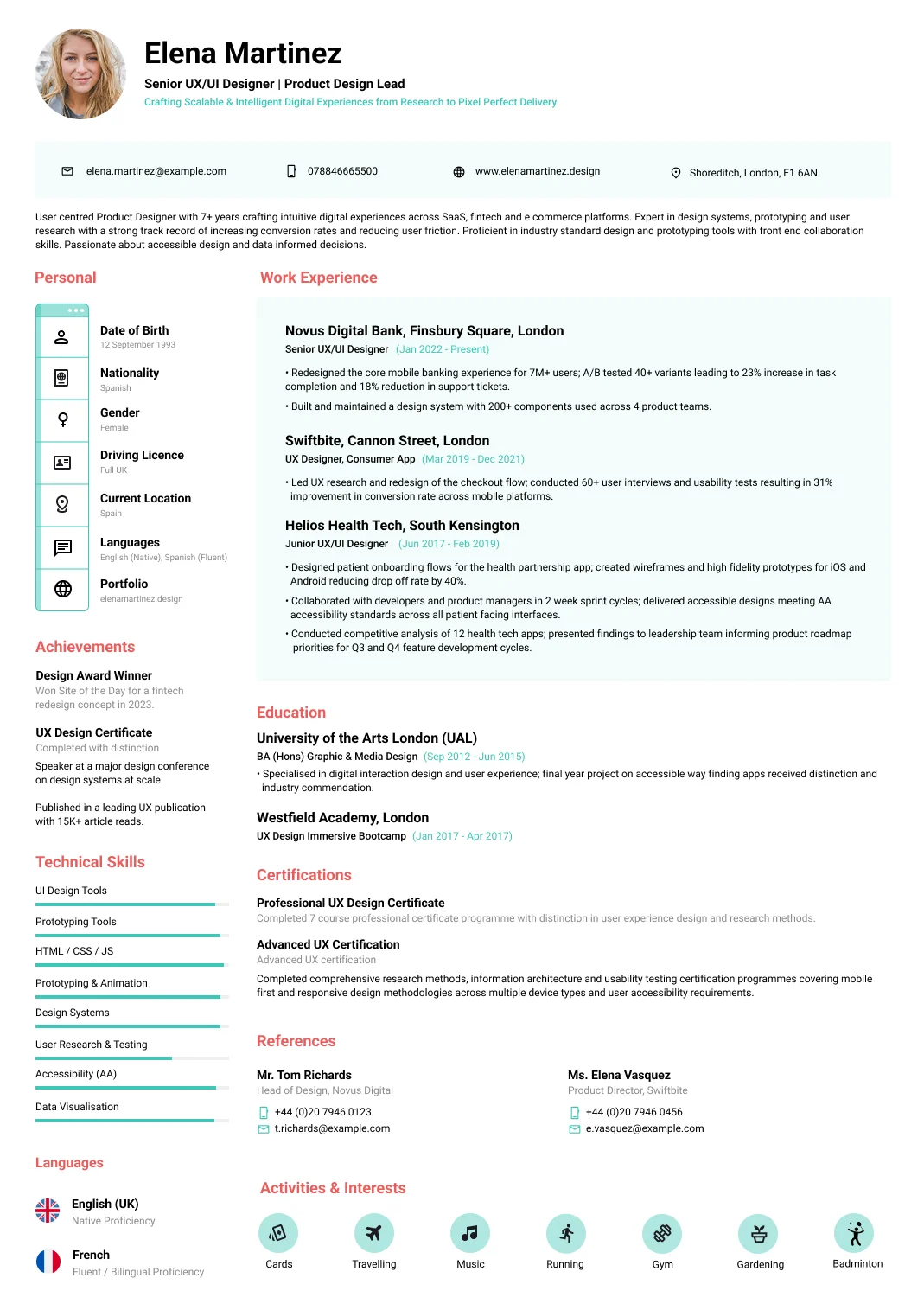
Optometrist with nine years examining eyes, prescribing and detecting disease at a practice and an eye clinic in London. Looks after people's sight as a primary eye-care clinician — performing thorough eye examinations, prescribing glasses and contact lenses, and spotting eye and wider health conditions early through what she sees in the eye. Detected several sight-threatening conditions early and built a loyal patient base across the years. Performs eye examinations, prescribes corrective lenses, diagnoses and manages eye conditions, refers when needed, and educates patients on eye health. Thorough, caring and clinically sharp. Looking for an optometrist role with a practice or clinic that values careful, patient-centred eye care.
Work Experience
Optometrist
London Vision Care, London, UK
Jan 2018 – Present
- Look after people's sight as a primary eye-care clinician, examining, prescribing and detecting disease.
- Detected several sight-threatening conditions early and built a loyal patient base across the years.
- Perform thorough eye examinations, testing vision and eye health carefully rather than rushing patients through.
- Prescribe glasses and contact lenses precisely, getting each patient the clearest, most comfortable vision.
- Diagnose and manage eye conditions and spot wider health signs, referring promptly when something needs more.
- Educate patients on their eye health, helping them understand and protect their vision for the long term.
Optometrist (Pre-Reg & Junior)
UK Eyecare Group, London, UK
Aug 2015 – Dec 2017
- Completed the pre-registration year and early practice under supervision, building clinical optometry hands-on.
- Examined patients and prescribed under supervision, steadily developing real clinical judgement over time.
- Learned examination, diagnosis and patient care on the job during these first years.
- Gained the registration and experience that led into a full optometrist role of my own.
Education
MOptom in Optometry, Optometry
City, University of London
Sep 2011 – Jun 2015
- Master's degree in optometry covering ocular health, examination, optics, diagnosis and patient care, with clinical placements. The programme built the clinical foundation primary eye care and diagnosis requires.
GOC Registration & Pre-Reg Year, Optometry
General Optical Council
Aug 2015 – Jul 2016
- Pre-registration clinical year and professional registration to a recognised standard. It built supervised clinical competence and accountability. It authorised independent practice as a qualified optometrist.
Highlights
Caught conditions early
- Detected several sight-threatening conditions early during routine examinations. The eye reveals both eye disease and wider health problems, so spotting them early through a careful exam can genuinely save a patient's sight.
A loyal patient base
- Built a loyal patient base who return and recommend her. In eye care, patients come back to the optometrist they trust with their sight, so a loyal following is the clearest sign of thorough, caring practice.
Registration
GOC Registered Optometrist
General Optical Council
Jul 2016 – Present
- Holds professional registration as an optometrist with the General Optical Council following a master's degree and pre-registration year, which authorises independent practice and grounds accountable, primary eye care.
Recognition
Trusted with patients' sight
- Valued by patients and colleagues as a thorough, careful optometrist, often credited by patients with catching problems others had missed and trusted with the practice's most complex examinations and cases.
Languages
- English (UK) — Native or Bilingual Proficiency
- Hindi — Native or Bilingual Proficiency
- Malayalam — Native or Bilingual Proficiency
Technical Skills
- Eye Examination
- Refraction & Prescribing
- Ocular Disease Detection
- Contact Lens Fitting
- Diagnosis & Management
- Clinical Referral
- Patient Education
- Diagnostic Imaging
- Paediatric & Elderly Eye Care
- Clinical Record-Keeping
Personal Skills
- Thoroughness
- Clinical Judgement
- Compassion
- Attention to Detail
- Communication
Activities & Interests
- Wine Tasting
- Newspaper
- Gymnastic
- Football
- Baking
What Matters Most
Before the detail, here is what actually decides a strong optometrist resume:
- Lead with your GOC (or state board) registration and independent prescribing status if you hold it. A recruiter checks you can legally see patients before anything else.
- Quantify clinical throughput and detection: sight tests per day, contact lens wearers managed, and how many urgent cases you referred correctly into the hospital eye service.
- Name your diagnostic kit. OCT, fundus photography, Goldmann and non-contact tonometry, visual fields and slit-lamp work tell a hiring practice you can walk in and test day one.
- Show the disease you actually detected and managed, not just the refractions you performed. Glaucoma monitoring, diabetic retinopathy screening and acute triage carry the most weight.
- Signal your setting fit. High-street, hospital secondary care, domiciliary and independent prescribing are different jobs, and the resume should read for the one you are applying to.
- Keep it clinical and specific. Patient-facing warmth matters, but a recruiter hires on scope, safety and the conditions you can be trusted to catch.
Why This Optometrist Resume Works
This sample belongs to a mid-career community optometrist, and its choices map neatly onto what a practice owner screens for. Here is what it gets right:
- The summary leads with clinical function, examining, prescribing and detecting disease, rather than a soft personality claim, so a recruiter sees scope in the first line.
- It states GOC registration and the pre-registration year explicitly, which is the gate a UK practice checks before considering anything else on the page.
- The experience separates the qualified role from the supervised pre-reg years, signalling a clean progression from trainee to independent clinician.
- Early disease detection is framed as an outcome (catching sight-threatening conditions), which is the single most valuable thing an optometrist does and the hardest to fake.
- The skills list pairs examination and refraction with ocular disease detection and diagnostic imaging, showing the resume is built around clinical judgement, not just dispensing.
- Loyalty and trust are backed by a concrete mechanism, patients returning and recommending, rather than left as an adjective.
How to Write an Optometrist Resume That Gets Interviews
An optometrist resume is a safety and scope document first. Work through these moves in order:
Put registration and prescribing status in the top third
State your GOC number and status (or state license and NBEO status in the US) in the header or summary, and flag independent prescribing if you hold it. A hiring practice cannot roster you without it, so burying it costs you the screen. If you are a therapeutic or IP optometrist, say so plainly, because it widens the conditions you can treat without a referral.
Lead each role with scope, then prove it with numbers
Open a role with the type of optometry (community, hospital, domiciliary) and the daily reality, then quantify it: sight tests per day, contact lens wearers on your books, urgent referrals per month. A line like 'assessed acute red eye and sudden vision loss in eye casualty, referring 3 to 5 sight-threatening cases weekly' tells a recruiter exactly what you can handle.
Foreground disease detection over refraction
Anyone with the qualification can refract. What separates candidates is what you catch and manage: glaucoma monitoring, diabetic retinopathy grading, macular degeneration, papilloedema flagged from a headache history. Give the pathway too, so the reader sees you refer correctly and on time, not just that you spotted something.
List the diagnostic technology by name
Recruiters and ATS filters both scan for kit. Spell out OCT, fundus photography, Goldmann and non-contact tonometry, automated perimetry, slit-lamp biomicroscopy and any specific platforms you have used. It reassures a practice you can use their equipment from day one rather than needing weeks of onboarding.
Tailor the resume to the setting you want
A high-street commercial role rewards contact lens conversion, dispensing links and clinic efficiency. A hospital post rewards shared-care glaucoma clinics, triage and post-op review. Reorder your bullets so the setting you are applying to sees its own priorities first, and cut the ones that do not fit that job.
Extra tips
Keep two versions of your experience section, one community-weighted and one hospital-weighted.
Reorder so the first three bullets match the exact setting in the job advert, then submit.
What to Include in an Optometrist Resume
Beyond the standard sections, an optometrist resume carries a few things a recruiter specifically looks for:
Registration and license details: GOC number and status in the UK, or state board license plus NBEO Parts 1 to 3 in the US, with independent or therapeutic prescribing flagged.
Clinical scope statement covering the conditions you diagnose and manage and the equipment you use, so scope is visible without reading every bullet.
Setting history: community, hospital eye service, domiciliary or academic, since these are materially different jobs.
Continuing education and CPD, which is a registration requirement in most jurisdictions and signals you are current on standards.
Any shared-care schemes, MECS or minor eye conditions services, and glaucoma or diabetic pathways you have worked within, because they show hospital-facing competence.
Optometrist Resume Summary Examples
Your summary should state scope, setting and prescribing status in the first two lines. These pronoun-free examples span different seniority levels and settings:
Entry-level resume summary example
Newly GOC-registered optometrist who completed a pre-registration year across a busy high-street practice and a hospital eye clinic, passing the OSCE at first sitting. Comfortable running full 25-minute sight tests, refracting to a stable endpoint, and fitting daily and monthly contact lenses with structured aftercare. Trained on OCT, fundus photography, non-contact tonometry and automated visual fields, with early experience grading diabetic retinopathy and flagging suspect discs for glaucoma referral. Detected a case of papilloedema from a headache history during the pre-reg year that led to a same-day neurology referral. Seeks a supported community optometrist role with a practice that invests in clinical development and CPD.
Senior-level resume summary example
Independent prescribing optometrist with twelve years across community practice and a hospital eye service, the last five running a consultant-led shared-care glaucoma clinic. Reviews 14 to 18 monitoring patients a day using Goldmann tonometry, OCT and automated perimetry, adjusting IOP-lowering therapy within agreed protocols and discharging or escalating on clear criteria. Established a community minor eye conditions service that cut avoidable hospital referrals for acute red eye by roughly 60 percent in its first year. Manages anterior eye disease directly, prescribing for bacterial keratitis, uveitis and blepharitis rather than referring routine cases on. Mentors pre-registration optometrists through to GOC registration. Seeks a lead or specialist optometry post in secondary or shared eye care.
Optometrist Work Experience Examples
Strong optometrist bullets pair a clinical action with a number and an outcome. These labelled sets show how the same career reads across different settings:
Community / high-street optometry
- Ran up to 20 sight tests a day in a busy high-street practice, holding full 25-minute exams so subtle optic disc and retinal changes were caught rather than missed under commercial time pressure.
- Fitted daily, monthly and toric contact lenses for around 400 wearers a year, teaching safe handling and cutting dropout by booking proactive aftercare checks at week one and month three of wear.
- Prescribed varifocals and complex corrections for high myopes and presbyopes, accounting for lens thickness and vertex distance so first-fit tolerance stayed above 90 percent and dispensing remakes fell.
- Screened for glaucoma, diabetic retinopathy and macular degeneration using OCT and fundus imaging, referring three to five urgent cases a month into the hospital eye service within agreed local pathways.
- Grew a loyal patient list by explaining findings in plain language, lifting recall uptake and turning routine tests into whole-family bookings for children and elderly relatives who returned each year.
Hospital / secondary care optometry
- Ran a consultant-led glaucoma monitoring clinic, reviewing 12 to 16 patients daily with Goldmann tonometry, visual fields and OCT, adjusting pressure-lowering drops and escalating progression within shared-care rules.
- Triaged acute eye casualty presentations including red eye, sudden vision loss and flashes and floaters, separating sight-threatening cases needing same-day ophthalmology from those safe to manage locally.
- Delivered low-vision assessments for patients with advanced macular degeneration, prescribing magnifiers and task lighting and referring to rehabilitation so people kept reading and living independently.
- Co-managed post-operative cataract patients, checking refractive outcomes and catching posterior capsule opacification early, then listing suitable cases for YAG laser through the consultant clinic.
- Supervised two pre-registration optometrists through their hospital placement, structuring case exposure, tutorials and staged sign-off so both passed the GOC final assessment at first attempt.
Independent prescribing / clinical
- Qualified as an independent prescribing optometrist and treated anterior eye disease directly, prescribing antibiotics and topical steroids for bacterial keratitis and anterior uveitis rather than referring each case on.
- Set up a community minor eye conditions service, assessing acute red eye and foreign bodies locally and cutting unnecessary hospital eye service referrals by roughly 60 percent across the first year of operation.
- Managed chronic dry eye and blepharitis with a stepped treatment plan, reviewing response at four to six weeks and lifting symptom scores for patients who had cycled through the practice without relief before.
- Built and audited local clinical pathways with the CCG, presenting outcome data that secured continued funding for community-based acute eye care across three neighbouring practices.
Top Optometrist Skills
List the clinical skills a practice actually screens for, leading with examination, disease detection and the diagnostic kit you use:
Hard skills
- Comprehensive Eye Examination
- Refraction and Prescribing
- Ocular Disease Detection
- Glaucoma Detection and Monitoring
- Diabetic Retinopathy Screening
- Contact Lens Fitting
- OCT Interpretation
- Fundus Photography
- Slit-Lamp Biomicroscopy
- Goldmann and Non-Contact Tonometry
- Automated Visual Field Testing
- Binocular Vision Assessment
- Paediatric Eye Care
- Low-Vision Assessment
- Acute Eye Triage
- Independent Prescribing
- Clinical Referral Pathways
- Patient Education and Counselling
Soft skills:
- Clinical judgement
- Thoroughness
- Compassion
- Attention to detail
- Clear communication
- Calm under acute presentations
Certifications and Licences for an Optometrist
For optometry, registration is a legal requirement and everything else is a differentiator. State the required licence first, then the credentials that widen your scope:
-
GOC Registration
— General Optical Council Legally required to practise as an optometrist in the UK; renewed annually with CPD.
-
Independent Prescribing (IP)
— College of Optometrists Optional but high value; lets you prescribe for a range of eye conditions without onward referral.
-
NBEO Certification
— National Board of Examiners in Optometry US pathway to state licensure; the equivalent gate to GOC registration for American roles.
-
Professional Certificate in Glaucoma
— College of Optometrists Optional specialty credential for optometrists working in glaucoma shared-care clinics.
Optometrist Salary
Optometrist pay depends heavily on setting and prescribing scope. US national figures are well sourced through the Bureau of Labor Statistics:
USD 66,000 – USD 95,000 · entry · US
Around the 10th to 25th percentile; early-career and salaried practice roles.
USD 110,000 – USD 145,000 · mid · US
National median annual wage is about 131,860 USD.
USD 160,000 – USD 208,000 · senior · US
Upper decile; practice owners and specialist or high-volume clinicians.
Sources: US BLS: Optometrists (OES 29-1041)
Common Optometrist Resume Mistakes
A few errors quietly cost optometrists interviews, and none of them are about typos:
- Hiding or omitting registration status. If a recruiter has to hunt for your GOC number or license, they assume a gap; put it in the top third.
- Listing refractions as the headline. Refraction is assumed. The resume should lead with the disease you detect and manage, which is what actually differentiates you.
- Leaving out the diagnostic equipment by name. 'Clinical imaging' means nothing to an ATS or a practice; 'OCT, fundus photography, automated perimetry' means you can start day one.
- Using the same resume for community and hospital roles. The two settings reward different bullets; sending one generic version signals you have not read the job.
- Vague safety language. 'Referred as needed' is weak. State the pathway, the criteria and the volume so the reader trusts your clinical thresholds.
- Overloading soft-skill adjectives. 'Caring and thorough' with no clinical evidence reads as filler next to a candidate who quantified detection and throughput.
Optometrist Resume FAQs
The questions candidates most often search when writing an optometrist resume:
Lead with clinical skills a practice screens for: comprehensive eye examination, refraction, ocular disease detection, glaucoma and diabetic retinopathy screening, contact lens fitting, and the diagnostic kit you use such as OCT, tonometry and visual fields. Add independent prescribing if you hold it, then a short set of soft skills like clinical judgement and clear patient communication.
Put it in the header or summary, not buried at the bottom. In the UK, state your GOC registration and number plus any independent prescribing qualification; in the US, list your state license and NBEO status. A recruiter checks you can legally see patients before reading anything else.
One page for early-career optometrists and two pages once you have several years, shared-care clinics or independent prescribing to evidence. Depth on clinical scope and detection is worth more than length, so cut generic dispensing bullets before you cut a page.
An optometrist resume centres on examination, diagnosis, disease detection and prescribing, since optometrists are clinicians. A dispensing optician resume centres on spectacle and contact lens fitting, dispensing accuracy and product knowledge. Keep the clinical scope front and centre so the two are never confused.
Lead with your pre-registration or clerkship placements and the settings you rotated through, then quantify what you did: sight tests supervised, conditions detected, equipment used. New graduates win on demonstrated scope and a clean registration pathway, not on years.
Yes, prominently, if you hold it. Independent or therapeutic prescribing widens the conditions you can treat without referral, which directly raises your value to a practice or hospital. Flag it in the summary and list the qualification in your certifications.
Optometry is a high-stakes clinical field where the wording around scope and prescribing has to be exact. If you would rather hand that to a specialist, you can work with a professional resume writing service to frame your clinical record correctly.
Get Started With Our
Free Resume Creator today!
Free sign-up. No credit card required.