Was this sample helpful? Rate it!
Average: 4.8 (17 votes)




Contents
Key Takeaways for a Junior Software Developer Resume
Why This Junior Software Developer Resume Works
How to Write a Junior Software Developer Resume
What to Include in a Junior Software Developer Resume
Junior Software Developer Resume Summary Examples
Junior Software Developer Work Experience Examples
Top Junior Software Developer Skills
Certifications for a Junior Software Developer
Junior Software Developer Salary
Common Junior Software Developer Resume Mistakes
Junior Software Developer Resume FAQs

Summary
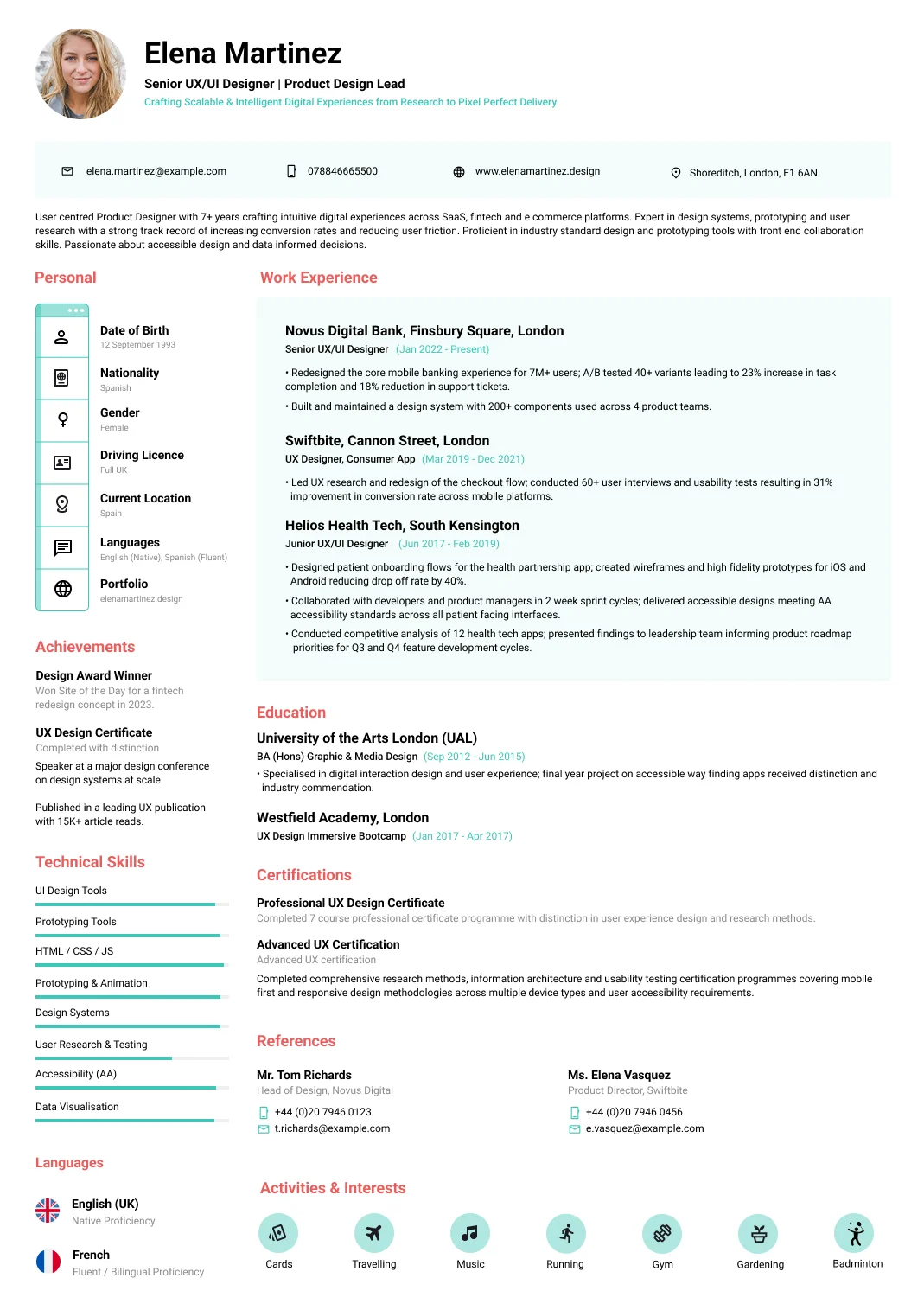
Junior software developer with two years on a product team in Pune, after a computer-engineering degree. Capable, conscientious and learning quickly, contributing real features to a live product, writing tests and fixing bugs across the stack while steadily growing from supervised work toward owning her own work. Shipped a well-received feature and helped cut a recurring source of bugs. Builds features across front-end and back-end, writes tests, fixes defects, takes part in code reviews, and works within an agile team. Diligent, curious and genuinely committed to becoming a strong engineer. Looking for a software-developer role with a team that does mentoring and code review well and will help it grow.
Work Experience
Junior Software Developer
Deccan Product Labs, Pune, India
Jan 2023 – Present
- Contribute real features to a live product across the stack, learning fast and growing toward owning my own work.
- Shipped a well-received feature and helped cut a recurring source of bugs through better tests and fixes.
- Build features across front-end and back-end under guidance, writing clean code and learning the codebase as I go.
- Write tests for the code I produce, catching problems early and keeping the product stable as it changes.
- Fix defects across the system, building my understanding of how it all fits together while improving quality.
- Take part in code reviews, giving and receiving feedback, which is where most of my growth is happening.
Software Intern
Pune Tech Studio, Pune, India
Jun 2022 – Dec 2022
- Built features and fixed bugs on a web product during a six-month internship, under code review.
- Wrote code and tests and learned professional workflow and version control on the job.
- Learned full-stack development, Git and agile delivery during the internship at the studio.
- Gained the experience and the offer that led into a permanent junior software-developer role.
Education
BTech in Computer Engineering, Computer Engineering
Savitribai Phule Pune University
Jul 2018 – Jun 2022
- Degree in computer engineering covering programming, systems, databases and software engineering, with a project. The programme built the engineering foundation a developer career requires. It led directly into software development.
Full-Stack Development Certification, Software Development
Online Bootcamp
Jul 2022 – Dec 2022
- Certification covering full-stack development with modern frameworks, APIs and databases. It complemented the degree with practical project skills. It supports building features across the whole stack.
Highlights
Shipped a well-received feature
- Built and shipped a feature that users and the team responded well to. Delivering something real and well-received early in a career shows genuine capability beyond just completing assigned tasks.
Cut recurring bugs
- Helped cut a recurring source of bugs through better tests and fixes. Tackling the root cause of repeat defects, rather than just patching them, is the habit that turns a junior into a dependable engineer.
Certifications
Full-Stack Development Certification
Online Bootcamp
Dec 2022 – Present
- Certification covering full-stack development with modern frameworks, APIs and databases to a recognised standard. It complemented the degree with practical project skills and supports building features across the whole stack.
Early Experience
Pune Tech Studio
Jun 2022 – Dec 2022
- Completed a six-month software internship building and fixing features on a web product under code review, which gave real hands-on development experience and the offer that led into a junior software-developer role.
Languages
- English (UK) — Full Professional Proficiency
- Hindi — Native or Bilingual Proficiency
- Marathi — Native or Bilingual Proficiency
Technical Skills
- JavaScript & Python
- React
- REST APIs
- SQL & Databases
- Testing
- Debugging
- Git & Version Control
- Agile Development
- Code Review
- Clean Code
Personal Skills
- Eagerness to Learn
- Conscientiousness
- Problem Solving
- Curiosity
- Teamwork
Activities & Interests
- Cricket
- Cards
- Movies
- Drinking
- Park
Key Takeaways for a Junior Software Developer Resume
Nobody expects experience, so evidence capability instead:
- Put a repository link in the header, since a hiring manager will look at your code before reading anything else at all.
- Show something you finished, because a deployed working project counts for far more than three abandoned tutorials.
- Name your stack honestly, listing what you can actually build with rather than everything you have briefly touched.
- Explain decisions in your project write-ups, as reasoning is what separates a junior who will grow from one who will not.
- Include collaborative evidence covering pull requests, code review, pair work or any open source contribution.
- Show learning velocity, since teams hire juniors on the expectation of improvement rather than on current output.
Why This Junior Software Developer Resume Works
This sample belongs to a first developer role applicant, and it substitutes demonstrable capability for a career history.
- A repository link sits in the header, giving a hiring manager the fastest route to the evidence they will actually judge on.
- A finished deployed project is described rather than several unfinished ones, since completion is itself a genuine signal.
- The stack is stated honestly and narrowly, which reads as self-knowledge instead of as a list of everything ever attempted.
- Design decisions are explained with reasoning attached, showing the thinking a team can build on during code review.
- Collaborative work appears through pull requests and review, which is what actually happens inside a professional codebase.
- Learning is evidenced concretely rather than claimed, and juniors are hired almost entirely on expected rate of improvement.
How to Write a Junior Software Developer Resume
A hiring manager is assessing whether you can build, explain and improve, rather than what you already know.
Lead with a repository
Header placement, live link, a clean readme on your best project. Every junior hire begins with looking at code, and a repository that is easy to navigate does more for you than any description of your abilities.
Finish one thing properly
Deployed, documented, tested, working. A single finished project with a readme and a live URL is worth more than several half-built ones, because completion demonstrates something that starting things repeatedly does not.
Be honest about the stack
List what you can genuinely build with, not every technology you have read about. Overclaiming is exposed within minutes at a technical interview, and a narrow honest list reads as self-knowledge rather than as a limitation.
Explain your decisions
Why that database, why that structure, what you would change now. Juniors are hired on how they think rather than on what they have built, and reasoning in a readme is the clearest window a manager gets into that.
Show collaborative work
Pull requests, code review given and received, pair programming, open source contributions, group projects. Professional development is collaborative, and evidence that you can work inside somebody else's codebase matters.
Evidence how fast you learn
A technology picked up for a specific project, a concept you struggled with and then understood, feedback you acted on. Teams hire juniors for their trajectory, so demonstrating movement is more persuasive than demonstrating knowledge.
Junior openings attract very large applicant pools, so shipped evidence is what separates you. You can build a free junior developer resume and put your repository link and projects where they will be seen.
What to Include in a Junior Software Developer Resume
Beyond the standard sections, a hiring manager looks specifically for these:
Repository link in the header with a clean readme on the project you most want somebody to look at.
One finished deployed project described properly, with the problem, the stack and a live link included.
Your stack listed honestly, covering only what you can genuinely build with rather than everything touched.
Design reasoning in your write-ups, explaining why you built something a particular way and what you would change.
Collaborative evidence including pull requests, code review, pair programming or open source contributions.
Learning evidence such as a technology picked up for a project or feedback you visibly acted upon.
Extra tips
Spend an hour on the readme of your best project explaining the problem, the stack and why you made each decision.
It is the first thing a hiring manager reads after opening your repository, and almost no junior applicant treats it seriously.
Junior Software Developer Resume Summary Examples
Two summaries, one before a first role and one shortly after, both leading with shipped work:
Entry-level resume summary example
Computer science graduate applying for a first developer role, with a deployed full-stack project built in Python and React backed by PostgreSQL. Built it end to end including the data model, the API, authentication and deployment, and documented the design decisions and their tradeoffs in the readme rather than only describing the features. Wrote tests covering the core logic rather than treating them as optional. Contributed three merged pull requests to an open source project including responding to review feedback. Comfortable working in Git including branching and resolving conflicts, and able to read unfamiliar code carefully rather than guessing at it. Looking for a team with a genuine code review culture.
Senior-level resume summary example
Junior software developer with a year building features in a Java and Spring Boot backend after joining from a computer science degree. Ships work independently on well-scoped tickets including tests, and takes review feedback as instruction rather than as criticism. Fixed a production bug involving a race condition that had been intermittently affecting a scheduled job, which required reading unfamiliar code carefully rather than guessing at the cause. Picked up the team's message queue tooling without formal training. Reviews pull requests from other junior developers and acts on review feedback consistently, and is looking to take on larger and considerably less well defined pieces of work.
Junior Software Developer Work Experience Examples
Three sets covering early developer work and pre-employment evidence, since building, collaborating and learning are assessed separately.
Building and shipping
- Built and deployed a full-stack application end to end including the data model, API, authentication and hosting, which is a meaningfully different exercise from completing a guided tutorial project.
- Wrote tests covering the core logic rather than treating them as optional, since a junior who tests without being asked is signalling something a hiring manager notices immediately in a repository.
- Documented design decisions and their tradeoffs in the readme, explaining why a particular database and structure were chosen rather than only describing what the finished application does.
- Shipped features independently on well-scoped tickets including the tests and documentation, rather than delivering code that then required somebody else to finish the surrounding work.
- Fixed a production bug involving a race condition affecting a scheduled job, which required reading unfamiliar code carefully rather than guessing at where the problem was likely to be.
Collaboration and code review
- Contributed three merged pull requests to an open source project including responding to review feedback, which is the closest available experience to working inside a professional codebase.
- Took code review feedback as instruction rather than criticism, since how a junior responds to review is among the strongest available predictors of how quickly they will actually develop.
- Reviewed pull requests from other junior developers, which forces you to read code properly and articulate concerns rather than only writing your own and hoping somebody else checks it.
- Asked questions early rather than spending two days stuck on something a colleague could have resolved in five minutes, which is a judgement juniors frequently take too long to develop.
- Worked in Git properly including branching, meaningful commit messages and resolving conflicts, since version control confusion is a common and entirely avoidable source of early friction.
Learning and development
- Picked up the team's message queue tooling without formal training by reading the existing code and documentation, then asking specific questions rather than general ones about how it worked.
- Learned a new framework for a specific project rather than through a course, since building something real with a technology teaches considerably more than following somebody else's structured tutorial.
- Read the codebase deliberately beyond the areas I was assigned, which built the context that makes a second year developer significantly more useful than a first year one on the same team.
- Acted on review feedback consistently so that the same comment did not appear repeatedly, which is what actually demonstrates learning rather than simply accepting corrections politely each time.
- Sought out the harder tickets once the straightforward ones were comfortable, because staying in easy work is the most common way a junior developer stops improving without noticing it.
Top Junior Software Developer Skills
What a hiring manager screens for, weighted toward demonstrable building and coachability:
Hard skills
- One Language in Depth (Java / Python / JavaScript)
- Git & Version Control
- REST API Development
- Relational Databases & SQL
- Unit Testing
- HTML & CSS
- A Frontend Framework (React / Vue)
- Debugging
- Reading Unfamiliar Code
- Command Line Basics
- Docker Basics
- Code Review Participation
- Documentation Writing
- Deployment Basics
- Data Structures & Algorithms
- Agile Ticket Workflow
- Error Handling
Soft skills:
- Coachability
- Asking Good Questions
- Persistence in Debugging
- Honesty About Gaps
- Learning Velocity
- Collaboration
Certifications for a Junior Software Developer
Development hires on demonstrable code, so a repository outweighs almost any credential here:
-
A Public Code Repository
— Not a certification, but treat it as the most important one A finished deployed project with a clean readme does more than any certificate. Hiring managers look at code before anything else, and a repository answers questions a credential never can.
-
Computer Science Degree
— A university Still the most common route and useful for larger employers who screen on it. Not required, and a strong portfolio regularly beats a weak degree, but it does open doors at organisations that filter early.
-
Cloud Practitioner or Associate Certification
— AWS, Microsoft or Google Genuinely useful because most applications now deploy to cloud infrastructure, and juniors who understand deployment are more immediately useful than those who have only ever run code locally.
-
Bootcamp Completion
— A recognised coding bootcamp Worth listing, though what matters is the work you built during it rather than the certificate itself. Lead with the projects and link the code, since employers assess bootcamp graduates on output.
Junior Software Developer Salary
Entry developer pay varies enormously by company type and location, with product companies well above agencies:
USD 65,000 – USD 110,000 · Junior software developer · US
The software developer median is around $135,980 across all levels. Junior roles sit well below it, with established product companies paying considerably more than smaller employers.
Common Junior Software Developer Resume Mistakes
These cost interviews in a pool where most applicants look broadly identical:
- Burying or omitting the repository link, when a hiring manager will look at your code before reading a single other line.
- Listing every technology ever touched, which reads as overclaiming and is exposed within minutes at a technical interview.
- Showing several unfinished projects, since one deployed and documented application demonstrates something that starting things does not.
- Describing projects by feature only, when the reasoning behind your decisions is what a manager is genuinely trying to assess.
- Omitting collaborative evidence, because professional development happens inside somebody else's codebase rather than alone.
- Padding with coursework, which crowds out the built work that the hiring decision is actually going to be made against.
Junior Software Developer Resume FAQs
The questions junior developers most often search when applying, answered directly:
Build and deploy one project properly, document the decisions in a readme, and put the repository link in the header. Add any collaborative work such as merged pull requests, and list your stack honestly rather than exhaustively.
One or two finished deployed projects with clean readmes explaining the problem, the stack and the design decisions. Depth beats quantity, and a project you can discuss in detail is worth more than five you cannot.
No, though it helps with larger employers who screen early on it. Bootcamp graduates and self-taught developers are hired regularly, and in those cases the portfolio carries the weight the degree otherwise would.
One language in genuine depth rather than five superficially, plus Git, SQL, testing and debugging. Add a framework you have actually built with, and any deployment or cloud familiarity you have picked up.
Name a technology you picked up for a specific project, a concept you struggled with and then understood, or feedback you visibly acted on. Teams hire juniors for trajectory, so evidence of movement matters most.
One page, always. Lead with projects and the repository link, keep the skills list honest and short, and place education after the work you have built rather than before it unless you are still studying.
Get Started With Our
Free Resume Creator today!
Free sign-up. No credit card required.