Was this sample helpful? Rate it!
Average: 4.7 (39 votes)




Contents
What Matters Most
Why This JavaScript Developer Resume Works
How to Write a JavaScript Developer Resume That Gets Interviews
What to Include in a JavaScript Developer Resume
JavaScript Developer Resume Summary Examples
JavaScript Developer Work Experience Examples
Top JavaScript Developer Skills
Certifications for a JavaScript Developer
JavaScript Developer Resume Mistakes to Avoid
JavaScript Developer Resume FAQs

Summary
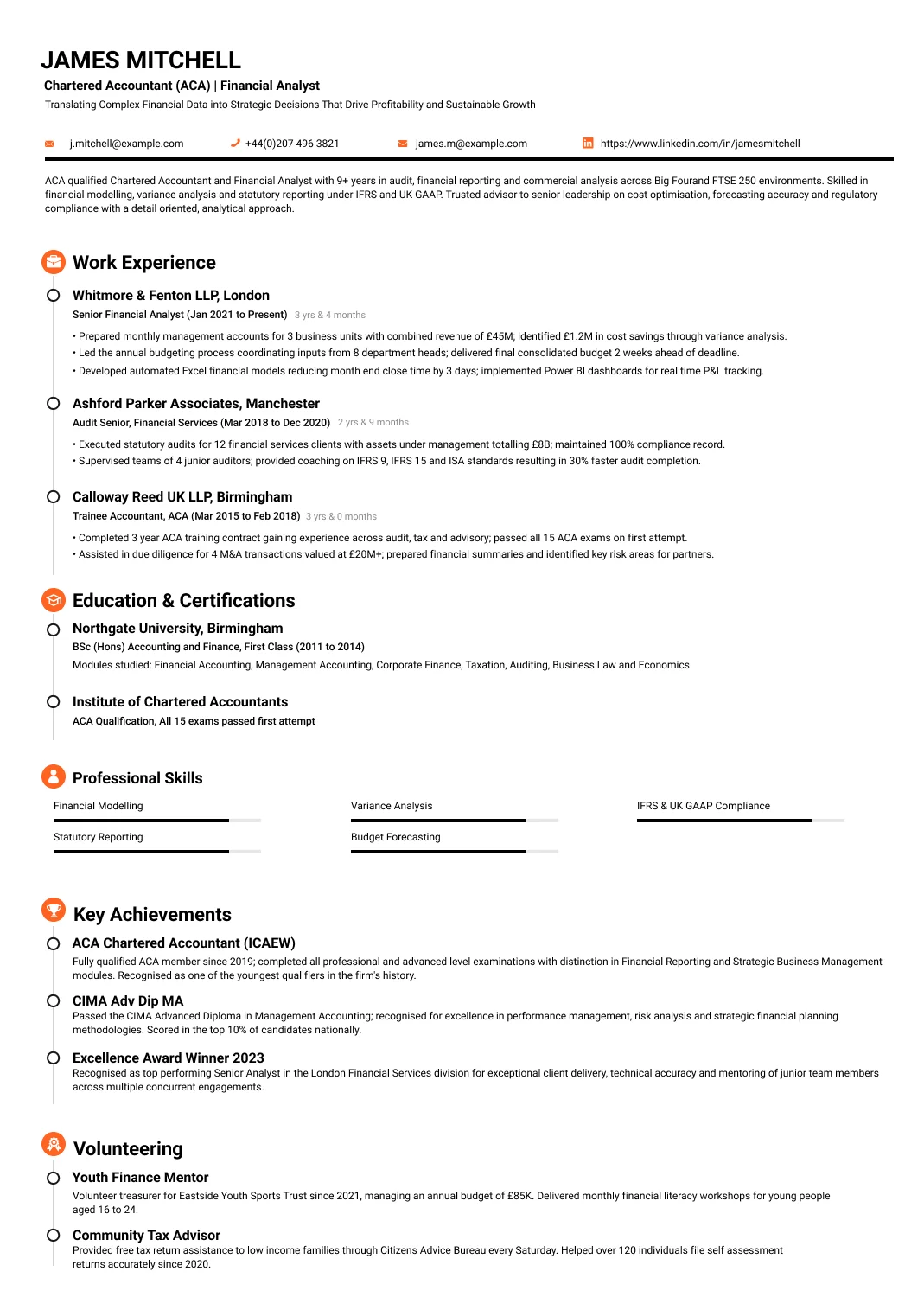
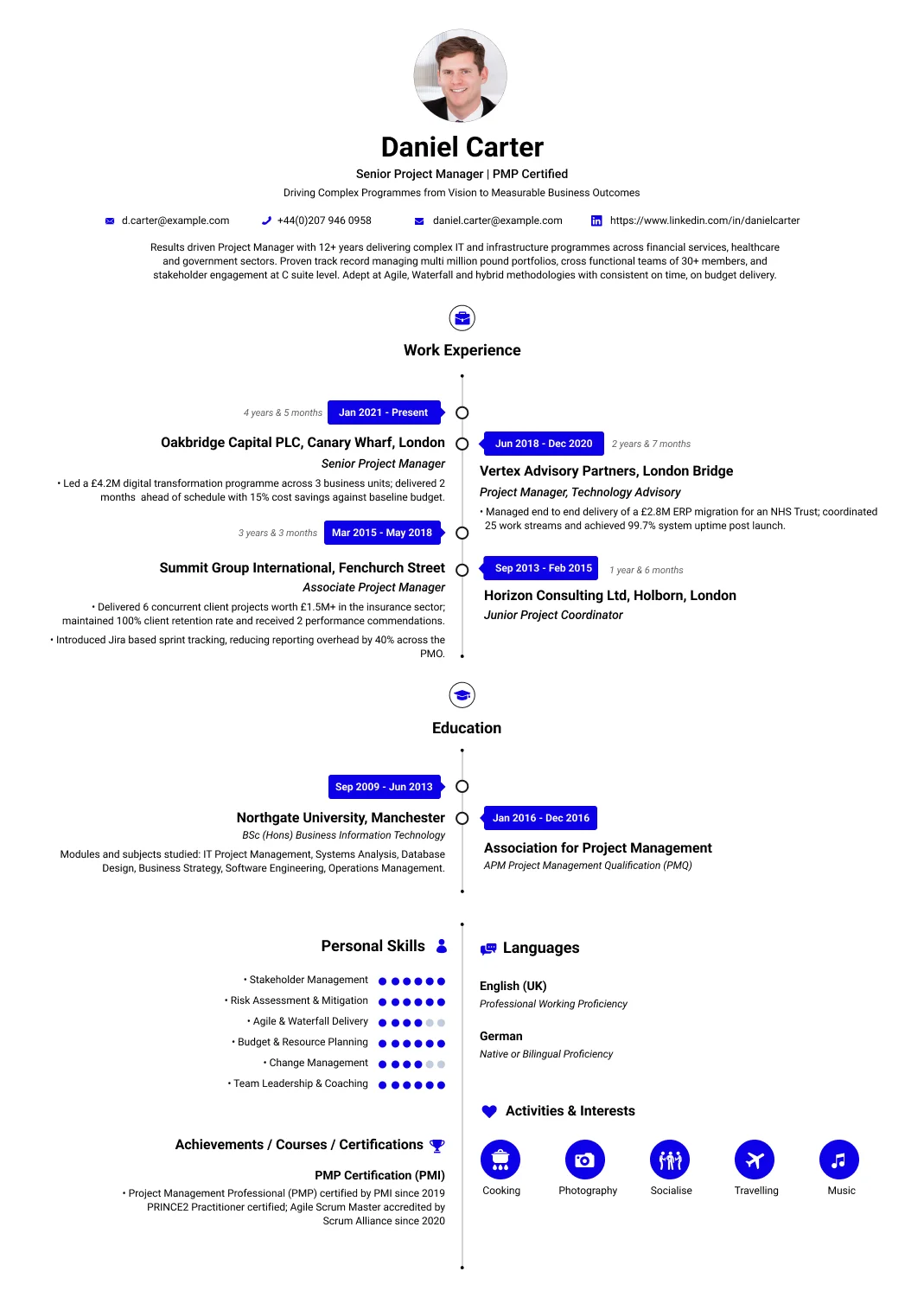
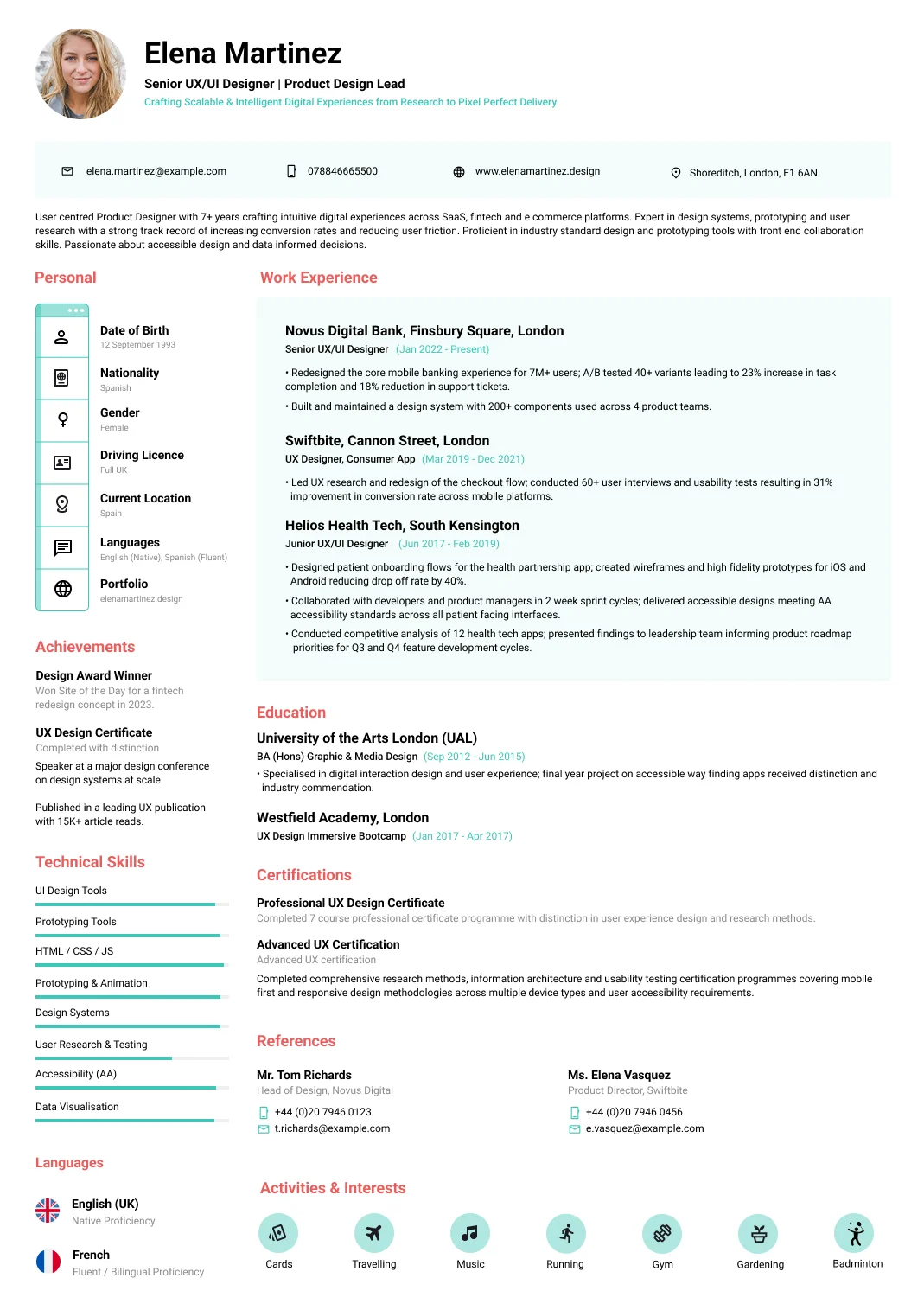
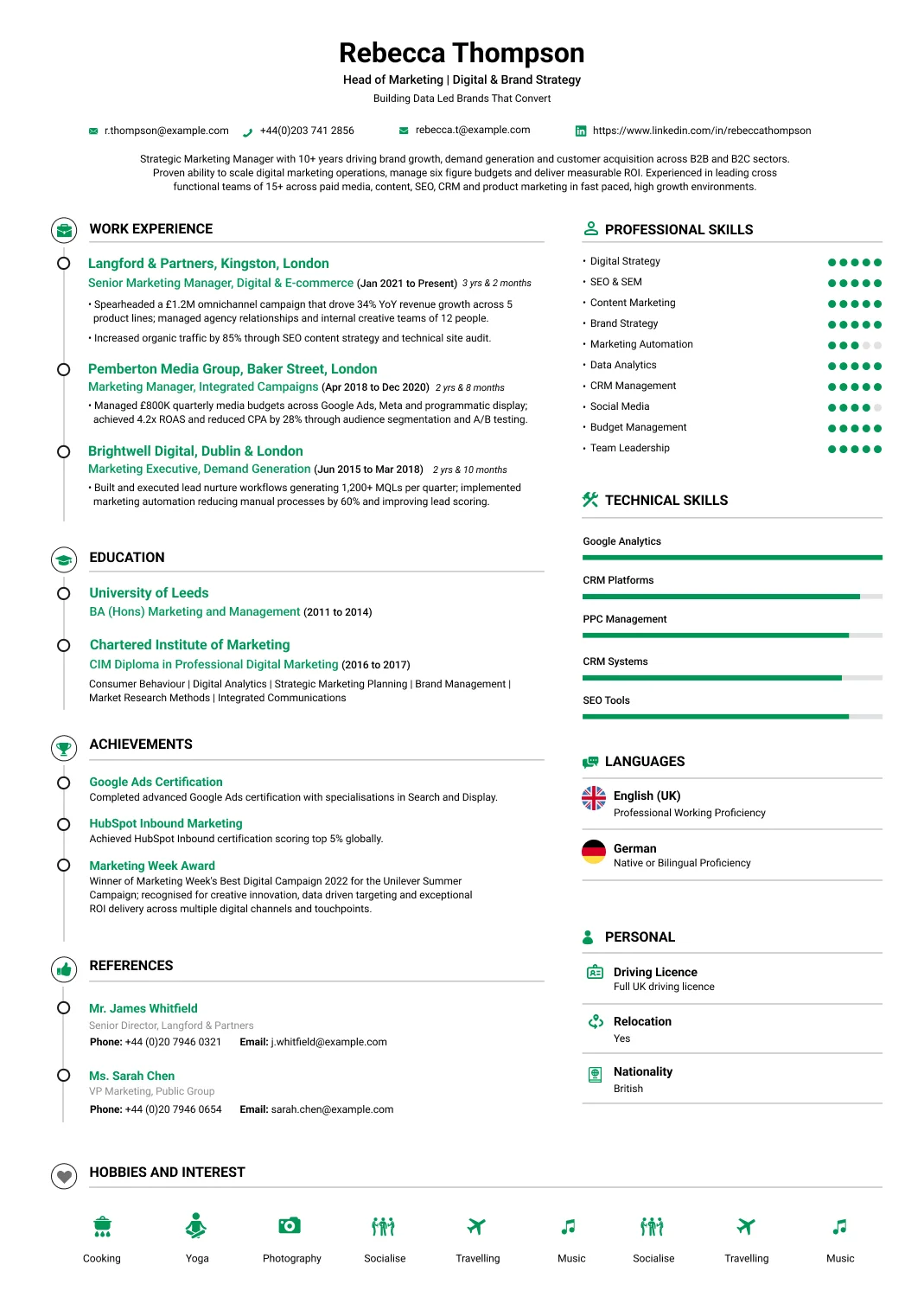
JavaScript developer with seven years building modern web applications across the stack for product companies in Seoul. Lives in JavaScript and TypeScript — crafting fast, polished React front-ends and Node back-ends, caring as much about how an interface feels to use as about the code behind it. Rebuilt a sluggish app into a fast, modern front-end that lifted engagement and built a component library adopted across teams. Builds React and TypeScript front-ends, Node APIs and full-stack features, optimises performance, writes tests, and shares reusable components and standards. Meticulous, fast-moving and genuinely product-minded. Looking for a senior front-end or full-stack JavaScript role with a team building products people love to use.
Work Experience
JavaScript Developer
Hangang Digital Products, Seoul, South Korea
Jan 2019 – Present
- Build modern web applications across the stack, caring as much about how an interface feels as about the code.
- Rebuilt a sluggish app into a fast, modern front-end that lifted engagement and built a shared component library.
- Build React and TypeScript front-ends, turning designs into fast, polished, accessible interfaces users enjoy.
- Build Node APIs and full-stack features, owning functionality end to end from the database to the screen.
- Optimise performance, hunting down the bottlenecks that make a web app feel slow and making it genuinely fast.
- Share reusable components and standards across teams, lifting the quality and consistency of the whole front-end.
Front-End Developer
Seoul Web Studio, Seoul, South Korea
Mar 2016 – Dec 2018
- Built front-end features for web products with JavaScript and React, working closely with designers.
- Developed responsive interfaces and fixed bugs, building modern front-end skills on the job.
- Learned JavaScript, React and web performance on the job across more than two years.
- Gained the experience and certifications that led into a full-stack JavaScript-developer role of my own.
Education
BSc in Computer Science, Computer Science
Korea University
Mar 2012 – Feb 2016
- Degree in computer science covering programming, web technologies, algorithms and software, with projects. The programme built the engineering foundation behind modern web development. It led directly into JavaScript development.
Front-End & React Certifications, Web Development
Meta / freeCodeCamp
Jan 2017 – Jun 2017
- Certifications covering modern front-end development, React and JavaScript to recognised standards. They sharpened modern web and component skills. They support building fast, maintainable front-end applications at scale.
Certifications
Front-End & React Certifications
Meta / freeCodeCamp
Jun 2017 – Present
- Certifications covering modern front-end development, React and JavaScript to recognised standards. They sharpened modern web skills and support building fast, maintainable front-end applications.
Highlights
Made a slow app fast
- Rebuilt a sluggish app into a fast, modern front-end that measurably lifted user engagement. Performance is a feature, and turning a slow interface into one that feels instant directly changes how much people use a product.
Component library teams adopted
- Built a shared component library that other teams adopted across the company. A well-built component library makes every team faster and the whole product more consistent, multiplying one developer's impact.
Front-End Rebuild
Front-End Rebuild & Component Library
Jan 2021 – Sep 2021
- Led a rebuild of a sluggish web app into a fast, modern React front-end and created a shared component library, which improved performance and engagement and was adopted by other teams to speed up their own work.
Languages
- Korean — Native or Bilingual Proficiency
- English (US) — Full Professional Proficiency
- Japanese — Limited Working Proficiency
Technical Skills
- JavaScript & TypeScript
- React
- Node.js
- Front-End Performance
- HTML & CSS
- REST & GraphQL APIs
- State Management
- Testing (Jest)
- Accessibility
- Component Libraries
Personal Skills
- Attention to Detail
- Product Sense
- Problem Solving
- Speed
- Collaboration
Activities & Interests
- Dog Walking
- Ski
- Climbing
- Football
- Weight Lifting
What Matters Most
Engineering managers skim JavaScript resumes in about twenty seconds. These are the things they are skimming for:
- Name the stack you ship in, with versions where they matter: TypeScript, React 18, Next.js App Router, Node 20. Vague 'JavaScript frameworks' phrasing reads as someone who has used none of them deeply.
- Performance numbers are the fastest credibility signal in front-end hiring. Largest Contentful Paint, bundle size in kilobytes, p95 API latency, Lighthouse score before and after.
- Show one feature you owned end to end, from API contract to rendered component to the tests that guard it. Ticket-closing volume tells a manager nothing about judgement.
- Testing is a screening filter, not a nice extra. Name the tools (Jest, Vitest, React Testing Library, Playwright) and what changed: coverage, flake rate, hotfix frequency.
- Link a GitHub profile and one live deployed URL. For JavaScript roles the code a manager can open often decides whether the phone screen happens at all.
- Give each role a one-line product context. What the app did, who used it, at what scale. A wall of library names with no product behind it is unreadable.
Why This JavaScript Developer Resume Works
This sample gets read all the way through, which most developer resumes do not. Here is what its structure does well:
- The summary commits to a lane, front-end leaning full-stack in JavaScript and TypeScript, instead of claiming every language, so a hiring manager can place the candidate immediately.
- It pairs an interface concern with an engineering concern in the same breath, signalling a developer who works with designers rather than one who treats the browser as an afterthought.
- Two achievements carry the whole resume: a performance rebuild tied to an engagement change, and a component library adopted by other teams. Both describe impact past the candidate's own tickets.
- The component library gets its own project entry with dates, which lets a reader see the scope of the work without hunting for it inside a bullet list.
- Skills are grouped by the way front-end work is actually divided, with performance, testing, accessibility and state management listed separately rather than dumped in one line.
- The earlier front-end role and the current full-stack role are clearly different in scope, so seven years reads as growth rather than the same year repeated seven times.
How to Write a JavaScript Developer Resume That Gets Interviews
Most JavaScript resumes are a list of libraries with no evidence attached. Write yours so an engineer reading it can picture the code:
If you would rather start from a working structure than a blank page, our online resume builder gives you a developer layout that keeps the stack and metrics readable.
Open with your lane, your stack and your scale
One sentence: 'Front-end leaning full-stack JavaScript developer, seven years, React and TypeScript with Node APIs, on a booking product serving 120,000 monthly users.' Lane, stack, scale. A recruiter can route that in five seconds, and an engineer can tell whether to keep reading.
Attach a number to every performance claim
'Improved performance' is invisible. 'Cut Largest Contentful Paint on mobile from 4.1s to 1.6s by adding server-side rendering, preloading fonts and serving responsive AVIF images' is a conversation. Bundle size in kilobytes, Core Web Vitals at p75, Lighthouse score, time to interactive. Front-end interviews go straight to these numbers, so put them in writing first.
Write the migration, not the framework name
Anyone can list TypeScript. Far fewer can describe moving 400,000 lines to strict mode incrementally without blocking feature work, or replacing a Redux store with React Query and deleting 3,000 lines of boilerplate. Migrations show architectural judgement, which is what mid to senior JavaScript hiring is really testing.
Prove you test what you ship
Name the tooling and the outcome together: Playwright end-to-end coverage on the five critical journeys, unit coverage lifted from 41 to 78 percent on a shared package, production hotfixes down from six a quarter to one. Teams with a broken release process screen hard for this.
Show the collaboration side of front-end work
Front-end sits between design, product and back-end, and that is half the job. Write the design system you published to a private npm registry and the four teams that adopted it, the API contract you negotiated with back-end, the accessibility audit you cleared to WCAG 2.1 AA. These lines get quoted back to you in interviews.
Keep links live and code current
GitHub, a portfolio, one deployed URL that still loads. Pin two repositories that show current practice, not a 2018 jQuery project. If your best work is in private repositories, write a two-line technical note about what you built and how it was architected instead.
What to Include in a JavaScript Developer Resume
Beyond the usual blocks, these are the sections that carry weight in front-end and full-stack hiring:
A technical skills block split into language, frameworks, testing, tooling and infrastructure, so a skim finds the match instantly.
GitHub, portfolio and one live deployed project URL, placed in the header rather than buried at the end.
Product context per role: what the application did, monthly active users or request volume, and team size.
A projects section for substantial work such as a design system, a migration or an open source contribution, with dates and scope.
Performance and reliability metrics gathered in one place, because these are the numbers technical screens open with.
Build and delivery tooling: Vite or Webpack, GitHub Actions, feature flags, monorepo setup with Turborepo or Nx.
Cross-functional signals such as design system ownership, accessibility work, mentoring, code review standards or RFC authorship.
Adjacent stack familiarity where it is real, such as Docker, AWS, PostgreSQL or Redis, kept short and honest.
JavaScript Developer Resume Summary Examples
The sample above belongs to a seven-year full-stack developer. Below are the rungs either side of that, so take whichever sits closest and swap in your own numbers:
Entry-level resume summary example
Front-end developer with eighteen months building production React and TypeScript interfaces for a B2B analytics dashboard used by 4,000 seats. Converted a legacy jQuery checkout across six screens to typed React components, removing roughly 4,000 lines of untyped code and halving reported validation bugs in the following quarter. Cut initial bundle size from 780KB to 420KB through route-level code splitting and replacing moment.js with date-fns. Writes unit tests with Jest and React Testing Library, having raised coverage on the shared component package from 41 to 78 percent. Comfortable working from Figma to pixel-accurate implementation and resolving accessibility defects found in axe audits. Looking for a mid-level front-end role on a product team with strong code review culture.
Mid-level resume summary example
JavaScript developer with five years across React, TypeScript and Node, currently owning the front-end of a booking product serving 120,000 monthly users. Ships weekly behind feature flags with staged rollout and a documented rollback path, and improved mobile Largest Contentful Paint from 4.1s to 1.6s by moving the app to Next.js server-side rendering with preloaded fonts and responsive AVIF images. Replaced a sprawling Redux store with React Query and Zustand, deleting 3,200 lines of boilerplate and eliminating an entire category of stale-cache defects. Added Playwright coverage across five critical journeys, dropping production hotfix releases from six a quarter to one. Seeking a senior front-end or full-stack position on a product with real scale.
Senior-level resume summary example
Senior full-stack JavaScript engineer with nine years building and scaling web products, currently setting front-end architecture for a team of nine. Designed a Node and TypeScript GraphQL gateway in front of twelve downstream services, cutting mobile client round trips from nine to two and holding p95 response time at 180ms under production load. Led a 400,000 line migration to TypeScript strict mode across two quarters using incremental adoption, so no feature work was blocked during the change. Instrumented real user monitoring against Core Web Vitals and used p75 field data to prioritise fixes that moved the mobile Lighthouse performance score from 52 to 89. Mentors four mid-level engineers and runs the team's RFC process. Seeking a staff engineer or front-end lead role.
JavaScript Developer Work Experience Examples
Three sets by seniority. Notice that every line names a technique and ends in a measurable change, which is the pattern engineering managers respond to:
Junior or first front-end role
- Built more than 30 reusable React components from Figma specifications for a customer analytics dashboard, matching spacing, state and focus behaviour so most tickets passed design review on the first pass.
- Converted a legacy jQuery checkout flow across six screens to React with TypeScript, removing roughly 4,000 lines of untyped code and cutting reported form validation defects by around half in one quarter.
- Wrote unit tests with Jest and React Testing Library for the shared form and input components, lifting coverage on the internal component package from 41 percent to 78 percent over three months.
- Resolved more than 60 accessibility defects raised in an axe audit, adding keyboard focus management and ARIA labelling so the signup and checkout flows passed a WCAG 2.1 AA review.
- Reduced the initial JavaScript bundle from 780KB to 420KB by code-splitting routes with dynamic imports, replacing moment.js with date-fns and removing three unused polyfills from the build.
Mid-level React and TypeScript developer
- Owned the React and TypeScript front-end of a booking product used by 120,000 people each month, shipping weekly behind feature flags with staged rollout and a documented rollback path for every release.
- Improved mobile Largest Contentful Paint from 4.1s to 1.6s by moving the application to Next.js server-side rendering, preloading critical fonts and serving responsive AVIF images above the fold.
- Replaced a sprawling Redux store with React Query and Zustand, deleting 3,200 lines of boilerplate and removing an entire class of stale-cache defects that had been recurring in the support queue.
- Built a design system package of 45 components published to a private npm registry, adopted by four product teams and cutting the build time for a new screen from about three days to one.
- Added Playwright end-to-end tests across the five most critical user journeys and wired them into CI, reducing production hotfix releases from six in a quarter to one over the following six months.
Senior or full-stack JavaScript engineer
- Designed and shipped a Node and TypeScript GraphQL gateway in front of twelve downstream services, cutting mobile client round trips from nine to two and holding p95 response time at 180ms in production.
- Led the migration of a 400,000 line JavaScript codebase to TypeScript strict mode over two quarters, using incremental adoption and codemods so no product feature work was blocked during the change.
- Set front-end architecture and review standards for nine engineers, introducing an RFC process that reduced rework on large features by settling design disagreements before implementation started.
- Instrumented real user monitoring with Core Web Vitals reporting, then used the p75 field data to prioritise the fixes that moved the mobile Lighthouse performance score from 52 to 89 in one quarter.
- Mentored four mid-level developers to promotion through weekly code review clinics and pairing sessions, which also lifted first-pass pull request approval rates across the wider front-end team.
Extra tips
Screenshot Lighthouse scores, bundle analyser output and p95 latency graphs the week you improve them.
Nobody can reconstruct those numbers two years later, and they are the bullets that get you interviews.
Top JavaScript Developer Skills
Applicant tracking filters and human skims both key off exact tool names, so write the ones in the job advert first and keep the list honest:
Hard skills
- JavaScript (ES2022 and later)
- TypeScript
- React and hooks
- Next.js and server-side rendering
- Node.js
- Express and Fastify APIs
- REST and GraphQL API design
- State management (React Query, Zustand, Redux Toolkit)
- Semantic HTML5
- Modern CSS (Grid, Flexbox, Tailwind, CSS modules)
- Web performance and Core Web Vitals
- Build tooling (Vite, Webpack, esbuild)
- Unit testing (Jest, Vitest, React Testing Library)
- End-to-end testing (Playwright, Cypress)
- Accessibility (WCAG 2.1 AA, ARIA)
- Git and trunk-based development
- CI/CD with GitHub Actions
- Browser profiling and debugging (DevTools, Lighthouse)
- WebSockets and real-time data
- Design system and component library development
Soft skills:
- Product judgement
- Code review craft
- Clear written technical communication
- Patience in debugging
- Mentoring
- Honest estimation
Certifications for a JavaScript Developer
Certificates matter less in JavaScript hiring than shipped code, so treat these as supporting evidence rather than the headline, and keep them to a short block near the end:
-
Meta Front-End Developer Professional Certificate
— Meta (via Coursera) Optional. Most useful for career changers who need external proof of React and front-end fundamentals.
-
JavaScript Algorithms and Data Structures
— freeCodeCamp Free and self-paced. Worth listing only for junior applications, and drop it once you have two years of shipped work.
-
JSNAD
— OpenJS Foundation (Linux Foundation) Optional but genuinely respected for back-end JavaScript roles; it is a hands-on exam rather than multiple choice.
-
AWS Certified Developer, Associate
— Amazon Web Services Optional. Relevant when the role includes serverless Node work with Lambda, API Gateway and DynamoDB.
JavaScript Developer Resume Mistakes to Avoid
These are the patterns that get JavaScript applications closed early, and each one is a five minute fix:
- Listing thirty libraries with no depth. A recruiter cannot tell Redux from Recoil, but the engineer reading second can, and an inflated list invites questions you will not enjoy.
- Describing tickets rather than outcomes. 'Worked on the dashboard' says nothing; the render time you cut or the bug class you removed says everything.
- No performance numbers anywhere. Front-end interviews open on Core Web Vitals and bundle size, so a resume without them starts the conversation on the back foot.
- Dead links. A broken portfolio URL or a GitHub profile whose last commit was in 2021 undoes the rest of the page instantly.
- Hiding TypeScript. Most production React teams are typed now, and leaving TypeScript off or burying it in a list reads as JavaScript-only experience.
- Ignoring testing entirely. A resume with no test tooling suggests someone else has been cleaning up after your releases.
- Writing 'full-stack' with no back-end evidence. If Node, database design and API work do not appear in your bullets, claim front-end and be strong at it.
JavaScript Developer Resume FAQs
The questions developers search most often before applying for a JavaScript role:
Start with JavaScript and TypeScript, your main framework, Node if you use it, testing tools, and web performance. Add build tooling, accessibility and API design, then match the exact wording of the job advert. Keep the list to tools you would be comfortable debugging in a live interview.
One page up to about five years of experience, two pages beyond that. Engineering managers read the top third closely and skim the rest, so put your strongest shipped work and your performance numbers in that first block rather than saving them for the end.
Yes, if the profile shows current work. Put it in the header next to your email and pin two repositories that reflect how you write code now. An empty or stale profile is worse than no link, so tidy it before you add the URL.
No. Most JavaScript hiring runs on a portfolio, a technical screen and a take-home or pairing exercise. A computer science degree helps with larger enterprises and visa applications, but self-taught and bootcamp developers with deployed products get hired at every level of the market.
Yes, and be specific about it. Name the version and the patterns you use, such as React 18 with server components or hooks-based state, plus your routing and data-fetching approach. 'React' alone is the most common word on these resumes and carries almost no information by itself.
Give each project three lines: what it does, the stack, and one measurable result or technical decision worth defending. Add a live URL and the repository. Two well-explained projects beat six placeholder entries, especially for junior applications where projects carry the whole resume.
It helps but it is not mandatory. A deployed application with a public repository does the same job, and for back-end leaning Node developers it does it better. If you do build a portfolio, make it fast, because a slow personal site from a front-end developer is a hard first impression to recover from.
Get Started With Our
Free Resume Creator today!
Free sign-up. No credit card required.