
Was this sample helpful? Rate it!
Average: 4.8 (25 votes)


Contents
What Matters Most
Why This Fraud Analyst Resume Works
How to Write a Fraud Analyst Resume That Gets Interviews
What to Include in a Fraud Analyst Resume
Fraud Analyst Resume Summary Examples
Fraud Analyst Work Experience Examples
Top Fraud Analyst Skills
Fraud Analyst Certifications
Common Fraud Analyst Resume Mistakes
Fraud Analyst Resume FAQs

Summary
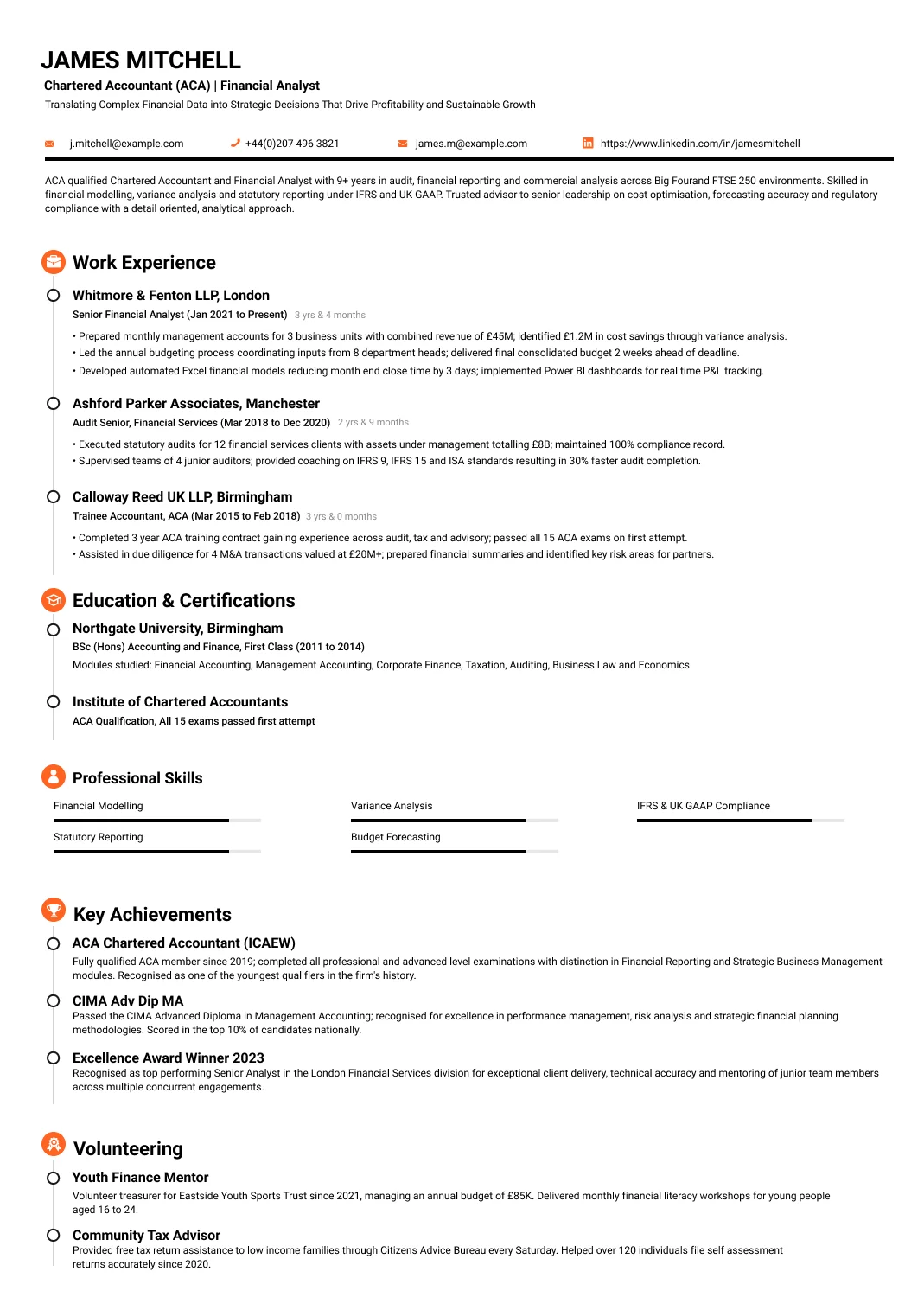
Highly analytical and detail-oriented Fraud Analyst with 5 years of experience in financial services, specialising in identifying, investigating, and mitigating fraudulent activities. He possesses proven expertise in utilising advanced data analytics tools, machine learning models, and regulatory knowledge to detect complex fraud patterns and protect organisational assets. James is adept at collaborating with cross-functional teams to implement robust fraud prevention strategies and enhance security protocols. He has a strong track record of reducing financial losses and improving compliance. Seeking to leverage his strong investigative skills and commitment to financial integrity to contribute to a leading institution's fraud risk management efforts.
Work Experience
Fraud Analyst
Barclays Bank, London, UK
Sep 2019 – Present
- Led investigations into complex financial fraud cases, including account takeover, payment fraud, and identity theft, resulting in a 15% reduction in annual losses.
- Developed and implemented new fraud detection rules within the transaction monitoring system, improving alert accuracy by 20% and reducing false positives.
- Collaborated with the data science team to refine machine learning models for proactive fraud identification, enhancing detection rates for emerging fraud typologies.
- Prepared detailed investigative reports and presented findings to senior management and law enforcement agencies.
- Mentored junior analysts on best practices for fraud investigation and case management.
Junior Fraud Analyst
HSBC, London, UK
Oct 2017 – Aug 2019
- Reviewed and actioned daily fraud alerts from various channels, including online banking, credit cards, and mobile payments.
- Conducted initial investigations into suspicious activities, gathering evidence and documenting findings in case management systems.
- Assisted senior analysts in preparing comprehensive fraud reports and trend analyses.
- Participated in cross-functional workshops to identify vulnerabilities and propose enhancements to fraud prevention controls.
- Maintained up-to-date knowledge of fraud trends, regulatory requirements (e.g., PSD2, GDPR), and industry best practices.
Education
Master of Science, Criminology and Criminal Justice
University College London (UCL)
Sep 2016 – Sep 2017
- Focused on financial crime, cybercrime, and forensic investigation techniques. Dissertation on the psychological profiling of online fraudsters.
Bachelor of Science, Economics
University of Manchester
Sep 2013 – Jun 2016
- Developed strong analytical and quantitative skills, with modules in econometrics, financial markets, and risk analysis.
Certifications
Certified Fraud Examiner (CFE)
Association of Certified Fraud Examiners (ACFE)
Mar 2020 – Present
- Globally recognised certification demonstrating expertise in fraud prevention, detection, and deterrence.
Professional Development Courses
Advanced Data Analytics for Fraud Detection
Coursera (IBM)
Jan 2021 – Mar 2021
- Intensive course covering advanced statistical methods, machine learning algorithms, and big data tools for identifying complex fraud patterns.
Financial Crime Prevention Specialist
International Compliance Association (ICA)
May 2018 – Jul 2018
- Comprehensive training on anti-money laundering (AML), counter-terrorist financing (CTF), and sanctions compliance.
Languages
- English (UK) — Native
- French — Professional
Technical Skills
- SQL
- Python (Pandas, NumPy)
- Microsoft Excel (Advanced)
- Fraud Detection Systems (e.g., Actimize, Falcon)
- Data Analysis & Visualization
- Anti-Money Laundering (AML)
- Know Your Customer (KYC)
- Risk Assessment & Management
- Regulatory Compliance (FCA, PSD2)
- Machine Learning Fundamentals
Personal Skills
- Analytical Thinking
- Problem-Solving
- Attention to Detail
- Critical Thinking
- Effective Communication
- Ethical Judgment
Activities & Interests
- Reading
- Taking Bath
- Shooting
- Music
- Talking
What Matters Most
Before the detail, here is what actually decides a strong fraud analyst résumé:
- Lead with quantified loss impact: fraud value prevented in £/$, detection-rate lift, and false-positive reduction beat any adjective.
- Name your detection stack explicitly: Actimize, Falcon, SAS, or a bank-built rules engine, plus SQL and Python for your own queries.
- Show you tune rules, not just clear alerts: rule writing, threshold changes, and the false-positive percentage you cut signal seniority fast.
- Anchor in regulation: FCA, PSD2, AML/KYC, and SAR/STR filing tell a UK or EU hiring manager you know the compliance perimeter.
- Quantify alert throughput and SLA: alerts worked per day and case turnaround times prove you can carry a real queue, not just describe one.
- Distinguish fraud from AML: investigations, chargebacks, and account-takeover work read differently from sanctions and transaction-monitoring-only roles.
Extra tips
Scheme representment wins cluster around 70 to 75 percent, so quote yours where it reads as strong.
Below 60 percent, drop the number and show dispute volume recovered instead.
Why This Fraud Analyst Resume Works
This résumé reads like five years inside UK retail banking rather than a generic compliance CV. Here is what it gets right structurally:
- The experience leads with a quantified loss outcome, the 15% reduction in annual losses, which puts the number a recruiter scans for at the front of the most senior role.
- It pairs the loss figure with a rule-tuning result, improving alert accuracy by 20% while cutting false positives, which is the move that separates an investigator from someone who only clears alerts.
- The fraud types are named, account takeover, payment fraud, and identity theft, so the typology coverage is explicit rather than hidden behind 'fraudulent activity'.
- The two roles show a clean junior-to-analyst arc at named banks, Barclays after HSBC, so progression is legible without a single seniority adjective.
- The skills list carries the real stack, SQL, Python, Actimize and Falcon, AML/KYC, and FCA/PSD2, which lines up with what an ATS and a fraud-team lead screen for.
- The CFE certification and the criminology MSc back the financial-crime angle, giving the regulatory and investigative claims a credential to stand on.
How to Write a Fraud Analyst Resume That Gets Interviews
A fraud résumé is judged on whether you can carry a queue and improve it. Build each section around that:
Open the summary with your fraud domain and a loss number
Name the fraud types you work and the value you protect in the first line. 'Fraud analyst, 5 years in UK card and payment fraud, £2.4m in losses prevented over two years' tells a hiring manager more than any 'analytical professional' opener. Drop the adjectives and lead with scope plus a figure, then drop that opener into a ready template and build the rest of the page around it.
Quantify every bullet with the metrics a fraud team tracks
Use the queue's own KPIs: alert volume worked, false-positive reduction %, detection or hit rate, fraud £ prevented, and case SLA. 'Reduced false positives 28% by retuning velocity rules' is a hireable bullet; 'monitored transactions for fraud' is wallpaper.
Name your detection systems and your query tools separately
List the platform you operate, Actimize, Falcon, SAS Fraud Management, or a proprietary engine, and the languages you use to investigate, SQL and Python. Teams want to know whether you only action alerts inside a vendor tool or can pull and analyse your own data.
Show rule and model work, not just alert clearance
If you have written or tuned detection rules, set thresholds, or worked with data science on model features, make it a bullet with a before/after. Rule tuning and false-positive control are the clearest seniority signal on a fraud résumé.
Frame the regulatory and reporting side concretely
Reference the actual obligations you touched: SAR/STR filing, FCA and PSD2 requirements, AML/KYC checks, and reporting to the MLRO or senior management. This shows you understand the controls your detection work feeds, not just the tooling.
What to Include in a Fraud Analyst Resume
Beyond the standard sections, these carry disproportionate weight for fraud and financial-crime hiring:
A certifications block: CFE (ACFE) and CAMS (ACAMS) are the two credentials fraud and financial-crime managers recognise on sight.
A named detection-systems line so screeners can match you to their stack, Actimize, Falcon, SAS, Lynx, or in-house.
Explicit typology coverage, card, payment, account takeover, application/identity, APP and authorised-push-payment scams, so your range is searchable.
Regulatory exposure spelled out: FCA, PSD2/SCA, AML/KYC, SAR filing, and where relevant the Fraud Act or scheme rules (Visa/Mastercard chargebacks).
Tooling for your own analysis, SQL and Python or SAS, distinct from the vendor platform you action alerts in.
Fraud Analyst Resume Summary Examples
Three summaries climbing from a first fraud-queue role to a senior rule-owner, each pronoun-free and built on loss figures and false-positive movement rather than adjectives; treat them as a shape to adapt, not a line to copy:
Junior-level resume summary example
Fraud analyst with two years on a UK card and payment queue, clearing 65 transaction-monitoring alerts daily in Actimize across online banking, debit, and CNP channels to a 24-hour first-action SLA. Wrote ad-hoc SQL to pull and link suspect authorisations, surfacing a card-testing pattern that fed a new velocity rule and contributed to roughly £180k in blocked losses across a single quarter. Comfortable triaging genuine fraud from false positives, documenting evidence for SAR referral under FCA and PSD2 obligations, and escalating confirmed cases cleanly to senior investigators. Studying for the CFE and building Python (Pandas) skills to move from clearing alerts toward tuning the rules behind them.
Mid-level resume summary example
Fraud analyst with five years across card, payment, and account-takeover fraud at two UK retail banks, operating Actimize and Falcon alongside SQL and Python for independent pattern analysis. Retuned velocity and geolocation rules to cut false positives 24% while holding detection rate steady, recovering meaningful analyst capacity on a queue averaging 70 alerts a day. Investigated account-takeover and CNP cases end to end, linking incidents by device and IP to expose a fraud ring behind £210k in attempted transfers, and authored chargeback representments under Visa and Mastercard rules at a 70% win rate. Files SARs to the MLRO and works AML and KYC step-up checks; CFE certified with strong FCA and PSD2 grounding.
Senior-level resume summary example
Senior fraud analyst with nine years spanning card, payment, account-takeover, and authorised-push-payment scams across UK retail banking, owning detection-rule tuning in SAS Fraud Management and Actimize. Cut false positives 31% over twelve months while lifting confirmed-fraud hit rate, and prevented an estimated £3.4m in losses last year through rule rewrites, BIN blocks, and earlier mule-account interdiction. Partners with data science on model features such as behavioural biometrics, reduced model false-negative leakage, and reports typology trends directly to the fraud risk committee. Mentors junior analysts on case management and SAR quality, and grounds every control in FCA, PSD2, and AML and KYC requirements; CFE and CAMS certified.
Fraud Analyst Work Experience Examples
Each set targets a different fraud specialism so you can borrow the angle nearest your own work; every bullet is pronoun-free, verb-first, and carries context plus a quantified action and the loss, alert-volume, false-positive, or SLA result behind it:
Card & payment fraud analyst
- Worked an average of 70 transaction-monitoring alerts daily across debit, credit, and card-not-present channels in Actimize, holding a four-hour first-action SLA while keeping queue backlog under one shift's volume.
- Retuned velocity and geolocation detection rules in Falcon, cutting false positives 26% over a quarter without lowering confirmed-fraud hit rate and freeing roughly a day of analyst capacity each week.
- Identified a card-testing pattern across 1,400 declined authorisations using SQL, then triggered a coordinated BIN block with the issuer team that prevented an estimated £480k in projected fraud losses.
- Authored 90-plus chargeback representment cases under Visa and Mastercard scheme rules, evidencing each dispute to a 71% win rate and recovering close to £140k of provisional credit.
- Escalated confirmed first-party and third-party fraud to the SAR team within SLA, documenting evidence trails in the case management system to support MLRO filing under FCA and PSD2 obligations.
Account-takeover & digital fraud analyst
- Investigated account-takeover alerts spanning credential stuffing, SIM-swap, and phishing across web and mobile, closing 40-plus cases weekly while keeping average case turnaround inside the two-hour digital-fraud SLA.
- Built SQL queries linking related ATO incidents by device fingerprint and IP, surfacing a coordinated fraud ring responsible for £210k in attempted transfers and feeding three confirmed law-enforcement referrals.
- Tightened KYC step-up authentication rules on suspected mule onboarding, lowering confirmed authorised-push-payment scam payouts 18% quarter on quarter and reducing downstream remediation cost.
- Partnered with data science to add behavioural-biometric features to the login-fraud model, lifting detection rate 12% on session-hijack attempts while holding the customer false-positive challenge rate flat.
- Produced weekly typology briefings on emerging digital-fraud trends for the fraud operations lead, translating alert clusters into two preventative rule changes deployed within the reporting period.
Rules-tuning & detection analyst
- Owned the detection-rule lifecycle in SAS Fraud Management, running monthly threshold reviews that cut the overall false-positive rate 31% across twelve months while preserving confirmed-fraud capture.
- Backtested proposed rule changes against six months of labelled transaction data in Python, quantifying precision and recall trade-offs before release to keep the live alert volume within agreed analyst headcount.
- Decommissioned 14 stale and overlapping rules generating high-noise alerts, reclaiming an estimated 22% of daily queue time and redirecting it toward genuine high-value fraud investigation.
- Designed a velocity-and-amount rule targeting emerging APP scam patterns that intercepted £620k in attempted faster-payment fraud across its first two full quarters live in production.
- Documented every rule change with rationale, thresholds, and measured impact for FCA-aligned audit readiness, giving the fraud risk committee a traceable record of detection-coverage decisions.
Top Fraud Analyst Skills
The hard skills a fraud team screens for, weighted toward detection tooling, query languages, and the regulatory perimeter:
Getting a named detection stack and your quantified outcomes to sit legibly side by side is half the work on a fraud CV. If a wall of keywords like Actimize, SQL and false-positive reduction is crowding out your loss figures, you can arrange your stack and results on a structured template so a fraud-team lead reads both in one scan.
Hard skills
- SQL
- Python (Pandas, NumPy)
- Fraud detection systems (Actimize, Falcon, SAS Fraud Management)
- Transaction monitoring
- Detection rules tuning
- False-positive reduction
- Anti-Money Laundering (AML)
- Know Your Customer (KYC)
- SAR / STR filing
- Chargeback & dispute handling
- Link analysis
- Data analysis & visualization
- Fraud typology analysis
- Case management systems
- Regulatory compliance (FCA, PSD2)
- Risk assessment & scoring
- Machine learning fundamentals
- Advanced Excel
Soft skills:
- Analytical thinking
- Investigative judgment
- Pattern recognition
- Clear written reporting
- Ethical judgment
- Cross-functional collaboration
- Decision-making under SLA pressure
Fraud Analyst Certifications
None of these are mandatory to work a fraud queue, but each one is recognised on sight by financial-crime hiring managers and turns up in senior job specs; list one in progress if you are still studying for it:
-
CFE
— ACFE Optional but the most valued fraud-specific credential; the one a fraud-team lead recognises fastest for investigation and detection roles.
-
CAMS
— ACAMS Optional; the standard AML/financial-crime credential, worth adding where a fraud role overlaps transaction monitoring, SAR filing, and KYC.
-
CFCS
— ACFCS Optional; a broader financial-crime credential spanning fraud, AML, and sanctions, useful if your work crosses those boundaries rather than sitting in fraud alone.
Common Fraud Analyst Resume Mistakes
These are the errors that cost fraud candidates interviews specifically, not generic résumé slip-ups:
- Writing 'monitored transactions for fraudulent activity' with no numbers, when the role is judged on alert volume, false-positive %, and £ prevented.
- Hiding the detection stack, leaving Actimize, Falcon, or SAS off the page so screeners can't match you to their tooling.
- Listing only alert clearance and never rule or model tuning, which reads as junior even at five years in.
- Blurring fraud with AML, treating sanctions screening, SAR-only roles, and fraud investigation as one thing when hiring managers screen for the specific one.
- Claiming 'regulatory knowledge' without naming FCA, PSD2, or KYC, the named obligations are what make the claim credible.
- Padding with vague adjectives about being careful or experienced instead of the throughput and recovery figures that actually carry the bullet.
Fraud Analyst Resume FAQs
The questions candidates most often ask when writing a fraud analyst résumé:
SQL is effectively expected and Python is a strong differentiator. SQL lets you pull and link transaction data for investigations, and Python (Pandas) signals you can analyse fraud patterns beyond a vendor dashboard; list both if you have them, with the libraries you actually use.
Lead with detection systems (Actimize, Falcon, SAS), SQL, transaction monitoring, rule tuning, and false-positive reduction, then AML/KYC, SAR filing, and FCA/PSD2 knowledge. Pair these hard skills with quantified outcomes rather than soft adjectives so each one is backed by evidence.
No, though they overlap. A fraud analyst investigates and prevents direct financial loss, card fraud, account takeover, chargebacks, while an AML analyst focuses on money-laundering typologies, sanctions, and SAR filing. Tailor the résumé to the specific role; lumping them together reads as unfocused to hiring managers.
It is not mandatory but it carries real weight. The CFE (ACFE) is the recognised fraud credential and CAMS (ACAMS) the AML one; either signals serious intent and both appear in many senior fraud job specs. List a certification in progress if you are studying for it.
No specific degree is required. Economics, criminology, data, accounting, or law backgrounds all work, and many strong analysts enter from operations or customer-facing roles. What matters more on the résumé is demonstrated analytical work and tooling, so a degree should support your numbers, not replace them.
Use the metrics the queue tracks: fraud value prevented in £ or $, false-positive reduction %, detection or hit rate, alerts worked per day, case SLA, and chargeback win rate. Even rough but honest figures beat vague claims, since these are exactly the numbers a fraud team lead measures performance by.
One page for under ten years of experience, two pages only if a longer financial-crime career genuinely needs it. Prioritise recent detection work, quantified outcomes, and your tooling; trim older or non-fraud roles to a line so the page stays scannable for a queue-focused hiring manager. If getting that balance right on a high-stakes financial-crime CV feels daunting, you can have a specialist writer shape it with you.
Get Started With Our
Free Resume Creator today!
Free sign-up. No credit card required.