Was this sample helpful? Rate it!
Average: 4.9 (26 votes)


Contents
Key Takeaways for an Elementary Teacher Resume
What This Resume Gets Right
How to Write an Elementary Teacher Resume
Key Sections for an Elementary Teacher Resume
Elementary Teacher Resume Summary Examples
Elementary Teacher Work Experience Examples
Top Elementary Teacher Skills
Certifications for an Elementary Teacher
How Much Does an Elementary Teacher Earn?
Common Elementary Teacher Resume Mistakes
Elementary Teacher Resume FAQs

Summary
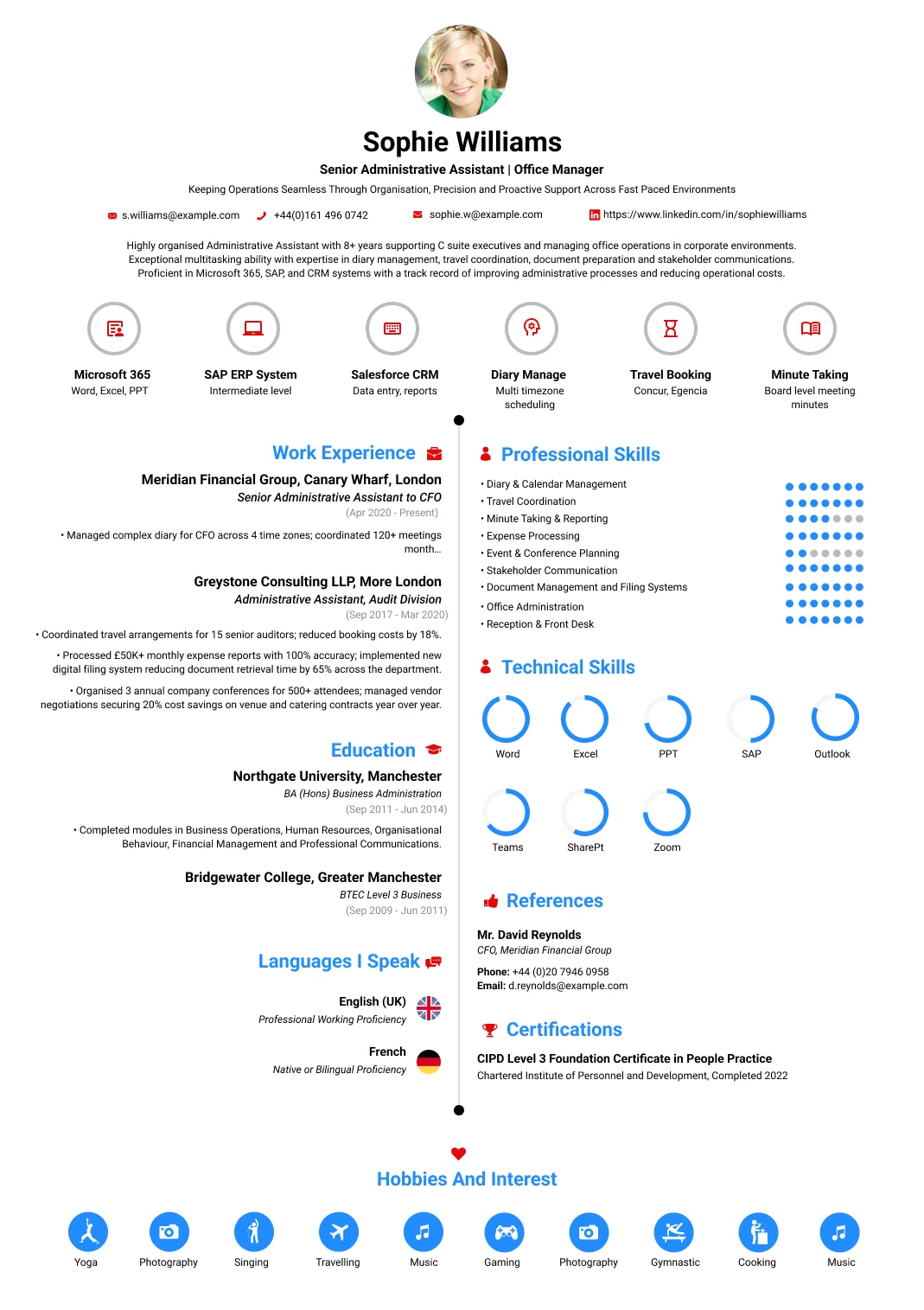
Elementary teacher with seven years teaching primary grades in bilingual public schools in Phoenix. Brings patience, creativity and high expectations to a classroom of mixed backgrounds and abilities, helping every child make real progress in literacy, numeracy and confidence. Improved reading levels across her class through small-group guided reading and was recognised by the district for the gains. Plans and delivers engaging, standards-aligned lessons, differentiates for English-language learners, assesses and tracks growth, and builds genuine relationships with families. Warm, organised and committed to equity in the classroom. Looking for an elementary teaching role with a school serving a diverse community that believes every child can succeed.
Work Experience
Elementary Teacher
Saguaro Elementary School, Phoenix, AZ
Aug 2019 – Present
- Teach a primary classroom of mixed backgrounds and abilities, helping every child grow in literacy, numeracy and confidence.
- Improved reading levels across the class through small-group guided reading and was recognised by the district for the gains.
- Plan and deliver engaging, standards-aligned lessons, then differentiate them for English-language learners and a range of needs.
- Assess and track each child's growth closely, using the data to target support and to keep families informed of progress.
- Build a warm, well-managed classroom with clear routines, so children feel safe, included and ready to learn each day.
- Partner with parents and colleagues across languages, joining up support for each child between home and school.
Teacher (Lower Grades)
Desert View Public School, Phoenix, AZ
Aug 2017 – Jul 2019
- Taught lower-grade classes in a bilingual school, planning and delivering lessons and assessing progress across the curriculum.
- Supported English-language learners with targeted strategies that improved their access and engagement in class.
- Learned differentiation, assessment and classroom management on the job across two years of full-time teaching.
- Gained the bilingual endorsement and the move into an elementary-teaching role with more responsibility.
Education
BA in Elementary Education, Elementary Education
Arizona State University
Aug 2013 – May 2017
- Degree in elementary education covering child development, literacy, numeracy and pedagogy, with student-teaching placements. The programme combined theory with real classroom practice. It qualified certification as an elementary teacher.
Bilingual Education Endorsement, Bilingual Education
Arizona Department of Education
Jan 2018 – Jun 2018
- Endorsement covering bilingual instruction and supporting English-language learners in the primary classroom. It deepened the ability to teach a linguistically diverse class. It strengthened equitable, inclusive classroom practice.
Highlights
Raised reading levels
- Improved reading levels across the class through small-group guided reading and earned district recognition for the gains. Lifting reading early opens the door to success in every other subject, which makes it some of the most important work a teacher does.
Teaches every learner
- Differentiates for English-language learners and a wide range of needs so every child can take part and progress. Meeting a diverse class where each child actually is is the heart of equitable, effective teaching.
Certification
Certified Elementary Teacher (Bilingual)
Arizona Department of Education
Aug 2017 – Present
- State teaching certification with a bilingual endorsement covering curriculum, assessment and supporting English-language learners. It is the credential required to teach and underpins the inclusive classroom practice applied every day.
Guided Reading Programme
Guided Reading Programme
Aug 2021 – May 2022
- Set up a small-group guided-reading programme tailored to each child's level, tracking growth closely, which measurably raised reading levels across the class and was recognised by the district as effective practice.
Languages
- English (US) — Native or Bilingual Proficiency
- Spanish — Native or Bilingual Proficiency
Technical Skills
- Lesson Planning
- Guided Reading
- Differentiated Instruction
- Bilingual Instruction
- Supporting ELLs
- Assessment & Data
- Classroom Management
- Literacy & Numeracy
- Family Engagement
- Social-Emotional Learning
Personal Skills
- Patience
- Creativity
- Warmth
- Equity Focus
- Organisation
Activities & Interests
- Kite Flying
- Friends
- Dart
- Cleaning
- Horse Riding
Key Takeaways for an Elementary Teacher Resume
Principals and district HR screen elementary applications quickly and on narrow criteria. These are the ones that decide it:
- State certificate first, grade band second. "Arizona certified, K-8 elementary, bilingual endorsement" in line one clears the compliance filter before anything else is read.
- Endorsements are screening criteria, not extras. Bilingual, ESL, SEI, reading and gifted endorsements often determine which vacancies you are even eligible for.
- Reading growth is the single most persuasive number on an elementary resume, so name the assessment behind it rather than claiming improvement in the abstract.
- Name the curricula and programs you have taught: Wonders, Eureka Math, Fountas and Pinnell, Heggerty, DIBELS. Principals hire for the shortest possible onboarding.
- Describe classroom management as a system with a result, not as a personal quality. Transition routines, a behaviour framework and the instructional minutes you recovered.
- If you teach a linguistically diverse class, make your language ability and family communication concrete, because in many districts it is the deciding factor between two equal candidates.
What This Resume Gets Right
The sample above is worth reading for its structure rather than its phrasing. Each of these choices does specific work with a principal:
- The first line fixes three screening facts at once: seven years of experience, primary grades, and bilingual public schools. A district screener can route the application from that sentence alone.
- The reading result is tied to a method and to external recognition rather than left as a claim, which is the difference between an assertion and evidence a principal can trust.
- Differentiation for English-language learners appears in the experience bullets and again in the endorsement, so the credential and the practice corroborate each other instead of sitting in separate lists.
- The guided-reading programme is given its own dated entry rather than buried inside a job. A distinct instructional initiative with a start and end date reads as leadership, not routine.
- Native-level Spanish is listed as a language rather than tucked into a skills line, which matters in this district because it is a hiring criterion for a bilingual classroom.
- Assessment and data tracking are described as a loop that feeds targeted support and family updates, which is exactly how an instructional coach would want a teacher to talk about data.
How to Write an Elementary Teacher Resume
An elementary application is screened in two passes: an eligibility check on certification, then an instructional read by the principal. Write for both:
Put certification and grade band above the fold
Open with the state, the certificate type, the grade range and every endorsement, with expiry years. "Arizona Standard Elementary Education Certificate, K-8, Bilingual Education Endorsement, valid to 2028" belongs in the top inch of page one. District HR checks this before a principal ever sees the file, and an unclear certification line is the most common reason an otherwise strong application stops moving.
Anchor to the grade you actually teach
Kindergarten, second grade and fifth grade are different jobs, and a resume that says only "elementary" makes a principal guess. Say which grades and for how long, and pick your examples from the band you are applying to teach. Phonemic awareness routines belong on a K-2 resume; a four-stage writing revision process and state science testing belong on a grades 3-5 one.
Give growth data with the assessment named
"Improved reading levels" is the weakest sentence on most teaching resumes. Name the measure and the movement: "lifted the class from 42 to 61 percent at benchmark on the winter DIBELS composite" or "moved 21 of 28 students up at least one level on the district narrative writing rubric between September and March." Instructional leaders read for the instrument as much as the number.
{TIP}
Show differentiation as a specific technique
Every teacher writes that they differentiate. Show the mechanics instead: sentence frames and preteaching for WIDA level 1 to 3 students, three targeted math groups regrouped every six weeks, a decodable text ladder for students below grade level. Naming the strategy and who it was for proves you can actually do it in a class of twenty-eight.
Describe classroom management as a system
Principals hire for the class that runs without them in it. Give the structure and its effect: a visual routine board and a three-step transition signal that cut lost instructional minutes from twelve to four a day, or a restorative check-in that reduced office referrals. This is far more convincing than any adjective about patience or warmth.
Make the family partnership concrete
Elementary hiring weighs family communication heavily because young children's progress depends on it. Give the cadence, the format and the result: weekly photo updates, conferences offered in both languages, attendance rising from 61 to 94 percent. If you can communicate with families in the community's home language, say so explicitly and early.
A teaching resume has to fit certification, endorsements, curricula and growth data into a very tight space. Laying it out in a free resume builder keeps that detail readable instead of crushed into the margins.
Key Sections for an Elementary Teacher Resume
Several blocks carry unusual weight in elementary hiring and are worth building deliberately:
A certification block near the top with state, certificate type, grade range, endorsements and expiry dates, plus any reciprocity if you are applying out of state.
Curriculum and program fluency, listing the reading, math and intervention programs you have taught rather than a generic technology list.
Assessment literacy: the screeners, benchmarks and state tests you have administered and used, such as DIBELS, NWEA MAP, ACCESS or your state assessment.
A student-growth block with two or three results tied to named measures, which is the closest thing an elementary teacher has to a sales figure.
Grade-band history, showing which grades you have taught and for how long, because principals hire for a specific classroom.
Languages spoken, at proficiency level, if you teach or want to teach in a bilingual or high-ELL setting.
Instructional leadership, including mentoring, grade-team lead work, curriculum piloting or coaching colleagues on a strategy you introduced.
Elementary Teacher Resume Summary Examples
The sample above is a mid-career bilingual teacher in the lower grades. These three shift the level and the classroom setting:
Entry-level resume summary example
Newly certified elementary teacher with an Arizona K-8 certificate, a Structured English Immersion endorsement and two full semesters of student teaching in first and third grade classrooms of twenty-six students. Trained in the Wonders reading curriculum and in Heggerty phonemic awareness routines, and comfortable running a small-group rotation while the rest of the class works independently. During the final placement, led a six-week guided reading intervention that moved eleven of fourteen struggling readers up at least one instructional level on running records. Bilingual in English and Spanish and experienced translating family conferences. Seeking a K-2 classroom in a district serving a diverse community.
Mid-level resume summary example
Elementary teacher with six years in grades three through five in a Title I district, certified in Arizona with reading and SEI endorsements. Runs a six-week assessment cycle using common formative assessments, regrouping students into targeted intervention groups and reteaching the standards with the widest gaps rather than moving on. Raised the proportion of fourth graders meeting or exceeding the state math standard from 47 to 68 percent in a single academic year, and introduced a writing workshop that moved 21 of 28 students up a level on the district narrative rubric. Trained in Eureka Math and mentors first-year teachers on the grade team. Looking for an upper elementary role with instructional leadership scope.
Senior-level resume summary example
Elementary teacher with fourteen years across kindergarten through fifth grade, National Board certified as a Middle Childhood Generalist and holding both bilingual and reading endorsements. Has led a grade-level team of five through two curriculum adoptions, writing the pacing guides and modelling the first units in colleagues' classrooms. Built a school-wide guided reading structure that lifted the percentage of students at benchmark on the spring literacy screener from 58 to 76 percent across three grade levels over two years. Coaches new teachers through their first year and represents the school on the district literacy committee. Seeking a lead teacher or instructional coaching role that keeps a classroom attached to it.
Elementary Teacher Work Experience Examples
Bullets written for three different elementary classrooms. Notice that each names the measure, not just the improvement:
Kindergarten and lower elementary, K-2
- Taught a class of twenty-four kindergarteners across all subjects, moving nineteen of them from letter recognition to reading decodable texts independently by May as measured on the school's running records.
- Ran daily Heggerty phonemic awareness routines alongside small-group phonics, lifting the class from forty-two to sixty-one percent of students at benchmark on the winter DIBELS composite score.
- Built a visual routine board and a three-step transition signal that cut lost instructional minutes between activities from around twelve a day to four across the first quarter of the year.
- Held forty-eight family conferences across the year, offering each in English or Spanish, and sent a weekly photo update that raised conference attendance from sixty-one to ninety-four percent.
- Set up a classroom library levelled to Fountas and Pinnell bands with a take-home book system, which lifted logged nightly reading from nine to twenty-one of the twenty-four children in the class.
Upper elementary, grades 3-5
- Taught fourth grade reading, writing, mathematics and science to twenty-eight students, raising the share meeting or exceeding the state mathematics standard from forty-seven to sixty-eight percent in one year.
- Ran a six-week data cycle on common formative assessments, regrouping students into three targeted math intervention groups and reteaching the two standards showing the widest gaps each cycle.
- Introduced a writing workshop with a four-stage revision process, moving twenty-one of twenty-eight students up at least one level on the district narrative rubric between September and March.
- Rebuilt the fifth grade science unit sequence around hands-on investigations, then coached two colleagues through the same sequence when the grade team adopted it the following academic year.
- Mentored a first-year teacher through the full year, co-planning weekly and modelling small-group instruction in her classroom twice a month until she ran the rotation independently.
Bilingual and dual-language classroom
- Taught a fifty-fifty Spanish and English dual-language third grade, planning parallel language objectives for every content lesson so students built academic vocabulary in both languages each week.
- Supported fourteen English-language learners at WIDA levels one to three with sentence frames, preteaching and structured partner talk, moving nine of them up a full proficiency level on ACCESS.
- Translated the weekly classroom newsletter and every family conference into Spanish, which brought in six families who had not attended a school conference in the previous two academic years.
- Coached a newly hired bilingual teacher on the district biliteracy framework, co-planning units and modelling guided reading in Spanish in her classroom twice a month across her first semester.
- Selected and levelled a Spanish-language classroom library of over three hundred titles, closing the gap that had left the Spanish literacy block running on photocopied texts for two years.
Top Elementary Teacher Skills
Elementary screening rewards named methods and named programs. These are the skills worth putting in front of a principal:
Hard skills
- Standards-aligned lesson planning
- Guided reading and small-group instruction
- Phonics and phonemic awareness instruction
- Differentiated instruction
- Bilingual and dual-language instruction
- Supporting English-language learners
- WIDA and ACCESS proficiency data
- Formative and benchmark assessment
- DIBELS and literacy screening
- Data-driven grouping and intervention
- Elementary mathematics instruction
- Writing workshop instruction
- Classroom management systems
- Behaviour support and restorative practice
- IEP and 504 accommodation implementation
- Family conferencing and communication
- Social-emotional learning instruction
- Curriculum adoption and pacing guides
- Classroom technology and learning platforms
Soft skills:
- Patience with slow progress
- Reading a child's mood quickly
- Consistency of routine
- Warmth without losing structure
- Collaboration with a grade team
- Talking honestly with worried parents
Certifications for an Elementary Teacher
One of these is a legal requirement to stand in front of a class; the rest widen the vacancies you qualify for. State rules vary, so check your own board before writing this block:
-
State Elementary Teaching Certificate
— State department of education (Arizona Department of Education in this sample) Required. List state, grade range and expiry, plus reciprocity status if you are applying across state lines.
-
Bilingual Education Endorsement
— State department of education Optional but often decisive. In high-ELL districts it can be the difference between two otherwise identical applications, and some bilingual posts require it outright.
-
Praxis Elementary Education: Multiple Subjects (5001)
— ETS The content exam most states use for initial elementary licensure. Worth listing with the year if you are newly certified.
-
National Board Certification, Middle Childhood Generalist
— National Board for Professional Teaching Standards Optional, takes one to three years, and carries a salary supplement in many districts. It is the strongest credential signal on a veteran elementary resume.
-
ESL or TESOL Endorsement
— TESOL International Association and state boards Optional. Distinct from a bilingual endorsement: it qualifies you to teach English learners in English rather than to teach content in two languages.
How Much Does an Elementary Teacher Earn?
Elementary pay is set by district salary schedules rather than negotiation, so your step, your degree level and your state matter more than your interview. The national picture:
USD 46,440 – USD 55,000 · entry · US
Around the BLS 10th percentile, which is roughly where a first-year teacher on a bachelor's degree starts in a lower-paying state.
USD 58,000 – USD 72,000 · mid · US
Straddles the BLS median of 62,340. Movement here comes from salary-schedule steps and a master's degree column.
USD 85,000 – USD 102,010 · senior · US
Approaching the BLS 90th percentile of 102,010, typically veteran teachers in high-paying states with a master's degree and stipends.
Common Elementary Teacher Resume Mistakes
These are the errors that specifically cost elementary candidates interviews, rather than general resume advice:
- Burying certification on page two. District HR screens for eligibility first, and a certificate that is hard to find reads as one that might not exist.
- Writing "elementary" with no grade band. Principals are filling one specific classroom, and a resume that could describe a kindergarten or a fifth grade teacher describes neither convincingly.
- Claiming growth with no instrument. "Improved student reading" carries almost nothing; the running record, DIBELS composite or state assessment behind it carries everything.
- Listing district acronyms with no gloss. PLC, MTSS, AzM2 and ACCESS mean nothing to an out-of-district reader, so spell out the first use.
- Describing classroom management as a personality. Warmth is not a system; the routine, the signal and the recovered instructional minutes are.
- Omitting the curricula you have taught. A principal running Wonders and Eureka Math would rather hire the teacher who already knows them than train from scratch in August.
- Leaving language ability off the page in a district where half the families speak Spanish at home. It is a qualification in that setting, not a personal detail.
Elementary Teacher Resume FAQs
The questions candidates search most before writing this resume, answered the way a hiring principal would:
Lead with state certification, grade band and endorsements, then student growth data tied to named assessments. Add the curricula and intervention programs you have taught, your classroom management system, and how you communicate with families. Everything else is secondary to those four.
Give the issuing state, the exact certificate name, the grade range it covers, every endorsement and the expiry year. "Arizona Standard Elementary Education Certificate, K-8, Bilingual Education Endorsement, valid to 2028" is the format that passes an HR eligibility check without a follow-up email.
Guided reading, phonics instruction, differentiation, formative assessment and data-driven grouping, classroom management and family communication are the core six. Name the programs alongside them, such as Heggerty, Fountas and Pinnell, Wonders or Eureka Math, because principals screen for training they will not have to repeat.
Use the assessments you already administer. Percentage of students at benchmark on a literacy screener, movement on running records or a district writing rubric, proficiency-level gains on ACCESS, or change on the state assessment. Give the before and after and the time period, and never report data that identifies a child.
One page for your first few years, two once you have curriculum leadership, endorsements and several years of growth data to show. Districts often also want a separate application form, so keep the resume tight and let the certification block do the compliance work.
No for a general classroom, yes for most designated bilingual or dual-language positions. It is a state-issued add-on to your existing certificate and usually requires coursework plus a language proficiency exam. In districts with large English-learner populations it widens the roles you can apply for considerably.
Years of experience, the grade band, the certification and endorsements, and one quantified instructional result. A principal deciding whether to keep reading wants to know you can legally teach the class, that you have taught that age before, and that children measurably learned something.
Get Started With Our
Free Resume Creator today!
Free sign-up. No credit card required.